Get Full Government Meeting Transcripts, Videos, & Alerts Forever!
Get email alerts on the Emergency Operations Plan topic
No spam. Unsubscribe anytime.
Oxnard City Council asked to adopt 2026 Emergency Operations Plan to preserve disaster funding eligibility
Summary
Fire Chief Alex Hamilton asked the Oxnard City Council to approve the City of Oxnard 2026 Emergency Operations Plan Part 1, saying the update aligns the city with state and federal emergency-management systems, expands multilingual and pet-sheltering provisions, and carries no fiscal impact to the city.
Fire Chief Alex Hamilton urged the Oxnard City Council to approve the City of Oxnard’s 2026 Emergency Operations Plan update, recommending the council adopt the Part 1 policy-level base plan and authorize the mayor to sign a letter of promulgation to make the plan effective.
Hamilton said the EOP serves as the city’s primary policy document for emergency management, defining roles, responsibilities and legal authorities and guiding preparedness, response and recovery across hazards. “The recommendation, before council tonight is that the City Council approve the City Of Oxnard 2026 Emergency Operations Plan update and authorize the mayor to sign a letter of promulgation making the plan effective,” he said.
The plan update reflects a five-year review cycle (the previous full update was in 2021) and is intended to keep the city aligned with state and federal requirements that govern emergency response. Hamilton noted the update was designed to preserve eligibility for state and Federal Emergency Management Agency public-assistance reimbursements and to align the city with the Standardized Emergency Management System (SEMS) and the National Incident Management System (NIMS).
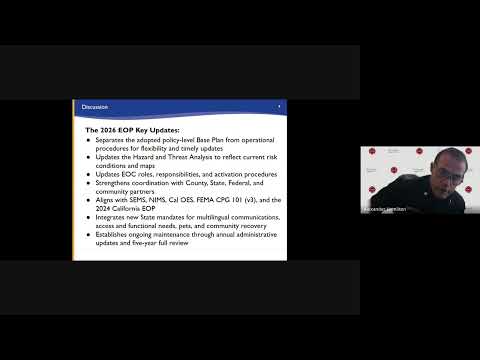
Key changes Hamilton highlighted include updated hazard and threat analyses and maps to reflect current risk conditions, clarified emergency operations center roles and activation procedures, and strengthened coordination with county, state and federal partners. He also said the update integrates state mandates for multilingual communications and access and functional needs: jurisdictions must address languages used by any population group that meets the state’s threshold (Hamilton cited English and Spanish for Oxnard).
Hamilton emphasized a new pet-sheltering requirement informed by recent disasters: “We now we’re now required when we set up a shelter to be able to house pets,” he said, adding that failure to accommodate animals in shelters has in past incidents contributed to people refusing evacuation. To support animal response, the EOP includes a mutual-aid framework with the American Society for the Prevention of Cruelty to Animals (ASPCA) to assist with rescue, emergency sheltering, veterinary care and transport; Hamilton said any activation would follow existing incident-command processes and that each party would be responsible for its own personnel costs and resources.
Hamilton told council there is no fiscal impact to the city from adopting Part 1 of the base plan and that the city will continue annual administrative updates with a full five-year review cycle (the next full review is expected before council in 2031). He closed by offering to answer council questions and said the city’s emergency manager would also be available for follow-up.
Hamilton presented the proposal as a recommendation to the council; the transcript does not record a subsequent motion or vote.