Get Full Government Meeting Transcripts, Videos, & Alerts Forever!
Get email alerts on the Environment topic
No spam. Unsubscribe anytime.
Residents urge North Bend to join Snoqualmie in seeking EIS and coordinated valley review of proposed large battery facility
Summary
Multiple residents and a planning commissioner urged the council to coordinate with Snoqualmie and King County to require an environmental impact statement and independent review for the proposed Cascadia Ridge/Jupiter Power battery storage project, citing public-safety and watershed contamination risks in the constrained Snoqualmie Valley.
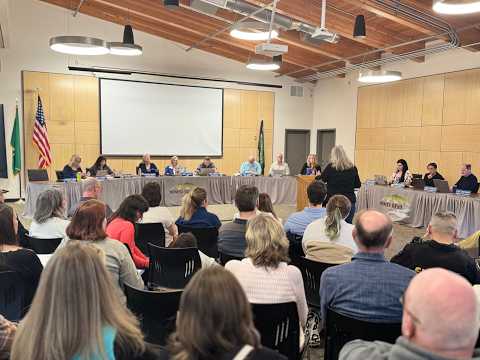
Several North Bend residents and a planning commissioner used the April 7 public‑comment period to urge the City Council to coordinate with neighboring Snoqualmie and King County and to seek a full environmental impact statement for a proposed industrial‑scale battery storage facility sited in the Snoqualmie Valley.
Danielle Wallace, speaking for the Snoqualmie Valley for Responsible Energy, described the Cascadia Ridge project as “industrial scale energy infrastructure—45 acres of batteries, over 100 megawatts of power—placed in constrained valley terrain” and asked North Bend to partner with Snoqualmie to seek a county determination of significance and an independent EIS.
Amanda Senft, a North Bend resident and environmental‑science teacher, emphasized watershed connectivity: “Water does not recognize jurisdiction,” she said, and urged the council to request train‑specific environmental modeling and independent review of watershed and airshed impacts because contamination could travel downstream across jurisdictions.
Greg McMains described safety concerns tied to large lithium‑ion installations, cited the Moss Landing incident and the resulting evacuations there, and urged North Bend to join Snoqualmie in demanding a full EIS and a countywide moratorium on battery storage next to residential zones. “A toxic gas plume does not respect jurisdictional boundaries,” he said.
Hannah Teal, a planning commission member, said the city should research what local code or annexation actions it could take to influence siting and mitigation, and suggested adding the issue to the council’s planning docket.
Council members responded by acknowledging the concerns and saying the city would continue to gather information. Several members said they had been in contact with Snoqualmie officials and would consider study and policy options, including possible annexation or coordinated valley‑level review. No formal action or motion to request an EIS was taken at the meeting; public comment and council interest were recorded for possible future steps.
The council did not adopt a formal letter or resolution at the April 7 meeting; speakers asked the city to take a proactive, valley‑wide approach if the project proceeds through county permitting.