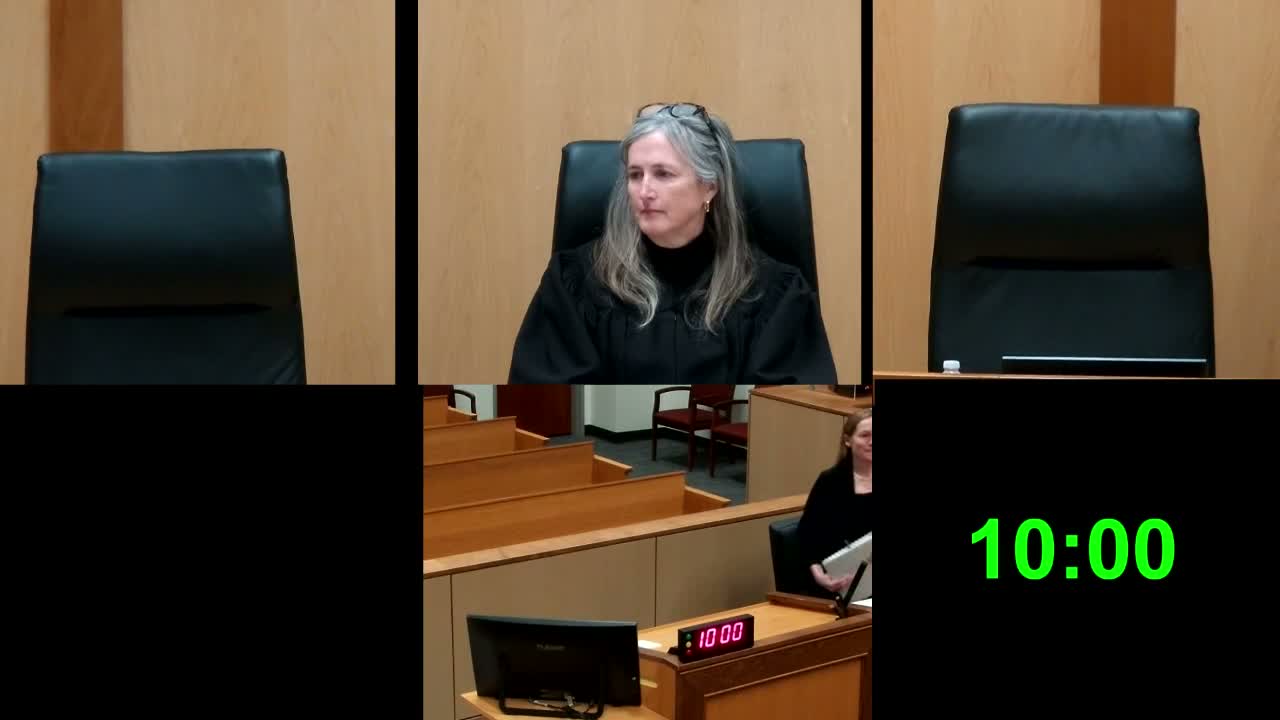
Court hears arguments over discretionary review in United Food v. City of Tacoma
Loading...
Summary
At a commissioner motion docket on April 1, counsel for petitioners and city counsel disputed whether a September superior-court ruling was a final, appealable judgment and whether petitioners may amend to add constitutional claims after a motion to amend was denied; the court said it would issue a written ruling.
The commissioner motion docket on April 1 opened with argument over whether the court should grant discretionary review in United Food v. City of Tacoma, Case No. 62808-2.
Caitlin Kinn, counsel for petitioners, told the court petitioners include the organizational sponsors of the Workers Bill of Rights Initiative, led by United Food and Commercial Workers Local 367, and six Tacoma voters. Kinn said the superior court had found the city violated petitioners’ due-process rights and that a qualified citizens’ initiative was kept off the November ballot. "We will pursue whatever pathway is indicated and needed," she said, urging the court to allow petitioners an opportunity to seek relief for the alleged constitutional violations.
The core dispute was whether the superior-court September order was a final, appealable judgment or an interlocutory decision requiring discretionary review. Kinn argued Civil Rule 15(b) applied because the constitutional issues had been briefed, argued, and the trial court requested additional briefing, so those claims should be treated as part of the original pleading. She said petitioners had at one point moved to strike the city's notice of appeal but did not ultimately press that motion so the appeal could proceed efficiently.
City counsel responded that the motion to strike was denied, a notice of appeal was filed, and the matter was an appeal of right because the court's declaratory judgment was a final judgment. "We win," counsel said, summarizing the city's view that the appealability question had been resolved and expedited briefing (including a cross-appeal) had already followed.
The court questioned whether any mechanism allows amendment of a complaint when a related order is up on review. City counsel cited caselaw permitting trial courts to deny late amendments where a case is effectively over; petitioners countered that some constitutional issues were effectively tried by consent and were thus preserved under CR 15(b).
Counsel discussed whether the petitioners had presented claims under "Section 19.83" (as referenced in briefing) and whether the Uniform Declaratory Judgments Act (UDJA) ruling resolved the case for all purposes; city counsel said damages and other constitutional claims had not been tried in the superior court and that the appropriate path may be to resolve the pending appeals first.
The court also asked whether anticipated litigation costs or a statutory mechanism for fee-shifting could constitute an "out-of-court effect" supportive of discretionary review. Kinn said a statute that provides for payment of attorneys' fees by another party could create such an effect and thus meet the out-of-court-impact requirement.
At the hearing's close, the commissioner said there were no ongoing superior-court settings because the motion to amend had been denied and that the court would issue a written ruling as soon as practicable. The in-person portion of the 04/01/2026 commissioner motion docket was recessed.
The court did not announce a decision on discretionary review during the session; a written ruling is pending.