Get Full Government Meeting Transcripts, Videos, & Alerts Forever!
Get email alerts on the Measure B Implementation topic
No spam. Unsubscribe anytime.
Council backs moving toward tax-roll billing for Measure B services; staff to return with fees after cost study
Summary
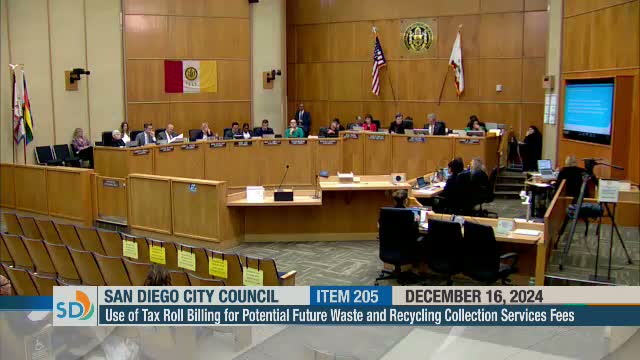
After presentations on outreach and operational findings, the council approved a resolution of support to pursue tax-roll billing as a likely cost-efficient method for charging residential waste and recycling fees; the vote passed 6-2 with two members voting no and one absent.
The San Diego City Council on Dec. 16 approved a resolution of support that allows Environmental Services Department staff to proceed with planning for tax-roll billing as a potential mechanism for future residential waste and recycling fees, a key implementation question under Measure B.
Assistant Director Jeremy Bauer and interim director Kirby Brady summarized outreach that reached thousands of residents and an operational-efficiency review that identified opportunities including improved training, spare-truck ratios, parts-supply strategies, field tablets and staffing adjustments. Staff said the outreach showed resident interest in free container replacement, expanded bulky-item pickup and more recycling options.
Brady described the tax-roll approach: the fee would be listed as a line item on the county property tax bill and collected through the county's existing process, with an estimated county charge of roughly $0.10 per parcel for billing and high compliance rates. "The way that this would work would be that the billing goes through the county... property owners receive their tax bill. Their fee for trash services is listed as a line item in their tax bill," Brady said. Staff said a portal (built on Salesforce) will handle enrollments, container selections, delivery-record tracking and an annual true-up.
Councilmembers probed practical implications: how short-term vacation rentals and ADUs would be handled, whether properties lacking on-site storage would be excluded from city service, and protections for low- or fixed-income homeowners who may face higher tax-roll bills. Staff described an open-enrollment window (July–December), container delivery in January, a 30-day swap window, and a once-a-year opportunity to change service with a true-up process.
Councilmember Ila Rivera moved the staff recommendation. Council President Lacava seconded. The council approved the resolution of support for planning tax-roll billing by a 6-2 vote (Councilmembers Foster and Campillo voted no; Councilmember Von Wilpert absent). Staff and the IBA will return with the consultant cost-of-service results early next year and a draft fee schedule; staff said the earliest formal vote to adopt a fee and tax-roll billing would be June 2025 if the council chooses to proceed.