Get Full Government Meeting Transcripts, Videos, & Alerts Forever!
Get email alerts on the Economic Vitality Plan topic
No spam. Unsubscribe anytime.
Gorge Commission revives economic vitality work; regional partners outline role of Bi-State plan
Summary
At the Economic Vitality Committee’s first meeting staff described past work on the FORGE 2020 management plan and asked the new committee to develop a work plan; regional partners from MAC ED and the Oregon Investment Board outlined coordination through a Bi-State Advisory Council and a five-year plan.
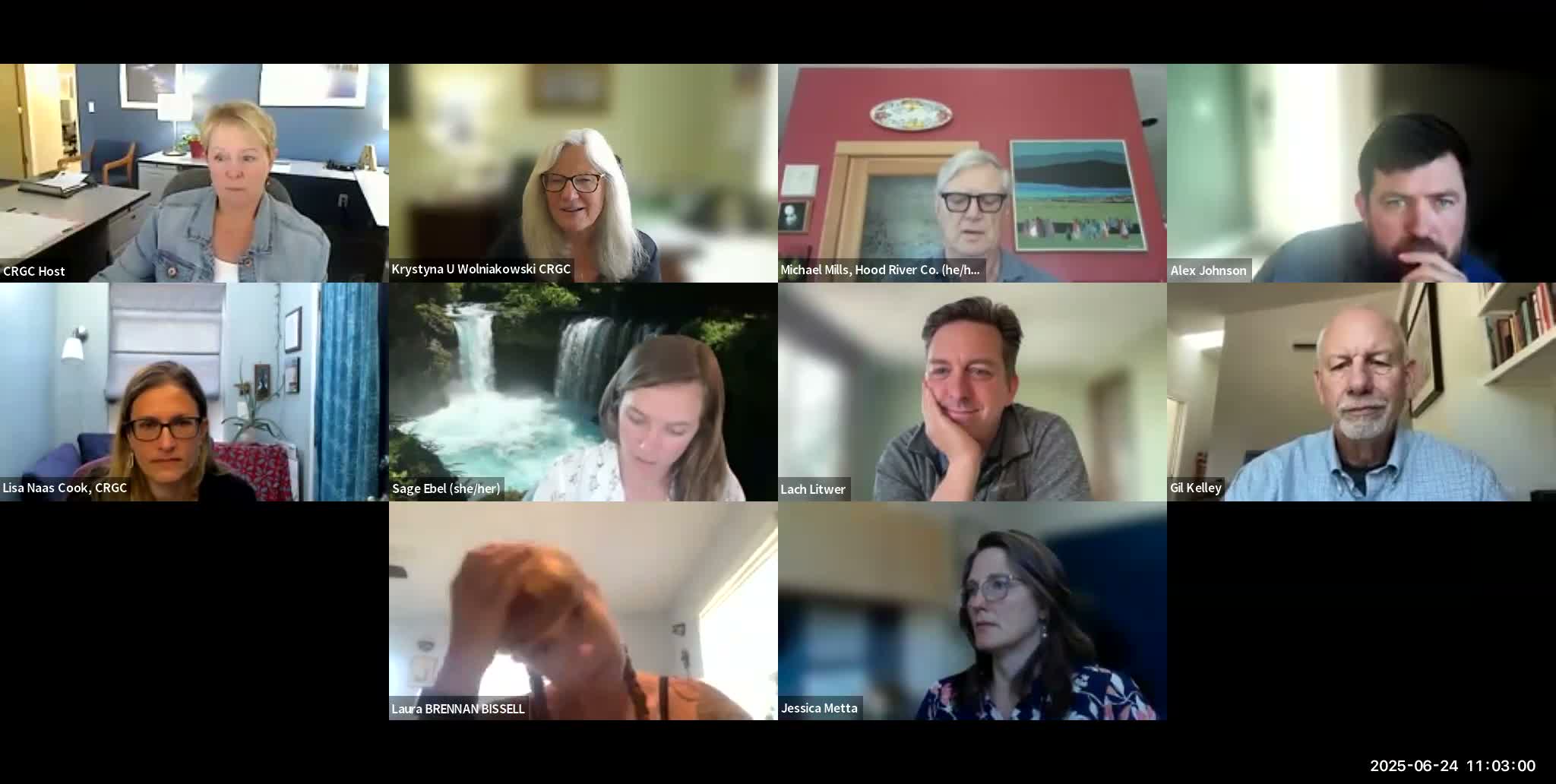
Christina, the Commission’s director, opened the inaugural Economic Vitality Committee meeting by asking commissioners to decide leadership and begin scoping a work plan to advance the economic provisions of the FORGE 2020 management plan.
"We should develop a work plan in the next couple of months that would help us identify where we want to go with this committee," Christina said, noting that the management-plan update process is decennial but that the committee can collect issues and public input ahead of the next update.
Christina reviewed past work: the 2018–2019 Economic Vitality Workgroup convened 28 representatives across sectors for seven meetings to help shape the economic chapter of the management plan. She pointed to two near-term topics that have emerged in public input: the agricultural income test and accessory dwelling units. "What are the things we actually did improve in the last several years with the new FORGE 2020 management plan that we've put into action," she said, urging members to reread the chapter in preparation for committee work.
Jessica Mehta, executive director for MAC ED, described the Bi-State Advisory Council that coordinates the Oregon and Washington Investment Boards, the states’ agencies, the Forest Service and local partners to produce a five-year economic vitality plan. "It is designed to coordinate the efforts of the investment boards... the states of Oregon and Washington, MAC ED, the Forest Service, and the Gorge Commission," Mehta said, adding the council convenes at least annually and includes non-voting members from state and federal agencies.
Gil Kelly, chair of the Oregon Investment Board, told the group he was willing to support the committee and emphasized why the term "vitality" was useful: it captures both existing urban-area economic activity and the need to sustain economic uses outside cities such as agriculture, silviculture and recreation. "The great bulk of the economic activity in the Gorge is within the urban areas," Kelly said, while also noting the importance of supporting non-urban sectors without compromising scenic values.
Ben Schumacher, representing the City of Stevenson, urged the committee to clarify what "encourage growth" means in practice and to partner with cities on grant and infrastructure support. "I think one of the questions I'd like to see you really embrace is from the Act, what it means for the Gorge Commission to encourage growth," Schumacher said, adding he is a willing partner to work with the committee on projects in Stevenson.
Christina and staff clarified that the Gorge Commission has limited jurisdiction in urban areas but can provide support letters for grant applications and infrastructure projects and can convene advisory groups. Staff committed to working with the chair and vice chair to produce the committee’s next agenda and work plan, and to invite investment-board representatives to future sessions.
The committee ended the meeting by asking for better transparency about members’ residency (who lives inside the scenic-area boundaries versus in cities) to help frame perspectives. Staff will develop a work plan and public engagement steps before the next meeting.