Get Full Government Meeting Transcripts, Videos, & Alerts Forever!
Get email alerts on the Transportation topic
No spam. Unsubscribe anytime.
Residents and council weigh safety changes at QuickStar–Highway 9 corner
Summary
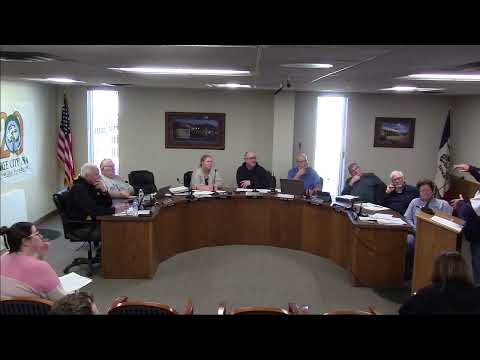
At the April 6 Cresco City Council meeting, nearby business owner Wayne Masiak and other residents urged the city to address truck and vehicle conflicts at the QuickStar/Highway 9/7th Street intersection; staff said a DOT-led decision would likely require a traffic study (estimated ~$10,000) and the council agreed staff should contact QuickStar and DOT to explore options.
Wayne Masiak, who operates a business at the A&W corner near the new QuickStar site, told the Cresco City Council on April 6 that heavy truck and vehicle traffic is already creating “tight” and potentially dangerous conditions at the QuickStar/Highway 9/7th Street corner. “I sent you that video of what I had — trucks backing up or cars backing up, trucks coming in. It’s just so tight in that area,” Masiak said during the public-comment portion of the meeting.
Public works staff reported that a March 20 meeting with Iowa DOT representatives covered Highway 139, Highway 9 and Highway 63 and noted that signal placement and speed limits are state-controlled. Staff said a traffic study by the city’s engineer (WHKS) would be the normal next step and estimated the study cost at about $10,000. Public works summarized DOT staff guidance — relayed in the meeting — that if a study concluded a signal was warranted, the city would be responsible for installation; if not, the state would not allow a signal at that location.
Council members and nearby residents discussed several options: widening the 7th Street approach, adding a right-turn lane or turning lanes on both approaches, reducing the local speed limit, or pursuing a traffic signal. Residents described semitrailers swinging wide and riding curbs to make turns and urged the city and QuickStar to coordinate design changes now so curb lines or green-space plans don’t preclude future improvements.
The mayor said staff would reach out to the QuickStar project manager and the DOT contact to determine what engineering work and DOT approvals would be needed and to consider filing any necessary entrance-widening or access applications. No formal action was taken at the meeting; council members characterized the next steps as staff-level coordination and, if warranted, pursuing a traffic study.
Why it matters: QuickStar’s new site sits at a busy commercial corner that also serves semitrailers; small design changes now (such as adding a turning lane or moving a utility pole) could reduce crash risk and costly retrofits later. The city’s ability to require or install a signal is limited without DOT concurrence, so staff follow-up with DOT and the developer is the essential next step.