Get Full Government Meeting Transcripts, Videos, & Alerts Forever!
Get email alerts on the Sustainable Mobility topic
No spam. Unsubscribe anytime.
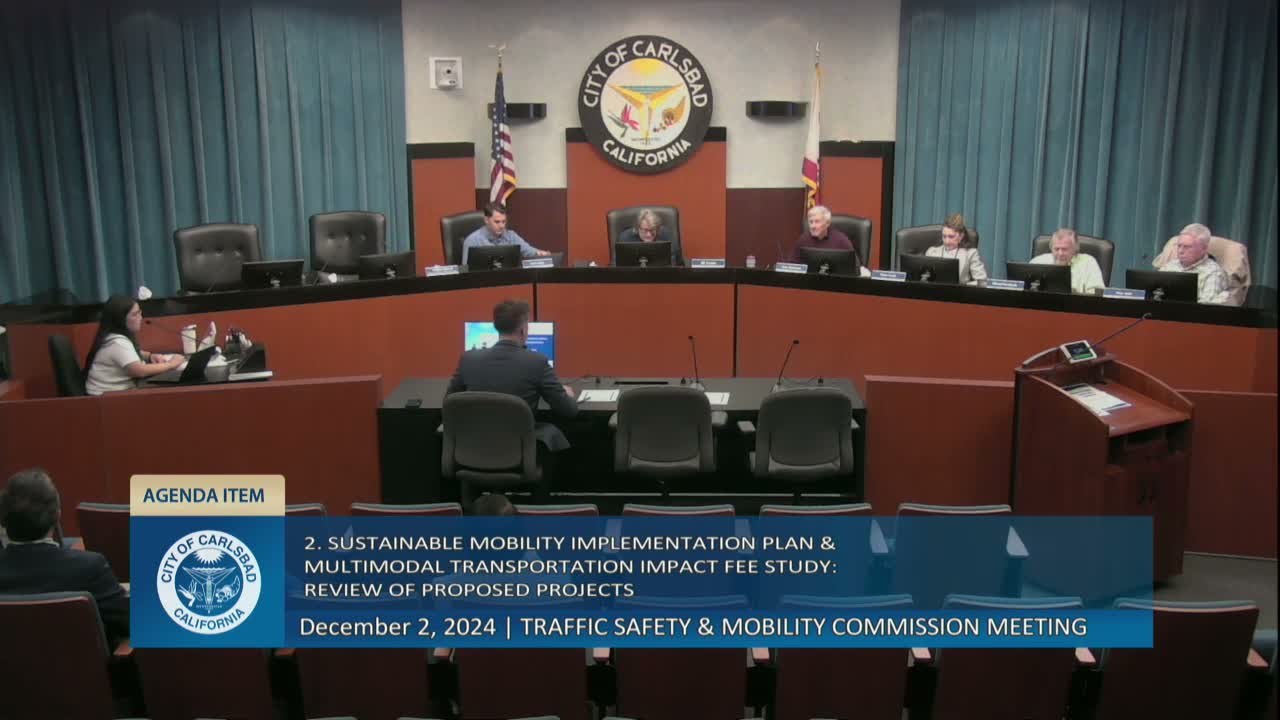
Carlsbad staff present 96 draft projects for Sustainable Mobility Plan; fees and grants discussed
Summary
Transportation staff presented a draft implementation list of roughly 96 projects tied to the Sustainable Mobility Plan and said cost estimates from that list will feed a legal nexus study and a proposed multimodal transportation impact fee; commissioners asked about buffered bike lanes, funding alternatives and feasibility for specific projects.
Nathan Schmidt, the city’s Transportation Planning and Mobility Manager, told the commission the Sustainable Mobility Plan implementation list contains about 96 draft projects and that staff has completed a high-level engineering feasibility review to develop initial cost estimates.
"It's a citywide transportation master plan focused on the multimodal transportation network," Schmidt said, explaining the SMP will guide project prioritization and the MTIF will be used to fund multimodal infrastructure so new development pays its share of system improvements.
Schmidt said the cost estimates will be used in a formal nexus study to establish a fee range and that those figures will be refined after further engineering and public outreach. He emphasized the current project descriptions are conceptual and likely to change during detailed design and stakeholder review.
Commissioners asked whether buffered or protected bike lanes could fit on specific streets and whether the Multimodal Transportation Impact Fee would meaningfully fund projects in a largely built-out city. Staff replied that buffered lanes may require roadway widening at some locations, that the fee will likely fund only an incremental portion of total project costs, and that staff and consultants will identify grant opportunities and other funding sources to supplement developer-paid fees.
Commissioners also raised feasibility questions about high-cost items—Schmidt confirmed one previously discussed tunnel under the freeway was omitted from the current list because of cost and Caltrans coordination—and asked that specific items return for detailed analysis as projects move from concept to design. A commissioner asked to replace the term "protected bike lane" in the materials with a MUTCD/standard term such as "Class 4" or "cycle track," and staff agreed to change the terminology.
Next steps: staff will refine project descriptions based on commission feedback, develop project cost estimates, pursue grant funding where feasible, prepare the nexus study, and present fee-range recommendations to City Council.