Get Full Government Meeting Transcripts, Videos, & Alerts Forever!
Get email alerts on the Zoning Farmland Protection topic
No spam. Unsubscribe anytime.
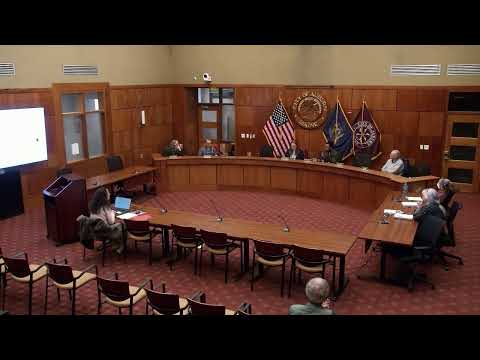
Auburn planning board forwards Chapter 60 zoning amendments, asks council to add PFAS handling language
Summary
The Auburn Planning Board reviewed council-initiated Chapter 60 amendments to bar new single-family homes from prime farmland and require licensed soil evaluators for solar siting; after public comment, the board voted to forward the draft to city council with a request to add language addressing PFAS-contaminated soils.
The Auburn Planning Board reviewed city-council-initiated changes to Chapter 60 zoning that would tighten protections for farmland and change how large solar projects are evaluated, and it voted to forward the draft to city council with a request to add provisions for handling PFAS-contaminated soils.
Planning staff member Sam told the board the proposal would prohibit new single-family homes from being sited on prime farmland or farmland of statewide importance as defined by the U.S. Department of Agriculture, bar siting on essential habitat, wetlands and slopes over 25 percent, and require a licensed soil evaluator to determine prime farmland for solar projects rather than relying solely on NRCS maps. "We're proposing that they cannot be sited on farmland of statewide importance or prime farmland soils," Sam said, describing a shift to on-site evaluation by a licensed soil scientist.
The board pressed staff for details. One member asked who makes the determination when the draft references both NRCS maps and the Maine Department of Agriculture, Conservation and Forestry; Sam said the intent is to have a licensed soil scientist conduct a site visit and make the determination because the statewide maps are less precise. Another member asked for data on what share of the Agriculture and Resource Protection Zone (AGRP) is classified as prime farmland; staff said that percentage was not available at the meeting and will be provided to the council.
Two members of the public spoke during the hearing. Steven (575 Johnson Road), who said he participated in a prior overhaul of the AG zone, urged adoption of the stricter amendments, arguing large solar arrays are "easiest and cheapest to build on the very best land that is best suited for farmland." "I urge that they be adopted in this fashion," he added. Michelle Millerano (576 Trap Road) warned that redesignating land to higher growth categories could substantially increase property taxes for owners and urged that properties be grandfathered at current tax rates unless owners build or sell; she also suggested that parcels confirmed to have PFAS contamination could be eligible for solar by special exception to preserve farmer income options.
Board members and staff discussed PFAS. Members asked whether PFAS contamination would remove a parcel's prime-farmland designation; Sam said contamination would typically remove the designation and that explicit language to address PFAS could be added to the ordinance. On costs, staff noted the SNRB had raised the question of who should pay for site soil evaluations; staff said that typically the developer or applicant pays for such a soil scientist and that the draft could specify that requirement.
Sam told the board staff was not seeking a final vote tonight but was collecting comments to incorporate into an updated draft to send to council. A member moved to authorize forwarding the draft to the city council with pending comments from SNRB and the planning board and to include provisions addressing PFAS-contaminated soils; the motion was seconded and carried.
The board also asked staff to report back to council with follow-up information, including the requested percentage of AGRP that qualifies as prime farmland, and signaled that the draft would be revised with SNRB comments before the council sees it. The planning board adjourned after a brief miscellaneous-comment period.