Get Full Government Meeting Transcripts, Videos, & Alerts Forever!
Get email alerts on the Public Health Syringe Service Programs topic
No spam. Unsubscribe anytime.
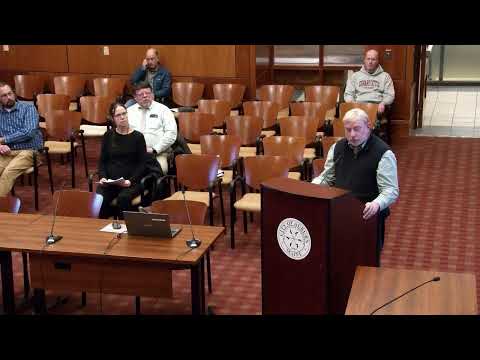
Auburn council hears state legal and public-health briefings as it weighs syringe service program rules
Summary
At a Nov. 3 workshop the Auburn City Council heard legal and Maine CDC presentations on syringe service programs (SSPs), data on overdoses and infectious-disease risks, and constraints on municipal regulation while councilors raised concerns about syringe litter and school buffer rules.
Mayor Jeff Hyman called a Nov. 3 workshop to discuss syringe service programs and a possible local ordinance, saying the council had imposed a six‑month moratorium to allow time for review. City legal counsel Stockford summarized the state regulatory landscape, emphasizing that Maine law and Maine CDC rules control certification, reporting and operational standards for SSPs and that municipalities must avoid ordinances that conflict with state law.
Stockford told the council that, under current law, SSPs must be certified by the Maine CDC and must require enrollment, follow confidentiality and recordkeeping rules, and provide education, referrals and safe disposal procedures. He warned the council that “an outright prohibition” of certified SSPs in a municipality could invite legal challenge and that local ordinances must be tailored to avoid frustrating state policy.
State presenters from the governor’s opioid‑response office and the Maine CDC described SSP services and the public‑health evidence supporting them. Glenn Smith, director of opioid response, framed SSPs as one pillar of a broader strategy that includes prevention, treatment and recovery, and said programs connect people to care. “There is no evidence after 30 years of these programs that distributing unused syringes to individuals causes more people to use drugs,” Smith said.
Anne (director, Infectious Disease Prevention Program, Maine CDC) defined harm reduction and listed typical SSP services — sterile syringes and equipment, naloxone distribution, wound care supplies, HIV and hepatitis testing, vaccination and referrals to housing and treatment. She cited county‑level data showing elevated hepatitis C and HIV incidence in Androscoggin County and described a recent Penobscot County outbreak that Maine CDC identified as linked to recent injection drug use and unstable housing.
Presenters described pending rule changes that would allow mobile and delivery services, require SSPs to show municipal zoning compliance, and — in one draft provision the council questioned — prohibit SSPs within 1,000 feet of school property. Stockford said the proposed rules would also expand CDC inspection and record‑access authority.
Councilors asked frequently about distribution limits and disposal. Councilor Belinda Gary asked why some programs distribute up to 100 syringes; Anne said distribution is needs‑based and that frequency of injection can be high with fentanyl, so travel distance and individual circumstances matter. Councilor Leroy Walker pressed state staff about syringe litter and pickup capacity in parks and downtown areas; presenters pointed to municipal pilots (public kiosks, redemption programs and sharps containers) and to examples in Portland, Bangor and Lewiston but acknowledged gaps in collection capacity.
No ordinance was adopted. Mayor Hyman and Stockford said the council will receive additional briefings and the city’s legal office would work with staff to craft ordinance options that respect state law and home‑rule limits. The council’s moratorium on new SSP operations remains in place during that review.