Get Full Government Meeting Transcripts, Videos, & Alerts Forever!
Get email alerts on the Comprehensive Plan Update topic
No spam. Unsubscribe anytime.
Pasco planning agency reviews ‘PascoServes’ draft; debate over low‑impact development, sewer policy and new wastewater options
Summary
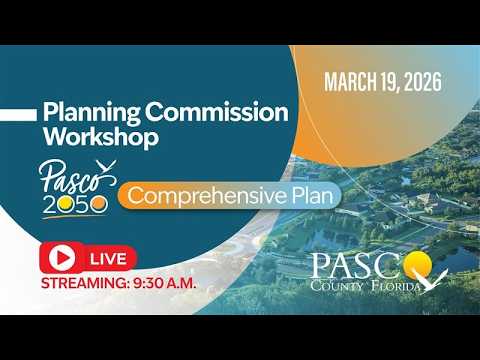
At a Pasco County Local Planning Agency workshop, staff presented the draft PascoServes (public facilities) chapter of Pasco 2050. Commissioners pressed for clearer language on low‑impact development standards, when central water and sewer must be provided, and how distributed wastewater treatment units fit with county operations.
Staff presented the draft 'PascoServes' chapter of the Pasco 2050 comprehensive plan update and outlined 4 goals, 23 objectives and 116 policies, including 11 new policies intended to update potable water, wastewater, solid waste and drainage guidance.
Principal planner Hyatt Mazzilli, the project manager for the comprehensive‑plan update, told the Local Planning Agency the chapter was developed by planning staff together with Public Works, Pasco County Utilities and Solid Waste and is mandatory under chapter 163 of the Florida Statutes. She said the update reflects two and a half years of outreach — “thousands of public comments and surveys” and more than 10 community workshops — and that the presentation would highlight major policy additions rather than a line‑by‑line readthrough.
Why it matters: the public‑facilities element sets the county’s long‑term framework for water, sewer, drainage and solid‑waste capacity and links policy direction to capital planning. Commissioners and utility staff said precise wording matters because it determines whether utilities can be used to limit growth in rural areas or must be extended to meet state‑mandated septic‑to‑sewer conversions in certain basins.
New potable‑water items and tiered rates: staff identified five new potable‑water policies, including a change that narrows where central water and sewer may be extended around the I‑75/County Road 41 employment node. Commissioners asked for details about a proposed shift toward tiered water rates. Garrett Van Litt, a Pasco County utility zone policy analyst, said, “We have a tiered water system where consumers have certain sizes of pipe that go to their area… it depends on how much water you’re using,” and offered to follow up with customer‑service detail and examples.
Wastewater provisions and feasibility links: staff described four new wastewater policies. One requires consideration of flood‑proofing for new sanitary sewer facilities; another responds to statutory direction to evaluate septic‑to‑sewer conversion feasibility for developments that meet specified thresholds; a third ties feasibility findings to the county’s five‑year capital improvement program so conversion projects can be scheduled and funded; and a fourth allows the county to consider distributed wastewater treatment units (DWTUs) if they meet environmental standards.
Policy tension on when to extend utilities: several commissioners raised a core tension: one set of draft policies encourages septic‑to‑sewer conversions in state‑designated basin areas while other draft language seeks to limit or avoid extending central utilities into low‑density rural lands to prevent sprawl. Commissioners said the draft objective (Objective 2.4) is unclear about whether it applies to RDR (rural density residential) land now defined to range up to 2.9 dwelling units per acre, and asked staff to rewrite the policy with objective, site‑level criteria (for example, explicit density thresholds and references to the tables that set proximity/availability metrics).
Low‑impact development (LID) debate: a commissioner sharply questioned whether LID standards would address major flooding, calling the notion that rain barrels or rain gardens would solve 100‑year flooding a “green fantasy.” Staff and other members replied that LID also addresses water quality, effluent management and other non‑volume outcomes and recommended softening the draft requirement: change the proposed mandate from “shall develop low‑impact development design standards” to language that would “evaluate the efficacy” of such standards before committing to prescriptive requirements.
DWTUs and operational concerns: staff and utility personnel explained that the Florida Legislature has enabled new forms of neighborhood‑scale wastewater systems and that the draft includes a policy to allow review of DWTUs on a case‑by‑case basis. Multiple commissioners flagged operational and control concerns: how would the county monitor or remotely manage such units, who would ensure long‑term treatment performance, and could the county legally accept wastewater from a failed private system? Utility staff said the county currently lacks remote‑control capabilities for many DWTU designs and would need operational procedures before approving them.
Emerging contaminants and solid‑waste monitoring: commissioners asked how PFAS and other emerging contaminants are being addressed. Utility staff said the county is developing testing capacity for PFAS in wastewater and monitoring federal and state rules; Tim Treschler, senior program manager for solid waste, said the solid‑waste program is tracking regulatory developments but has no currently applicable PFAS regulations.
Next steps and schedule: staff committed to redrafting unclear language (notably objective 2.4 and the parallel water/wastewater references), to cross‑referencing the appropriate tables that set proximity/availability criteria, and to returning with edits. The LPA tentatively set a sequence of spring workshops (Pasco Moves/transportation elements on April 9 and April 16; other chapters in May) and staff said the full comprehensive plan would return to the LPA in June with possible transmittal to the Board of County Commissioners in July and adoption later in the summer.
Adjournment: the agency moved to adjourn and approved the motion by voice vote.