Get Full Government Meeting Transcripts, Videos, & Alerts Forever!
Get email alerts on the Land Use topic
No spam. Unsubscribe anytime.
Fairfax County task force reviews denser residential proposals for Fair Oaks Mall and adjacent sites
Summary
Fairfax County staff and developers presented coordinated master-plan concepts for Fair Oaks Mall, Oakwood, Greenwood, Fairfax Town Center and Reserve at Fairfax Corner that would shift the core area toward more housing and less office/retail; staff will test a high-impact scenario in an April 6 transportation study.
The Fairfax Center Area Study Phase 3 Task Force on March 16 reviewed multiple developer proposals that would modestly increase density around Fair Oaks Mall and neighboring parcels while reducing office, hotel and some retail uses.
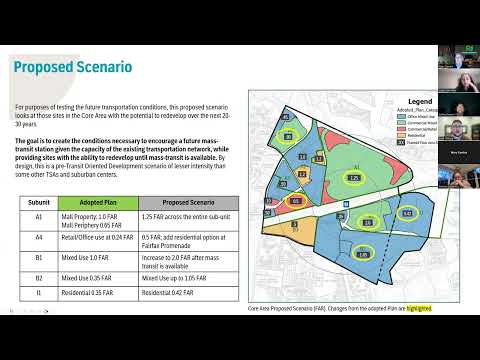
Ryan Stewart, a Fairfax County staff member who opened the meeting, said staff prepared a high-impact scenario to “stress test” the transportation network and that slides and the recording will be posted after the meeting. Stewart summarized staff’s request that mall landowners provide a coordinated master plan showing how a roughly 1.25 floor-area-ratio (FAR) could be accomplished on the mall site, and emphasized the scenario is for transportation testing, not a final plan.
Tony, a landowner representative involved in the Fair Oaks Mall proposals, told the task force, “We do propose a a meaningful potential increase in residential. That's really the jet fuel that I think would take most advantage of this incredibly strategically located property.” He urged flexibility in any plan guidance and noted redevelopment will likely happen over decades.
Task force members and staff discussed quantification and phasing. Mary summarized a preliminary tally, saying, “the net net is an additional 4,700,000 square feet to the area,” and Stewart later provided the aggregated scenario estimate: “about 1,400,000 less square feet of nonresidential uses, about 5,400 new residential units in the core area,” spread over a 20–30 year horizon. Staff said more detailed FAR-to-acre conversions and breakdowns would be provided to help visualize those changes.
Site-by-site concepts reviewed included: - Fair Oaks Mall: owners were asked to prepare a coordinated master plan showing how to achieve a higher FAR while addressing fragmented ownership of anchors and shared parking. Developers proposed more residential, less retail/office, and new open-space elements. - Oakwood: concepts ranged from a 5-over-1 podium conversion with multifamily housing and retained garage to an alternative of roughly 88 townhomes; task force members raised concerns about vehicle access and the safety/character of the existing access road. - Greenwood: proposals included a multifamily scheme (about 426 units at ~1,000 sq ft each) and a mixed multifamily-plus-townhome option (rough counts of ~301 and ~287 units for different sizes); members criticized preservation of large surface parking and urged coordination with the mall plan. - Fairfax Town Center: participants said the site may be able to redevelop under existing guidance (0.8 FAR) without a plan amendment; staff encouraged activating the central plaza and ground-floor retail to link residential and retail uses. - Reserve at Fairfax Corner: the owner is seeking a modest increase to about 0.42 FAR to allow redevelopment and flexibility; one hypothetical number discussed was up to roughly 335 units pending later design and county direction.
Members repeatedly emphasized connectivity and multimodal access: the group noted large surface parking lots will be poor long-term uses near a potential future Metro station, the 66 Parallel Trail does not directly access the mall today, and planned trail work at Random Hills Park may improve linkages. Ashley (county staff) and Stewart said transportation staff will present pedestrian, bicycle and vehicular analyses at the April 6 meeting.
No formal votes or binding decisions were taken. Stewart closed by outlining next steps: the task force will review the transportation study on April 6, discuss the Government Center Visioning Project on April 27, hold public outreach in late spring, and aim for Planning Commission and Board of Supervisors hearings in the late summer/early fall. Staff will post slides and the meeting recording and provide additional quantifications requested by members.
The task force adjourned with members encouraged to submit written comments and with staff committed to follow-up materials ahead of the next meeting.