Get AI Briefings, Transcripts & Alerts on Local & National Government Meetings — Forever.
Commission hears CIP briefing; sewer equalization tank cost estimate rises sharply
Loading...
Summary
City staff presented a five‑year capital improvement plan totaling about $166.9 million and warned of a sales‑tax 'base reset' tied to 2024 state law. Engineers reported the second sewer equalization tank estimate rose from ~$21 million to roughly $40 million, prompting discussion about timing, regulatory drivers and rate impacts.
S1 (Chair) led a detailed capital improvement plan briefing covering revenues, major projects and spending priorities across utilities, transportation, facilities and parks.
Staff described a recent state change in how online sales taxes are allocated as a likely cause of a near‑term revenue reset. "We think it's gonna line up... it has to do with how the retailer was handling online transactions," S1 said, referencing a 2024 state clarification that moved collections toward a destination‑based approach. Commission projections assume a conservative 2.5% sales‑tax growth rate from the new base.
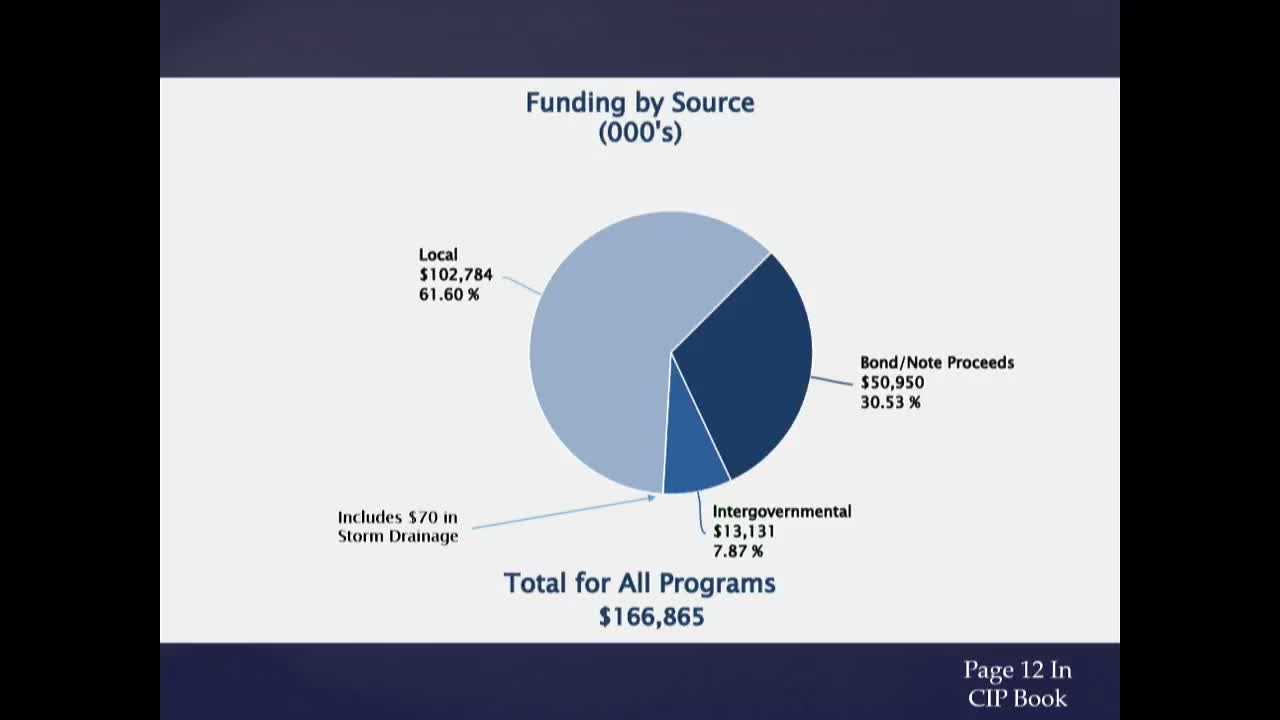
The CIP total for the five‑year period was presented as $166,865,000, with funding sources roughly 61.6% local tax dollars, about 30.5% bond proceeds and 7.87% intergovernmental funds. S1 noted staff will rely more on fund balances and a combination of cash and modest debt to maintain the five‑year program amid tightening revenues.
A central utilities item drew the most technical and budgetary scrutiny: engineers reported that the planned second equalization tank for the sanitary‑sewer system has an updated best‑estimate cost substantially higher than earlier figures. "We were looking at that as about initially $21,000,000. Now the estimating is at 40," S1 said, and staff and engineers attributed the jump to a combination of tightened material prices (notably steel), labor and refined design scope. S10 (engineer) told the commission the hydraulic model and master plan underpin tank sizing; S10 said the first tank performs as designed but has reached capacity during several high‑intensity storms, supporting the system need for a second tank to limit sanitary overflows. Commissioners asked whether a short pause to reassess procurement timing could reduce costs and requested regional comparisons to recent similarly sized tanks.
Staff recommended continuing design work to firm estimates, engaging state regulators on timing and exploring whether any artificial price factors can be mitigated, while recognizing eventual rate impacts and bond‑service tradeoffs will need to be modeled and presented to the commission.
The commission moved on to line‑item CIP projects after the discussion but did not vote on any capital authorization at this meeting; staff said they will return with refined cost estimates, regulatory clarifications, and options for pacing the project and funding its debt service.