Lifetime Citizen Portal Access — AI Briefings, Alerts & Unlimited Follows
Court of Appeals Division 2 hears bid for interlocutory review in Peezel challenge to 'always hiring' job postings
Loading...
Summary
Division 2 of the Washington State Court of Appeals heard argument on a request for discretionary interlocutory review in Case No. 62170-3, where petitioners contend recurring "always hiring" job postings constitute a "specific available position" as a matter of law; the court took the matter under advisement.
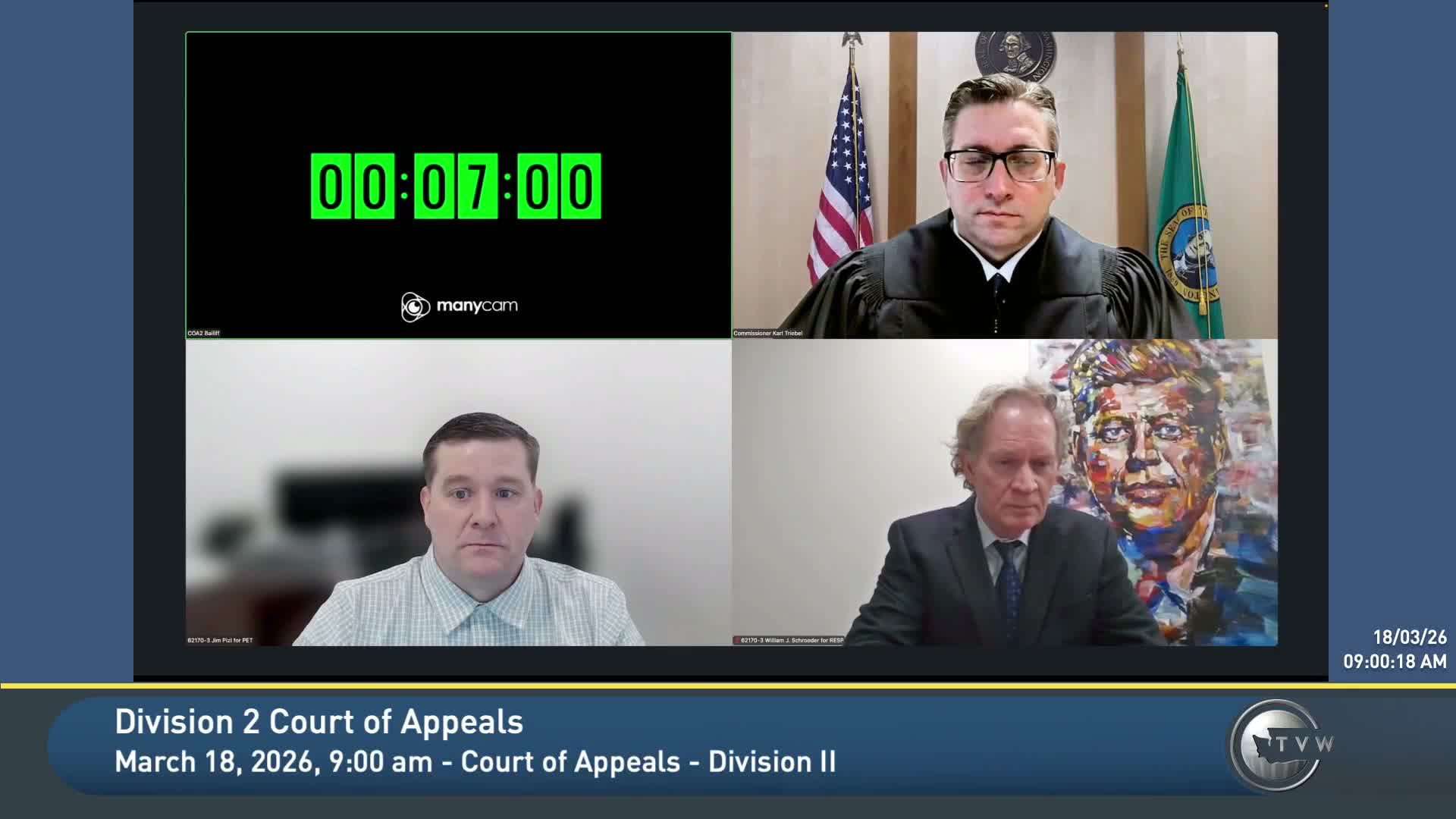
Division 2 of the Washington State Court of Appeals heard oral argument on March 18, 2026, in Case No. 62170-3, Kimberly Peezel v. CJ of Washington, on whether the court should grant discretionary review of a trial-court ruling that denied cross-motions for summary judgment. The court announced the matter and allotted time for petitioner rebuttal before hearing arguments and questions from the presiding commissioner.
Petitioner’s counsel, Jean Peezel, argued the trial court’s denial of both summary-judgment motions without a definitive ruling constituted reversible procedural error and warranted interlocutory review. "The trial court denied both motions for summary judgment, and petitioner believes by not ruling one way or the other, that constitutes obvious error that renders further proceedings useless," Peezel said, pressing that the postings themselves present undisputed facts and that the legal question is whether those postings advertise a "specific available position."
The petition rests on a narrow legal question: whether recurring or "evergreen" job postings that advertise roles (for example, a shift leader with a requisition number and listed qualifications) qualify under the statute as a "specific available position," or whether availability is a fact-specific inquiry that must be developed at trial. Petitioner told the court that because the postings' text is undisputed, the Court of Appeals should decide the statutory meaning now rather than defer to post-trial appeal.
Respondent counsel William Schroeder said the availability inquiry is factual and the motions were properly denied to allow record development. "We view that whether a job is available is a question of fact," Schroeder argued, explaining that witnesses and depositions are necessary to determine whether a specific opening existed at the time of the posting. He also noted that an oral ruling is not a substitute for the certification or other requirements petitioner cites for discretionary review.
The presiding commissioner repeatedly queried both sides about the record. The court asked whether any deposition testimony or documentary evidence showed a specific available position existed and asked for clarification about exhibit materials that referenced maximum pay rates (figures mentioned in briefing included $18 and $20 per hour). Counsel for the respondent said the pay figure may have been part of an uploaded exhibit that did not appear in the public posting.
Both sides referenced authority and precedent during argument (petitioner's briefing invoked "2.3 b 1" in support of interlocutory review; respondent cited a Branson decision and distinguished the Shannon decision cited by petitioner). The court pressed how the petitioner could satisfy the "effect" prong if, as counsel acknowledged, the matter would ultimately be subject to appellate review after trial in any event.
After rebuttal, the presiding commissioner said the court would take the matter under advisement and issue a ruling "as soon as practical." No ruling was announced from the bench at the hearing’s close.
The next procedural step is issuance of a written order from the Court of Appeals indicating whether discretionary review is granted. If the court declines interlocutory review, the parties will proceed in superior court and the question may be raised again on appeal; if the court grants review, the appellate process will resolve the statutory interpretation prior to trial.