Get Full Government Meeting Transcripts, Videos, & Alerts Forever!
Get email alerts on the Annexation topic
No spam. Unsubscribe anytime.
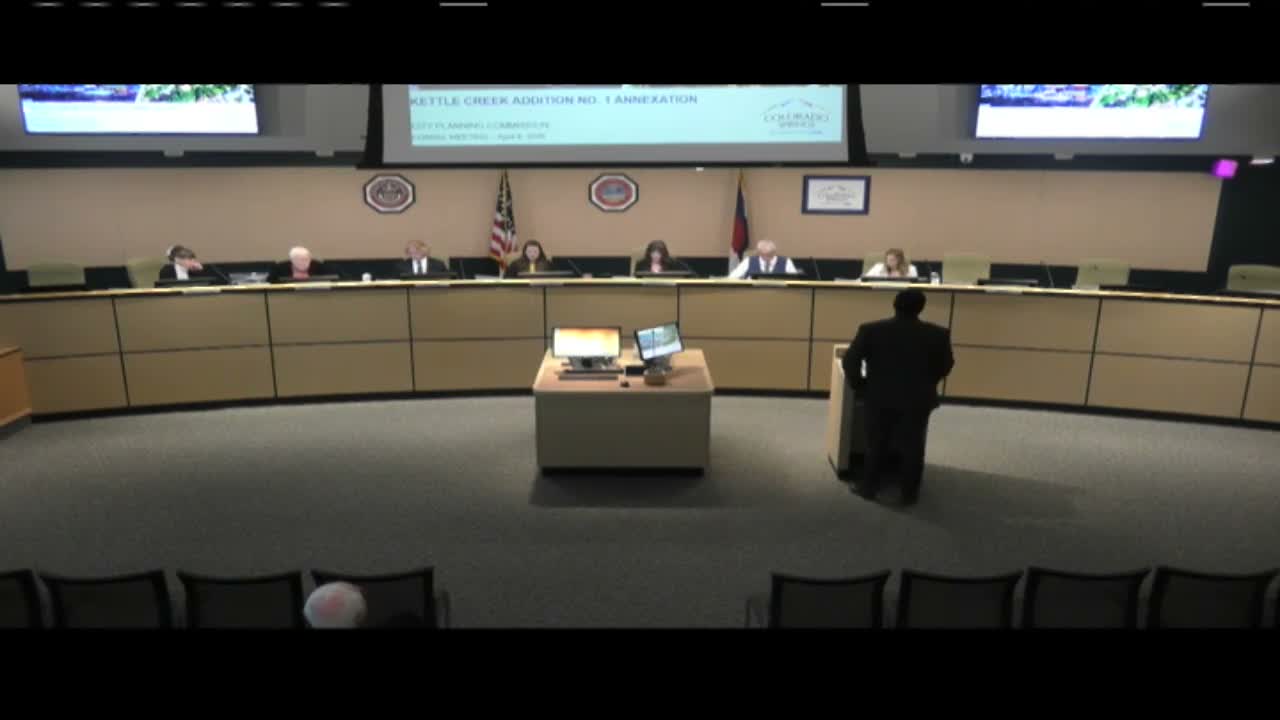
Commission recommends Kettle Creek annexation, rezoning and land‑use plan despite traffic concerns (5–2)
Summary
The commission recommended that city council approve the annexation of about 19.88 acres northeast of Old Ranch Road and Kettle Creek Road, rezoning to ArFlex medium with overlays and a land use plan for roughly 123 units; motions recommending all three items passed 5–2 amid questioning on traffic and utilities.
The Planning Commission on April 8 recommended City Council approve the Kettle Creek Addition No.1 annexation, related rezoning to ArFlex medium and the associated land use plan for about 19.88 acres at the Old Ranch Road/Kettle Creek Road area.
Case planner Chris Sullivan told commissioners the annexation includes three parcels (two ownerships) and would allow an ArFlex medium zone (5–16 dwelling units per acre); the land use plan notes an intent of about 123 units, which equates to roughly 11–12 dwelling units per acre. Sullivan said the site is contiguous with city limits and that staff finds the annexation, zone map amendment and land use plan meet applicable review criteria.
Springs Utilities staff applied the city’s water extension ordinance and said projected water demand for the proposed land use is approximately "29 acre feet a year," which is below the de minimis threshold of about 53 acre feet and therefore meets one of the ordinance conditions for service; CSU estimated capital cost to extend utilities in the $900,000–$1.3 million range.
Traffic engineering discussed Old Ranch Road improvements funded through PPRTA, including a planned bridge and corridor safety project that would add a center turn lane and multimodal facilities; engineers said some design work is expected in the next 1–2 years with construction possible within 4–5 years, and interim measures (left‑turn lanes) could be implemented earlier.
Commissioner Robbins voiced opposition, citing existing roadway capacity and school‑area conflicts; Commissioner Gigiano reiterated concerns about overdevelopment and strained public facilities. Despite those remarks, Commissioner Case moved to recommend approval of the annexation, rezoning and land use plan to City Council; each motion passed 5–2 with Commissioners Robbins and DeGiano opposed.
The planning commission’s recommendations now go to city council, where two public hearings will be required for annexation finalization.