Get Full Government Meeting Transcripts, Videos, & Alerts Forever!
Get email alerts on the Downtown Plan topic
No spam. Unsubscribe anytime.
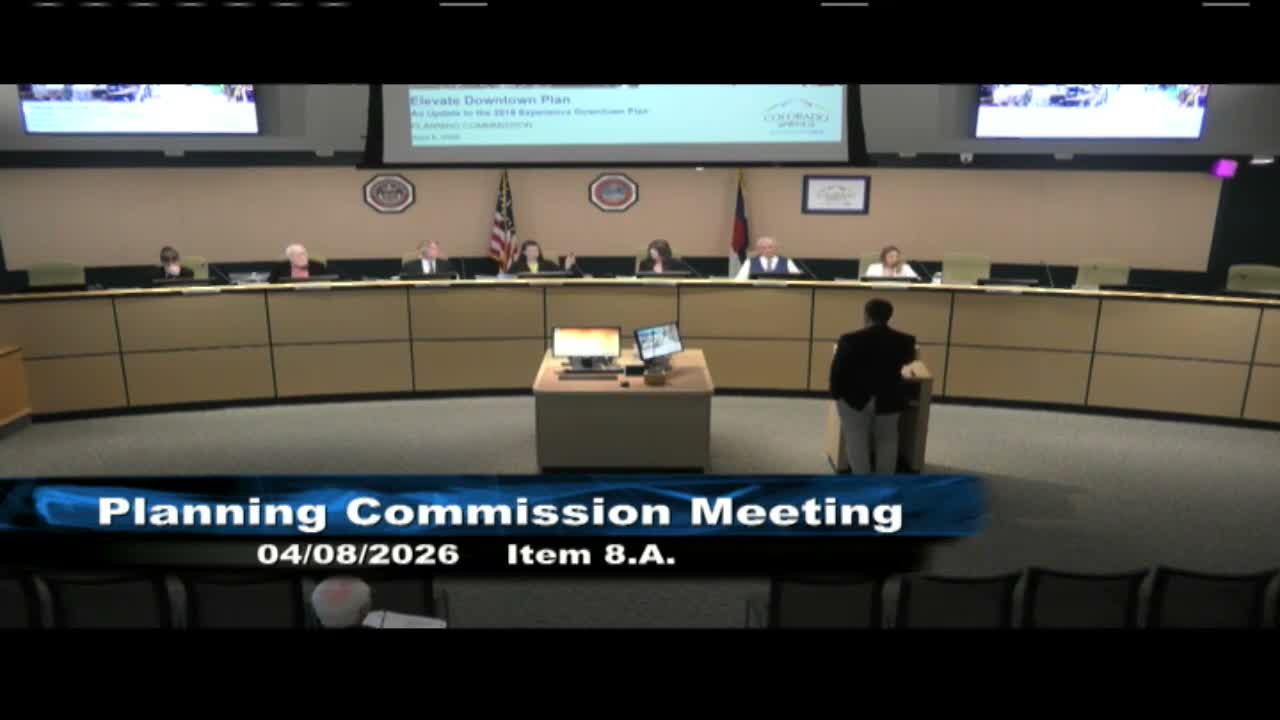
Planning commission recommends updated 'Elevate Downtown' plan after broad outreach
Summary
The commission recommended that city council adopt the Elevate Downtown plan — an update to the 2016 neighborhood plan — following staff and consultant presentations and public support from downtown stakeholders. The recommendation passed 6–1.
The Colorado Springs City Planning Commission on April 8 recommended that city council adopt the Elevate Downtown neighborhood plan, an update to the 2016 framework that sets land use, mobility and economic goals for roughly one square mile of downtown.
Staff told the commission the two‑volume plan meets applicable Unified Development Code and Plan COS criteria and provides a required plan of development that guides the Downtown Development Authority’s use of tax increment financing. "The plan is consistent with the purpose of the UDC...and consistent with Plan COS," staff said.
Consultant Ellie Schafer said the plan grew from more than a year of engagement, including focus groups and more than 2,000 survey responses. "We have been working on this since January 2025," Schafer said, and she highlighted five goals aimed at strengthening downtown as both a commercial center and a neighborhood.
Sam Clark, chair of the Downtown Development Authority, praised the public process and the plan’s comprehensiveness. "This has been an exhaustive process of really taking in a lot of input from virtually every axis of the downtown community," Clark said. Diane Bridges of the Historic Neighborhoods Partnership also voiced support, citing the plan’s attention to historic context and traffic safety.
Commissioners questioned how the plan will interface with form‑based code updates and asked for examples from peer cities; presenters cited several case studies and pointed commissioners to plan pages with benchmarking information. After the discussion Commissioner Robbins moved to recommend the plan; the motion passed 6–1 with Commissioner Gigiano opposed.
The planning commission’s recommendation now proceeds to city council review, where the plan of development (Volume 1) will be required for formal adoption.