Get Full Government Meeting Transcripts, Videos, & Alerts Forever!
Get email alerts on the Procedures Udc topic
No spam. Unsubscribe anytime.
Planning Commission recommends UDC administrative amendments after debate over appeals, variances and work‑session minutes
Summary
The Planning Commission unanimously recommended that City Council adopt amendments to Article 5 (Administration and Enforcement) of the Unified Development Code, clarifying appeals language, the treatment of development plans, administrative adjustments/variances for use‑specific numeric standards, and post‑decision timing; commissioners deferred a final decision on requiring minutes for work sessions and removed that sentence from the package for separate consideration.
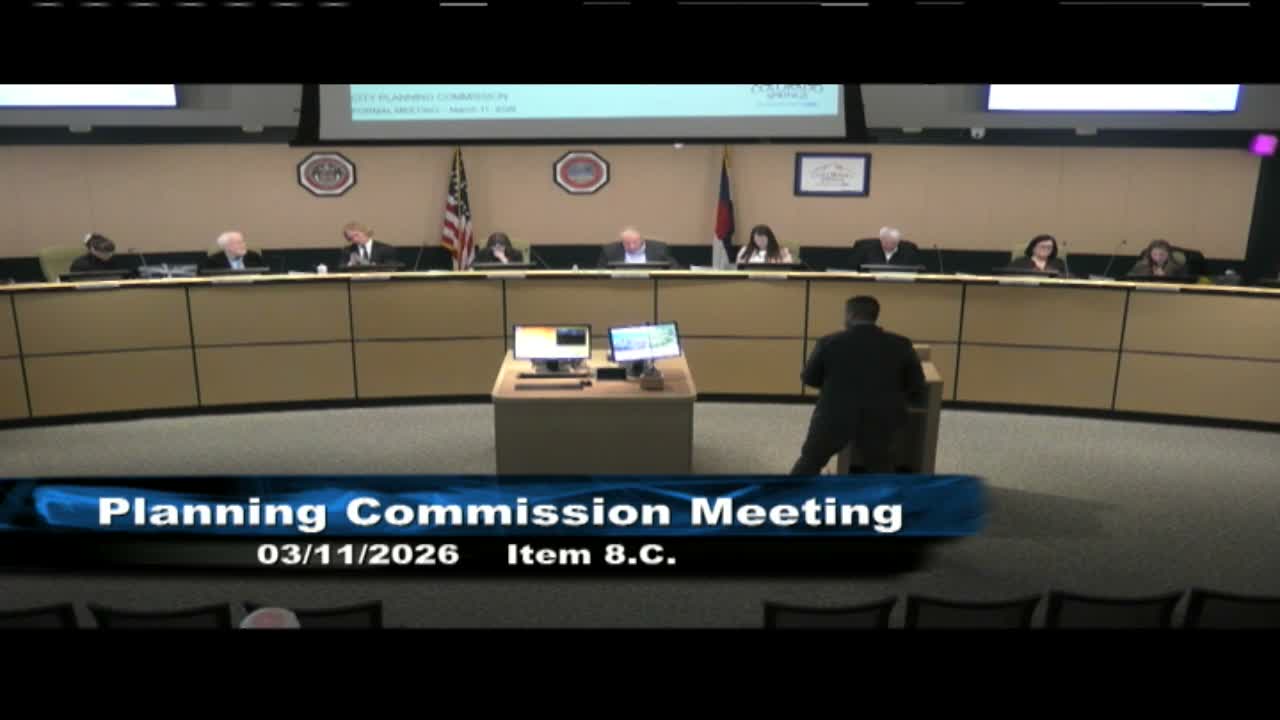
The Colorado Springs City Planning Commission unanimously recommended on March 11 that City Council adopt a package of administrative changes to Article 5 of the Unified Development Code (UDC) designed to correct omissions and clarify procedures, while setting aside a controversial minutes requirement for further discussion.
Daniel Sexton, presenting the ordinance, said the edits are the first phase of a multi‑step effort to refine the UDC since its adoption. He identified several key changes: clarifying that recommendations by advisory and review bodies (the Planning Commission, FBZ review board and Historic Preservation Board) are recommendations and not appealable final actions; reaffirming that development plans do not automatically bundle upward with other applications and that managers have discretion to keep certain development plans at the administrative level; and correcting an omission so applicants can seek administrative adjustments or nonuse variances for numeric, use‑specific dimensional standards that staff said were unintentionally excluded from the existing text.
Legal counsel explained the intent behind the appeals clarification and warned that recording and retaining transcripts or audio from additional meetings carries record‑retention implications. Commissioners debated a late‑added proposed deletion of a sentence that staff had interpreted as requiring minutes for work sessions; concerns included transparency, staff resources and record retention. Several commissioners proposed alternative language (for example limiting minutes to "regular and special" commission proceedings) or asked staff to bring the minutes issue back for separate consideration. Sexton and legal staff said the minutes clause could be removed from the current package and returned for more deliberation; commissioners agreed to proceed without that sentence in the package for Council review.
Commissioner Cecil moved to recommend approval of the ordinance as amended; the motion passed unanimously. The recommendation will go to City Council for final consideration.
What changed and what’s next: The ordinance clarifies appeals, administrative adjustment and variance procedures and the status of development plans under the UDC; it also outlines post‑decision expiration and extension rules for variances. The commission removed the work‑session minutes sentence from the package for further study and asked staff to propose a practicable approach balancing transparency and record‑retention costs. City Council will receive the commission’s recommendation and consider the ordinance and any separate future action on meeting‑minutes rules.