Get Full Government Meeting Transcripts, Videos, & Alerts Forever!
Get email alerts on the Legislative Session topic
No spam. Unsubscribe anytime.
Nebraska Legislature passes dozens of bills on final reading; several emergency measures approved
Summary
On the floor of the Nebraska Legislature, senators completed final reading and roll-call votes on dozens of bills — including multiple measures enacted with emergency clauses — and sent a package of legislation to the governor. Several measures passed unanimously while a few drew closer margins.
The Nebraska Legislature completed a long session of final-reading votes Wednesday, passing a broad package of bills ranging from workers'-compensation updates to higher-education reporting requirements and appropriations measures.
The presiding officer opened the 59th day of the 109th Legislature, second session, and the body moved quickly through the calendar, dispensing with at-large readings and calling roll for final readings. The presiding officer noted signing authority and listed a set of bills to be signed into law.
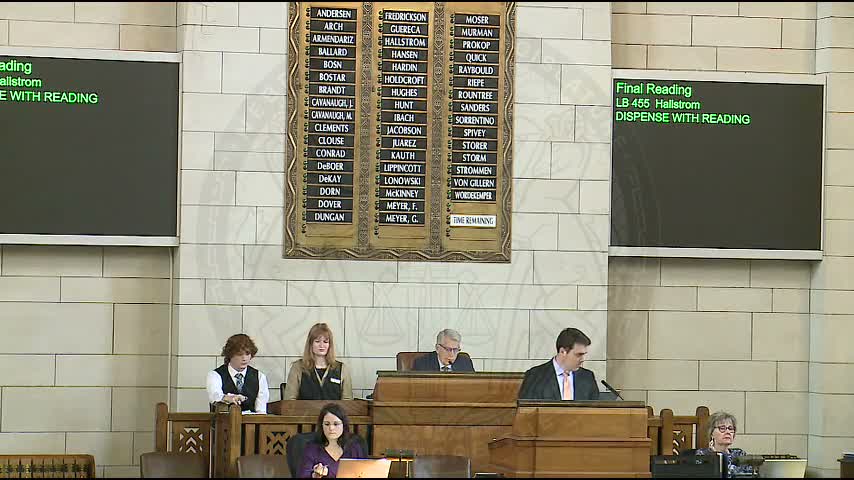
Several bills passed with large, often unanimous majorities. For example, LB 781 (motor-vehicle-inspection and federal-reference updates) passed with the emergency clause and a recorded vote of 49 ayes, no nays. LB 8 20, addressing retirement-system provisions, also passed with unanimous support and an emergency clause. In contrast, LB 455 — a workers'-compensation-related amendment on final reading — passed on a recorded vote of 37 ayes, 12 nays.
A handful of measures drew narrower margins. LB 10 29, a bill requiring covered postsecondary institutions to report certain funding from foreign adversarial sources, passed on final reading by a 29–20 vote after the clerk recorded the roll call.
Many appropriation or budget-related bills were advanced with emergency clauses and funding figures read into the record; the clerk read the titles and appropriation amounts before the body recorded votes. Where totals were reported on the floor, the clerk read the tally aloud and the presiding officer announced the result.
The session included routine procedural business (quorum calls, the dispensing of at-large readings, and clerk announcements of registered lobbyists and filed reports) and ended with the presiding officer proposing to sign the bills that had passed. The body adopted a motion to adjourn and recessed until April 17 at 9 a.m.
What happened next: The measures passed on final reading are scheduled to be presented to the governor for signature or veto as required; bills carrying emergency clauses would take effect upon approval if signed.