Get Full Government Meeting Transcripts, Videos, & Alerts Forever!
Get email alerts on the County Budget topic
No spam. Unsubscribe anytime.
Prince George's County Council holds FY27 budget orientation, outlines key figures and hearing schedule
Summary
The Prince George's County Council held a budget orientation March 23, 2026, reviewing the proposed FY27 operating and capital budgets — including a $4.97 billion general fund, a $4.1 billion six-year CIP and the school system's $2.97 billion proposal — and set public hearing dates ahead of a tentative May 21 adoption.
Prince George's County Council members received a one-item budget process orientation on March 23, 2026, with staff and agency representatives laying out the proposed FY2027 operating and capital budgets and the calendar for review and adoption.
“My colleagues and I will present a brief review and refresher of the current budget process for the various FY '27 proposed budget cycles,” Sylvia King, senior legislative budget officer, told the council as she opened the orientation. King said the county executive transmitted the proposed FY27 operating and capital budgets by the March 15 deadline and reminded the council that it must adopt a budget before June 1.
King provided headline figures for the county’s planning: an estimated general fund revenue level of $4,989,000,000 and a general fund budget of about $4,970,000,000, with an initial shortfall of $58,300,000. She said the proposed FY27–2032 capital improvement program totals about $4,100,000,000 and described new items in the FY27 package, including the creation of an emergency operations fund and the transfer of the DPI enforcement division to the office of homeland security.
The council was given the calendar for public review: staff reviews and committee hearings through April and May, evening public hearings on April 28 and May 4, and a tentative budget adoption on May 21 at 11 a.m. King also noted that staff will publish questions and agency responses on the council’s intranet and that a new public-facing budget and policy analysis hub will post prior reports and presentation materials for public use.
Arun Parakin, presenting for the Education and Workforce Development committee, summarized the Board of Education’s proposed FY27 operating budget at about $2,970,000,000 — roughly $21,000,000 higher than FY26 — and listed the BOE’s stated priorities: “universal pre K expansion, special education services, school construction and modernization,” among others. Parakin outlined the BOE revenue mix as roughly 60% state, 34% county, 4% federal and about 1% from board sources and the fund balance. He noted the BOE’s schedule of hearings and the EWD work session on April 27, with public hearings set for April 28 and May 4.
A presenter for the Maryland-National Capital Park and Planning Commission reviewed that agency’s budget structure and constraints, saying the Prince George’s County portion of the commission’s annual budget is about $609 million, of which roughly $488 million are operating funds. The presenter emphasized that the commission operates under a separate taxing authority governed by the state land use article and that strict fund-use rules mean some funding cannot be shifted across categories. He noted that Prince George’s must negotiate CAS (Central Administrative Services) charges with Montgomery County; the county’s share of the CAS budget is about $15 million of a $29 million CAS total. A parks-focused public hearing is scheduled for April 22 at 6 p.m., and the bi‑county discussion of the commission’s CIP is scheduled for May 7.
Kenneth Battle, director of the council’s Transportation, Infrastructure, Energy and Environment committee, summarized the Washington Suburban Sanitary Commission (WSSC) review timeline and the scale of WSSC’s budget. He described WSSC’s budget as roughly $1.9 billion this year — about $1.2 billion in operating spending and $742 million in CIP — and reminded the council that Montgomery and Prince George’s counties must confer on rates and affordability. Key WSSC process dates provided included a council overview delivered March 17, the TIE review on April 9 and a WSSC public hearing on April 21 ahead of the by‑county meeting on May 7.
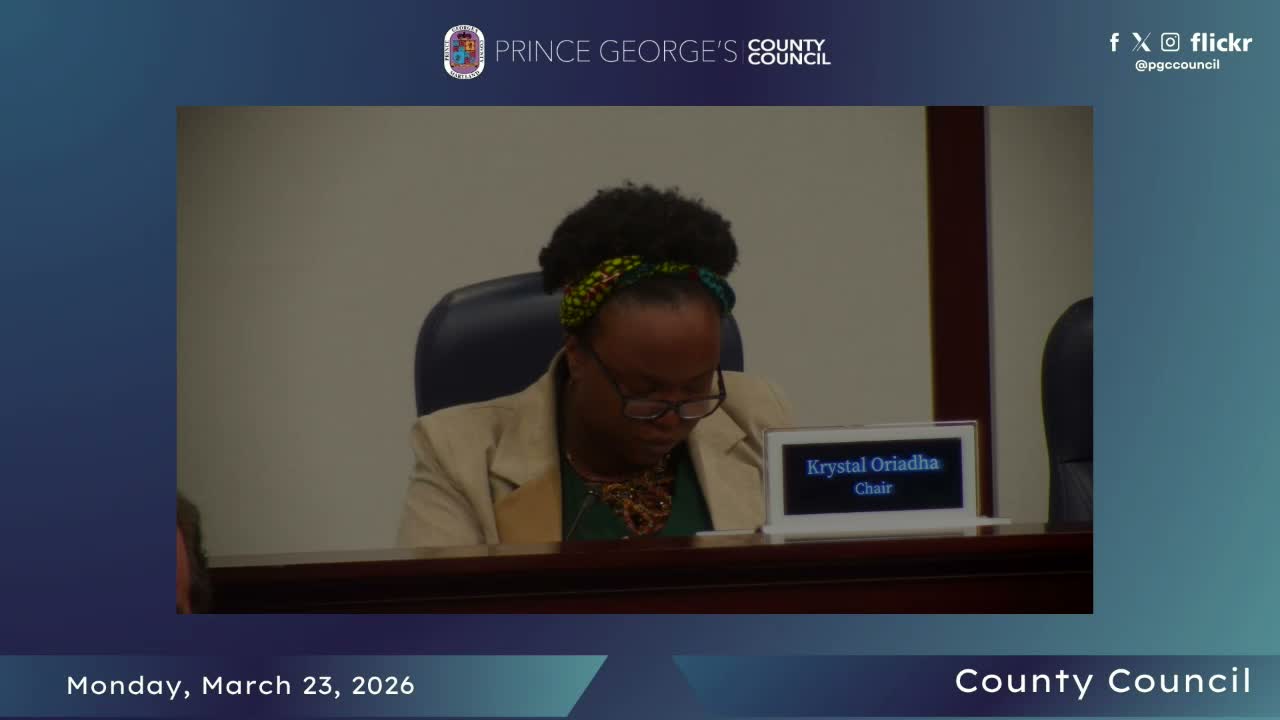
Council members asked logistical questions and expressed appreciation for staff work. Council member Harrison thanked committee directors and urged efficient, respectful public hearings so attendees — particularly seniors — would not be kept late. Chair Ollieva confirmed two community listening sessions at the end of March and asked staff to compile and publish a concise report of the listening-tour comments and survey findings for council review.
No formal budget votes occurred at the session; the meeting ended with a routine motion to adjourn. The council’s next procedural steps are staff reviews, committee sessions in April and May, and the public hearing schedule noted above as the council prepares for final action before the June 1 statutory deadline.