Get Full Government Meeting Transcripts, Videos, & Alerts Forever!
Get email alerts on the Budget topic
No spam. Unsubscribe anytime.
Hillsborough board approves revised 2024–25 school budget after public hearing
Summary
After a public hearing, the Hillsborough Township Board of Education approved a revised 2024–25 budget that restores portions of state aid and authorizes related waivers and reserve withdrawals; board members debated whether one‑time restoration funds should prioritize staff restoration or new programs such as full‑day kindergarten planning.
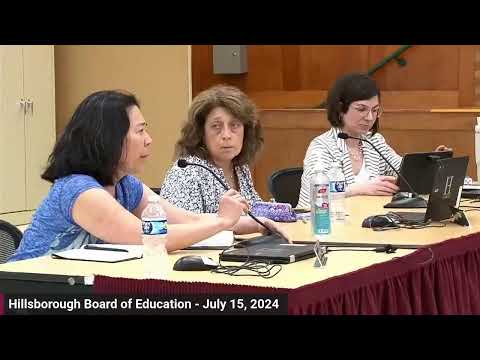
The Hillsborough Township Board of Education voted to approve a revised 2024–25 school budget at its July 15 meeting following a public hearing and staff presentation.
Superintendent (speaker S7) and district finance staff (speaker S2) told the board that recent state legislative changes extended the budget timeline and allowed districts to recoup a portion of previously lost state aid. The district’s revised budget totals shown by staff included a general fund of $148,367,502, grants and entitlements of $1,906,885, and debt service of $2,187,950. Staff said the change reflects a 2% tax-levy increase, a health‑benefits cap waiver of $777,806, and a state‑aid restoration tax‑levy waiver of about $5,740,681, plus a one‑time state aid restoration grant of $1,227,827 and withdrawals from capital and maintenance reserves for one‑time projects.
The board held a public hearing required under New Jersey law before voting. Residents who spoke during the budget hearing urged the board to consider priorities such as student health, class size and full‑day kindergarten as the district decides how to allocate increased resources. After discussion among board members about spending priorities — including whether to restore previously cut instructional positions or fund new programs — the board voted on a block motion covering items 6.3–6.10 (the revised budget, health‑benefits waiver, state‑aid cut restoration waiver, travel reimbursement caps, professional service maximums and reserve withdrawals). The motion passed; the board president announced the budget was officially approved.
Board members emphasized that the approved budget authorizes spending levels and that any specific hires or capital projects will require separate future board action. The superintendent noted some funds are one‑time and must be used for capital or non‑recurring purposes, while recurring obligations will need ongoing budgeting consideration.
The next step is submission of the approved budget to the executive county superintendent for final approval; staff said a user‑friendly version of the budget would be posted on the district website by July 17, 2024.
The board’s action restores some capacity for intervention staffing and capital work, but debate at the meeting showed division about the district’s immediate priorities and whether to use one‑time funds to start new initiatives or principally restore instructional staff cut in prior years.