Get Full Government Meeting Transcripts, Videos, & Alerts Forever!
Get email alerts on the Climate Policy topic
No spam. Unsubscribe anytime.
City administrator says Climate Commitment Act is already affecting municipal gas utility; council asked to consider policy options
Summary
City Administrator Chris Searcy told council the municipal gas utility is marginally above the CCA’s 25,000 metric‑ton threshold and that the city has paid roughly $250,000–$400,000 annually so far; he outlined allowance mechanics, bill‑charge differences between legacy and new customers, and suggested exploring alternative compliance or legislative options with Ellensburg.
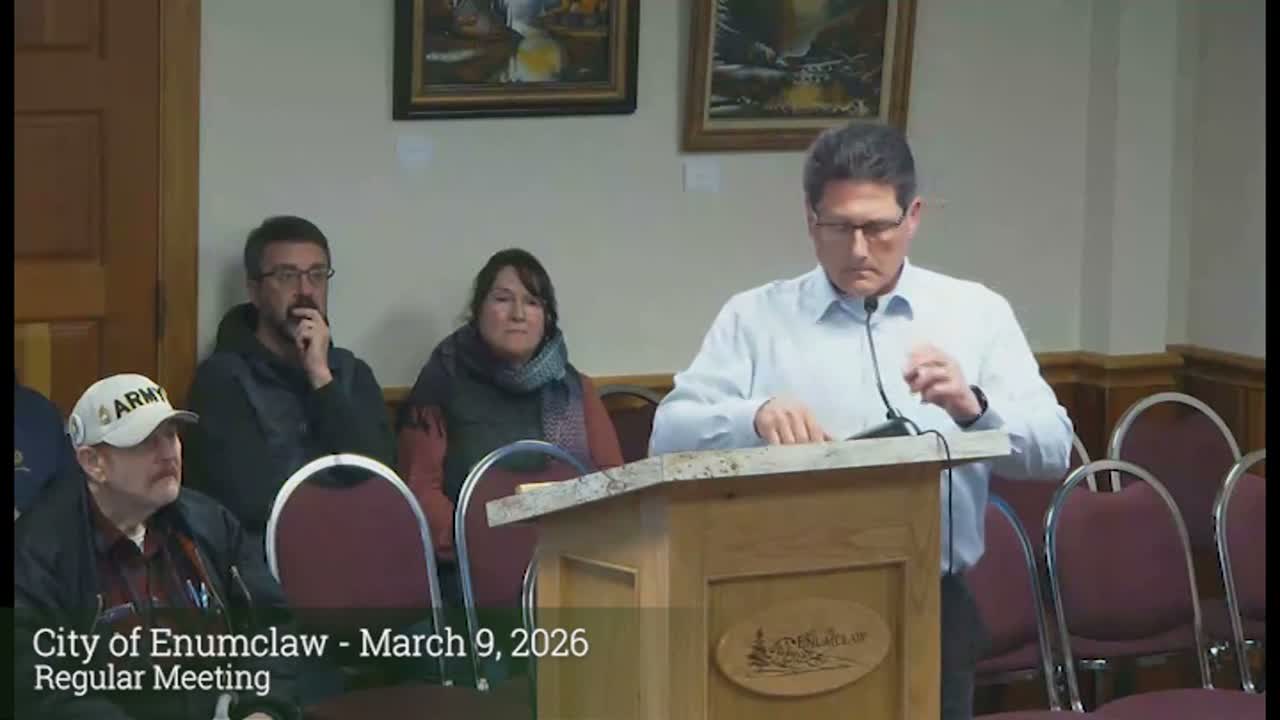
City Administrator Chris Searcy led a detailed Climate Commitment Act workshop at the March 9 Uniontown City Council meeting, telling council members the city’s municipal natural gas utility is currently subject to Washington’s cap‑and‑invest program and that the city should consider policy options and additional staff or consultant support to respond.
Searcy explained the program’s basic mechanics — covered entities must obtain annual carbon allowances equal to their greenhouse gas emissions, allowances are available through state auctions and Ecology provides a declining allocation of no‑cost allowances. "We are just marginally over the threshold of being pulled into the program," he said, citing the 25,000 metric‑ton cutoff and noting that Ecology can keep entities in the program if they fall within 10% of the threshold. He advised targeting a buffer of roughly 22,500 metric tons to reduce the chance of re‑inclusion.
The administrator noted the city’s compliance costs have grown since the program began: "The first year was about $250,000 in 2023..." and recent figures were closer to $400,000, he said. Searcy cautioned that future costs depend on auction prices, which could rise if Washington links with California's broader market. He said no‑cost allowances decline by about 7% per year and that a rising share of allowances must be consigned to auctions until 2030.
Searcy described how the city reflects CCA costs on customer bills: legacy customers receive a smaller per‑unit CCA charge (roughly 6–7¢ per CCF historically), while new, "non‑legacy" customers connected after July 25, 2021, face a higher straight‑conversion charge (as much as 23–33¢ per CCF in initial estimates). He emphasized low‑income customer exemptions required under the law.
Options and next steps discussed included pursuing an alternative compliance path similar to a concept Ellensburg advanced (placing compliance costs into a restricted account and using funds for decarbonization efforts), seeking state grants for decarbonization planning, and asking council to provide policy guidance on matters such as full cost recovery for new development. Searcy also noted limited in‑house capacity to run decarbonization programs and suggested the city may need dedicated personnel or technical contractors.
Why it matters: the CCA affects municipal utility finances and rate design and could increase future costs for local customers; council policy choices may shape whether the city pursues legislative relief, alternative compliance mechanisms or programmatic decarbonization investments.
What council asked for: Searcy recommended the council "let this sink in," solicit feedback from stakeholders and revisit the topic in May with further information and refined projections.
Key quote: "We are just marginally over the threshold of being pulled into the program," said City Administrator Chris Searcy, summarizing the city's current standing under the CCA.