Get Full Government Meeting Transcripts, Videos, & Alerts Forever!
Get email alerts on the Elementary Education topic
No spam. Unsubscribe anytime.
Principal outlines Hatch Elementary interventions as parents urge digital citizenship policy
Summary
Hatch Elementary principal Jeff Glenn briefed the board on student demographics, stagnant ELA/math results and targeted reading interventions; several parents urged the district to adopt a digital citizenship curriculum and tighten Chromebook usage policies for younger students.
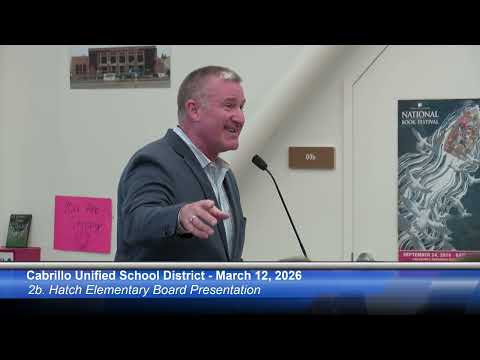
Principal Jeff Glenn presented an overview of Hatch Elementary's programs and performance to the Cabrillo Unified School District board on March 12, highlighting dual-immersion demographics and targeted interventions intended to lift student outcomes.
Glenn said Hatch enrolls about 549 students, including roughly 172 English learners (about 31%), with 39% qualifying for free or reduced-price meals and 12% identified for special education. He described a data-driven approach using DIBELS screening, a Wilson Reading System, peer observations and a 35-minute daily phonics intervention that groups students by reading level. Glenn said ELA and math scores have been largely stagnant districtwide while some grade cohorts showed gains; he singled out declines in fifth-grade science and affirmed the school's effort to reclassify English learners via ELPAC.
During public comment, several parents told the board they are concerned about children's screen time and the use of Chromebooks in early grades. Parent Rachel Martin said Hatch staff responded quickly after families reported students using devices unsupervised during breakfast; Principal Clinton (Jeff Clinton) enacted a 'computers in the classroom only' rule the day after parents provided evidence of unsupervised screen use. Commenters asked the district to develop a digital-citizenship curriculum that would teach students how to evaluate online sources, understand algorithms and manage devices responsibly.
Board members thanked staff for the presentation and asked staff to provide Spanish-assessment reporting and further data about immersion-program outcomes so trustees can evaluate supports for both English learners and higher-achieving students. Trustees expressed interest in exploring parent-facing materials explaining grade-by-grade expectations and recommended the district consider pilot approaches that balance interventions with enrichment for advanced students.
The board did not take formal action on technology policy during the meeting but directed staff to continue conversations with principals and return with data and options.