Lifetime Citizen Portal Access — AI Briefings, Alerts & Unlimited Follows
Platteville program committee reviews 'Magic School' AI pilot, privacy safeguards and classroom rules
Loading...
Summary
Program Committee members heard a presentation from librarian Paige Leahy on the district's pilot of the Magic School AI platform, its FERPA/COPPA safeguards, a classroom 'scale of use' rubric tied to policy 363.2, and an estimated $7,400 enterprise subscription cost for next year.
Paige Leahy, a librarian with the Platteville School District, presented to the Program Committee on the district’s pilot of the Magic School AI platform and explained how the tool would be used, monitored and taught to staff and students.
Leahy told the committee that Magic School offers educator-focused tools — including IEP generators and worksheet creators — and said the platform is designed for K–12 use. "One of the things that's really lovely about it is that it is intended for educators," Leahy said, adding the vendor describes the product as FERPA- and COPPA-compliant and that district data would not be used to train external models.
The presentation said the district purchased access through CESA/CISA as a discounted pilot in February, with the trial running through the end of the school year. Leahy said three district librarians (Rachel Kelleher, Sam Charles and herself) completed available trainings and the district notified staff by email that the enterprise edition was available. She noted the enterprise edition allows administrators to monitor usage.
Committee members asked how the platform handles personally identifiable information (PII) and what happens if a staff member or student mistakenly submits PII. Leahy said staff should avoid inputting names or identifying details and that she would follow up to clarify how the vendor’s "safety loop" prevents or handles such errors. "I will go back and look at this and compare it to the enterprise and see if there's anything contradictory," she said regarding the district policy attachment.
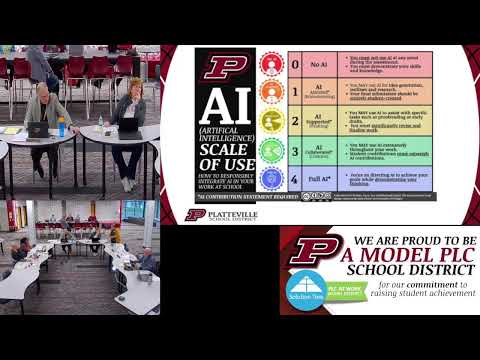
A central element of the rollout is a "scale of use" rubric (levels 0–4) attached to the district’s acceptable-use rule, policy 363.2, which Leahy said teachers should post with assignment instructions and use a badge system to indicate allowed AI activity. She described the expectation that teachers define whether AI use is allowed (level 0 = no AI) or permitted for brainstorming or other specified tasks, and that students must include a contribution statement where AI is used.
Committee members also raised how the district would detect AI-generated student work. Leahy and others said existing tools such as Turnitin have limits and detection is an evolving challenge; they emphasized teacher familiarity with students and classroom verification as primary academic‑integrity tools.
When asked about cost, the committee was told the district expects to pay about $7,400 next year for enterprise accounts covering students. Leahy said the district could build district-specific "notebook" instances or custom bots seeded with district handbooks so staff could query materials tied explicitly to local policy and procedures.
The committee's discussion focused on training staff to prompt responsibly, maintain human oversight of AI outputs, and ensure classroom expectations are clear. The Program Committee adjourned at 6:51 p.m.