Get AI Briefings, Transcripts & Alerts on Local & National Government Meetings — Forever.
Governor signs about 22 bipartisan bills in Olympia, including AI‑disclosure and nitrous‑oxide ban
Loading...
Summary
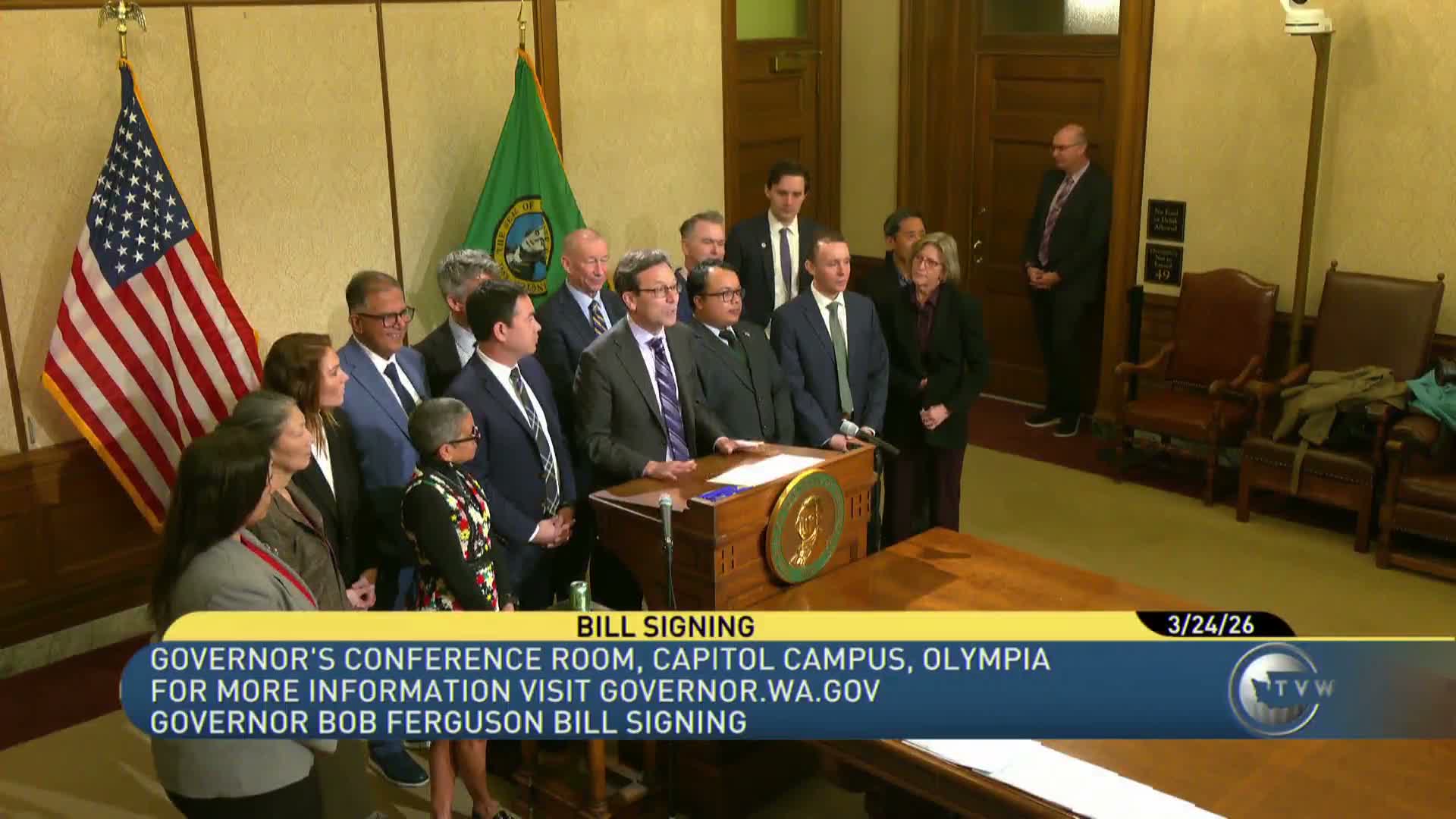
At a morning bill‑signing in Olympia, the governor signed roughly 22 bipartisan bills covering AI disclosure and safety, limits on school restraints, transport and housing measures, and a new gross‑misdemeanor ban on certain nitrous‑oxide products, officials said.
The governor signed roughly 22 bills into law in Olympia on Monday, touching topics from artificial‑intelligence transparency to student safety and public‑health measures.
"By making it clear when AI generates media, Washingtonians are better protected against confusion, deception, and misinformation," the governor said while signing House Bill 1170, which requires large AI companies to embed data that indicates when images, video or audio have been created or altered by artificial intelligence. The day’s session included picture moments and brief remarks for sponsors and community members.
The ceremony included several bills described by the governor and sponsors as protections for young people. House Bill 2225 — requested by the governor and signed at the event — requires AI companion chatbots to implement protocols that detect and respond when a user expresses thoughts of suicide or self‑harm, including referrals to crisis resources; it also requires content filters for minors and bars manipulative engagement tactics with young users.
The governor signed House Bill 1795 to tighten restrictions on restraint and isolation in public schools, banning mechanical, chemical and life‑threatening restraints, prohibiting new isolation rooms and limiting use of such measures to true crises. Lawmakers and family members who testified at committee hearings were acknowledged at the signing.
Multiple other bipartisan measures were signed during the morning event. Highlights include bills to accelerate school construction financing (HB 1796), align tax treatment for certain timberland sales (HB 1983), waive replacement fees for defective license plates (HB 2114), expand reporting obligations for deadly use‑of‑force incidents (HB 2508) and modernize rules for asbestos removal training (SB 6188). The governor also signed worker‑centered changes to the state workers’ compensation system (SB 5847) and legislation giving Labor and Industries discretion to prioritize severe wage‑theft cases (SB 6058).
Transportation and housing‑oriented bills included measures to allow additional electric‑vehicle manufacturers to sell vehicles in Washington showrooms and to provide EV rebates (SB 6354), to give county ferry districts consistent revenue tools with an advisory committee requirement (HB 2588), and to prohibit homeowners’ associations from banning fire‑hardened building materials in wildfire‑risk areas (SB 6054).
On public‑safety policy, the governor described House Bill 2532 as a response to harm observed in communities. "Nitrous oxide has been responsible, unfortunately, for a number of overdose deaths in our state," the governor said before signing the bill, which makes it a gross misdemeanor to sell, furnish, administer, distribute or give away certain nitrous‑oxide products while exempting legitimate medical uses. Representative Joe Timmons, the bill’s prime sponsor, said the measure originated from constituent reports of rising youth use: "This issue was brought to me by a constituent who was concerned with seeing the rise of nitrous oxide use, particularly for young folks in our community," he said.
Several technical or procedural bills were also signed: changes to guardianship and conservatorship procedures (SB 5837), enhanced penalties for repeated plumbing violations (SB 6197) that allow suspending certificates after five infractions within five years, and measures to modernize energy procurement for consumer‑owned utilities (SB 6076). The governor and sponsors repeatedly framed the package as bipartisan work and thanked families, staff and agency partners who contributed testimony and drafting assistance.
The signing ceremony was largely ceremonial: sponsors and community members were invited to join the governor for photos after each signing, and the governor noted there would be additional signings in an afternoon session. The administration did not announce implementation deadlines for the newly signed laws during the event; where the bills specify effective dates or follow‑up requirements, those details will appear in the enacted versions of each bill.