Get Full Government Meeting Transcripts, Videos, & Alerts Forever!
Get email alerts on the Legislation Signing topic
No spam. Unsubscribe anytime.
Governor signs bipartisan package of bills on literacy, public safety, health and taxes
Summary
At a ceremonial signing in the governor’s office, the governor enacted a broad batch of mostly bipartisan bills, including requirements for early-grade literacy curriculum, a ban on distributing digital firearm blueprints, an estate-tax rate cut, expanded school asthma treatment authority and reforms to probate and veterans’ benefits.
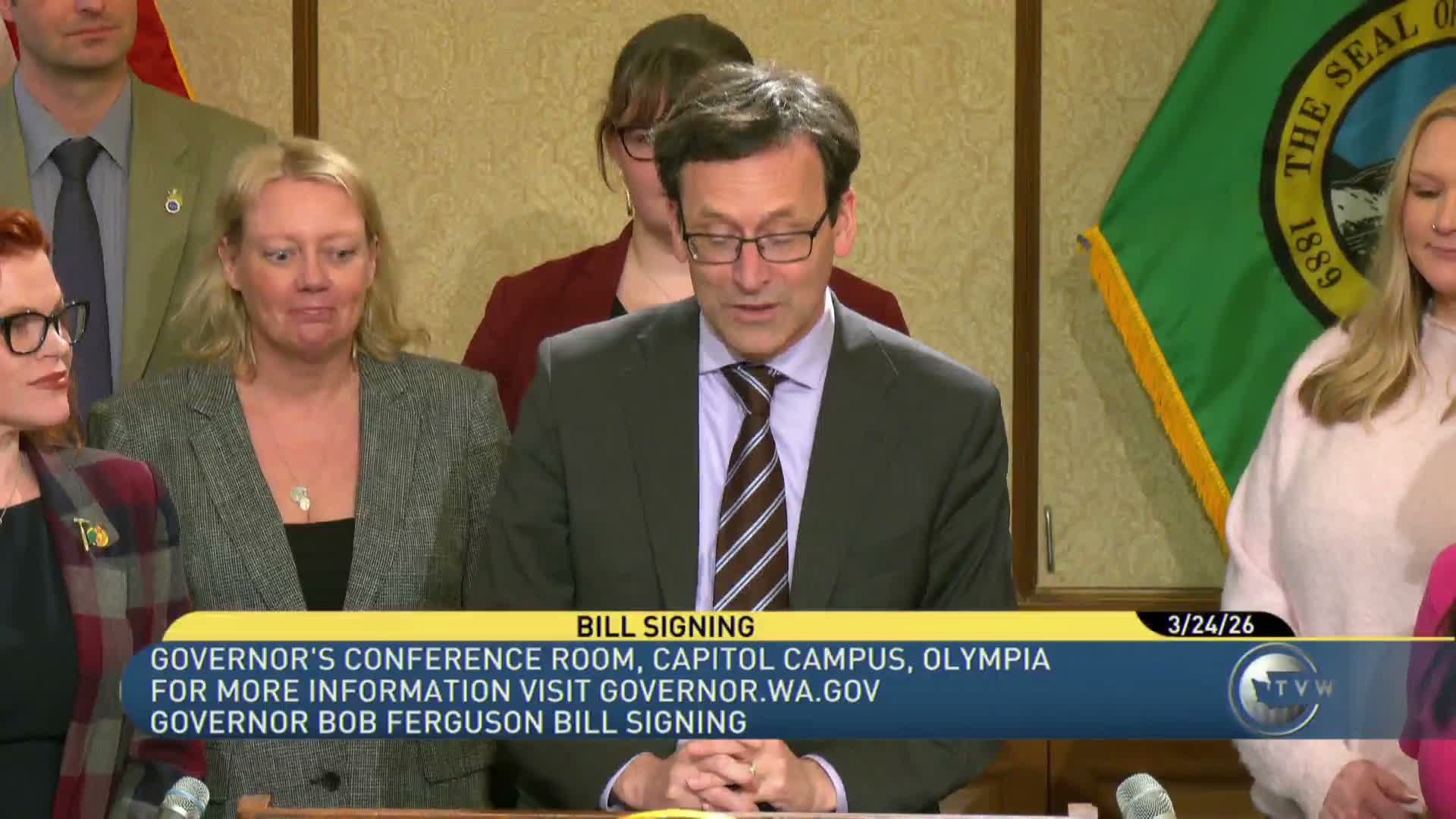
The governor signed a large, mostly bipartisan package of bills in an afternoon ceremonial session that included lawmakers, advocates and stakeholders for photo opportunities after each enactment. Major measures signed included new requirements for early-grade literacy instruction, a prohibition on distribution of digital firearm-manufacturing blueprints, an estate-tax rate reduction and new authorities for school emergency asthma treatment.
Why it matters: the bills affect public safety, education, health-care delivery and tax policy across Washington and were described at the signing as measures that will improve access, public-safety protections and administrative clarity. Sponsors and stakeholders attended the event as each bill was presented and photographed with the governor.
Among the notable bills the governor described at the signing: House Bill 1295 requires school districts and teacher-training programs to adopt “science-based literacy curriculum” in kindergarten through fourth grade beginning Sept. 1, 2027, and directs the Office of the Superintendent of Public Instruction to update educator literacy training, including for students showing indications of dyslexia. At the podium, the governor said the change responds to data showing too many fourth-graders are not reading at grade level.
On public safety, House Bill 2320 “prohibits the distribution of the digital firearm manufacturing manufacturing code, the digital blueprint, to anyone who is not a federal firearms manufacturer or dealer,” a provision the governor said will limit access to tools that can create untraceable firearms. The sponsor named at the signing was state representative Sal Houdin, with companion sponsor state senator Javier Valdez.
The governor also signed Senate Bill 6347, which reduces the state’s top estate-tax rate from 35% to 20%. The governor called the change “important” and credited bipartisan support; prime sponsors identified at the event were Senator Claudia Kaufman and Representative Larry Springer.
Several health and social-service measures were included in the package. House Bill 2360 allows schools to maintain and administer albuterol for emergency asthma treatment on school property and at off-site school functions; the governor said the bill will help children who experience sudden asthma symptoms. Senate Bill 5124 sets network-adequacy standards for Medicaid managed-care organizations to aid post-acute placements, and House Bill 2211 creates standards for medically tailored meals that supporters said will support local food infrastructure and patients with serious medical needs.
Other items signed at the session addressed probate oversight (House Bill 2445, requested by the Attorney General’s Office), preservation of historical records (Senate Bill 5863, which requires retention of records from Lakeland Village through 2030), expanded telehealth for veterinary care (House Bill 2247) and changes affecting labor relations and corrections employees’ supplemental retirement benefits (House Bills 2091 and 1069, respectively). The governor repeatedly thanked lawmakers and community members at the event: “We so appreciate the hard work of everybody who made this legislation possible,” the governor said when presenting multiple bills.
What happened next: each bill presentation concluded with applause and a photograph; sponsors and advocates posed with the governor as each bill was signed. No formal votes or further legislative actions were taken at the event itself; the ceremony recorded signatures that make the measures law according to the standard enactment process described at the signing.
Details and procedural notes: the literacy law’s effective date was stated as Sept. 1, 2027. Several bills described rule-making steps or implementation work by state agencies — for example, the board of nursing and the Department of Health were mentioned in relation to implementing training or safety standards in bills affecting health-care staffing and practice. Where the transcript did not provide additional numerical specifics (for example, implementation timelines beyond those stated or detailed rule-making deadlines), the article marks those items as not specified in the transcript.
Next steps: sponsors and agency staff named at the signing were identified as the officials expected to follow up on implementation and rule-making; no further procedural steps were announced during this event other than the formal signing and photographs.