Committee reviews bill to modernize Alaska's health information exchange, clarify governance and add behavioral-health representation
Loading...
Summary
Sen. Forrest Dunbar and staff presented SB 272 to update Alaska's HIE law for current EHR/HIE practices, clarifying department and designee roles, adding behavioral-health representation on the governing body, codifying public-health use, creating patient authorization and opt-out procedures, and requiring self-sustaining funding through user fees.
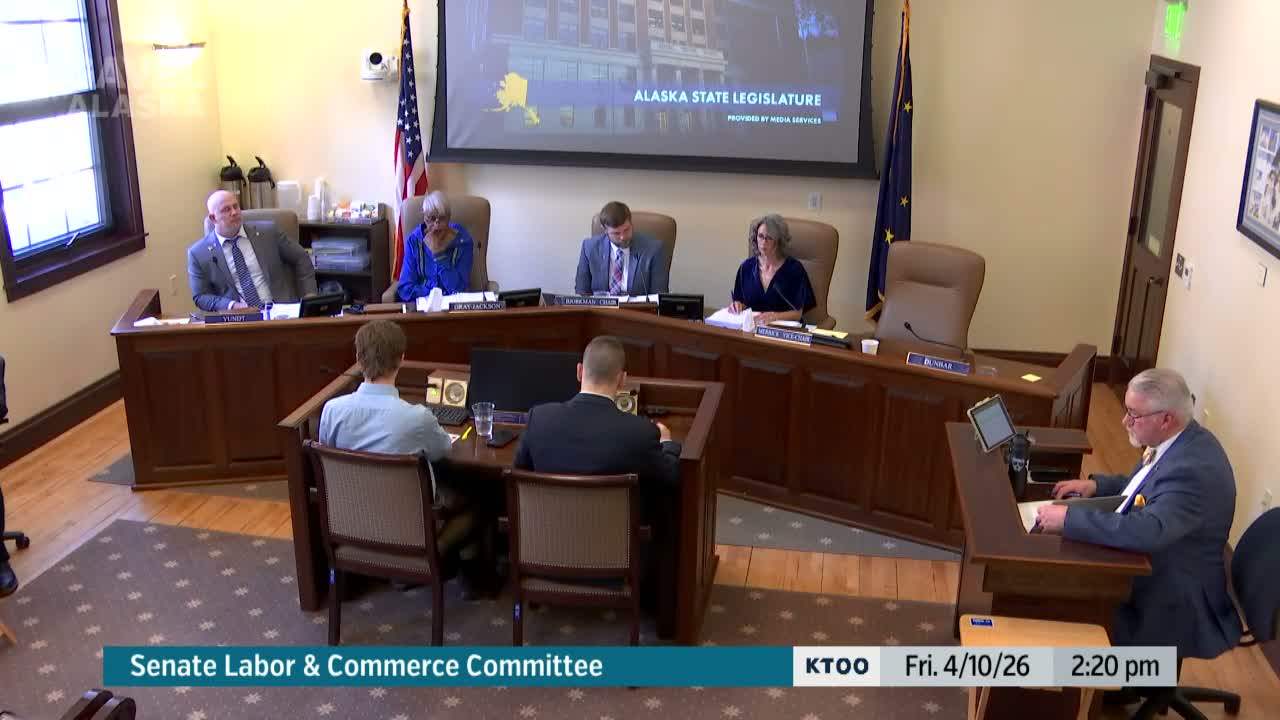
Juneau — The Senate Labor and Commerce Committee heard a first presentation April 10 on SB 272, a bill to modernize Alaska’s statutory framework for health information exchange (HIE) and align it with current electronic health record and data-exchange practices.
Senator Forrest Dunbar said the bill updates Alaska’s HIE law to reflect technological and policy developments since the Health Information Technology for Economic and Clinical Health Act (HITECH) era. Halen Behnken, staff to Senator Dunbar, ran a sectional analysis that described amendments to AS 18.23.030–.310: clarifying the Department of Health’s mandate for the statewide HIE, requiring the commissioner to designate qualified entity(ies) to administer the system, allowing the designee to be a public or private entity under contract, expanding the governing body to include a behavioral-health representative, and adding privacy, disclosure, patient opt-out and notification provisions.
Kendra Stica, executive director of Healthy Connect Alaska (the state-designated HIE), testified the measure generally clarifies existing practice rather than changing core allowable uses. She explained that patients do not directly access the HIE repository; instead, participating providers’ electronic health records automatically feed data into the HIE, which other participating providers can access under HIPAA-protected relationships. Stica said one substantive change would allow an individual to authorize disclosure for particular non-routine purposes (for example, consolidating records to support a disability determination), which could create administrative efficiencies when an individual asks for records to be used in a single, centralized way.
Stica and staff emphasized clarity in language about responsibilities between the Department of Health and the designee, strengthened privacy and notification protocols in the event of confidentiality violations, and a requirement that the system seek public and private funds and become self-sustaining through user fees. Senator Dunbar said the bill preserves allowable uses while modernizing governance and ensuring the HIE functions as state health infrastructure.
Committee members posed several technical questions about how patients and providers interact with the HIE; Jason Ball (chief data officer, Department of Health) was present on the phone but the transcript records no substantive questions directed to him. The committee set SB 272 aside for additional consideration.
(Reporting from the April 10, 2026 Senate Labor and Commerce Committee hearing in Juneau.)