Lifetime Citizen Portal Access — AI Briefings, Alerts & Unlimited Follows
Lawmakers hear broad testimony on licensure compacts and scope-of-practice updates in HB 110
Loading...
Summary
At a third hearing on House Bill 110, staff said the bill would join an interstate licensure compact; invited witnesses and numerous practitioners testified about related compacts (medical licensure, PSYPACT) and urged updates to occupational therapy scope and respiratory therapist licensure for patient safety and rural access.
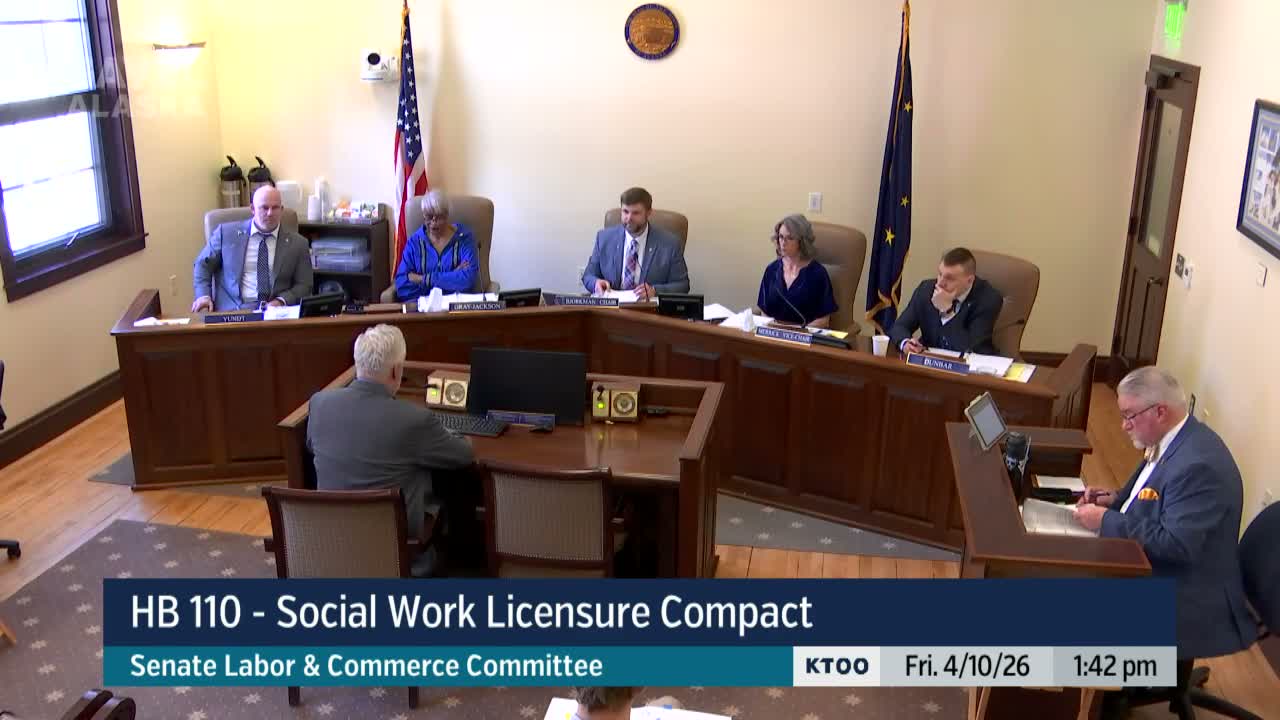
Juneau — In a broad third hearing Tuesday, the Senate Labor and Commerce Committee took testimony related to House Bill 110, which staff described as legislation to join an interstate licensure compact while preserving multiple pathways to licensure.
Kyle Johansen, staff to Representative Andrew Gray, said HB 110 "would have Alaska join [an] interstate compact" and would preserve existing licensure pathways so professionals could use either the compact mechanism or the current state process.
Several invited witnesses addressed compacts affecting other professions. Pam Zdrenshan, executive director of the Alaska State Medical Association, told the committee her organization supports joining the interstate medical licensure compact and said the state’s licensure process can take up to eight months for residency or practice permits — a delay that can hinder recruitment. "We know that residents who want to come to Alaska ... it takes them on average up to 8 months to get their residency practice permit," she said, urging committee support.
Dr. Kevin Tarlow, representing the Alaska Psychological Association, read his organization's endorsement of PSYPACT, the psychology interjurisdictional compact, saying the compact would improve continuity of care, expand telepsychology access for rural Alaskans, and protect state licensing boards' regulatory authority.
Much of the public testimony focused on occupational therapy scope and respiratory-therapist licensure. Lindsey Gilday, a registered respiratory therapist and state representative of the Alaska Society for Respiratory Care, said, "Currently, Alaska is the only state in the nation without licensure for respiratory therapists," and argued licensure is essential to protect patients and hold practitioners to consistent standards.
Multiple occupational therapists and patients urged changes to OT statutory language so therapists may provide active rehabilitation rather than only assistance to "cope" with limitations. Tori Daughtry, a member and secretary of the state Physical Therapy and Occupational Therapy board, said a 2023 law opinion identified a statutory gap in AS 8.84.190(3) that limited occupational therapy to coping rather than improving function; HB 110 would allow the board to adopt regulations that align with modern national standards.
The committee closed public testimony on HB 110 and set the bill aside for future consideration; no committee vote on the bill occurred during this hearing.
(Reporting from the April 10, 2026 Senate Labor and Commerce Committee hearing in Juneau.)