Get Full Government Meeting Transcripts, Videos, & Alerts Forever!
Get email alerts on the Energy Wind topic
No spam. Unsubscribe anytime.
Laramie County rejects Laramie Range Wind site plan after lengthy public hearing
Summary
After several hours of public testimony and technical presentations, the Laramie County Board of County Commissioners voted down the site‑plan approval for the Laramie Range Wind Project on Sept. 16, 2025. The board framed the decision around local impacts, regulatory timing and unresolved agency conditions.
The Laramie County Board of County Commissioners on Sept. 16 declined to approve the Laramie Range Wind Project site plan after an extended public hearing that drew more than a hundred pages of oral and written comment.
The project developer, represented by Charlie Behnke of ConnectGen/Repsol, and a team of technical and legal advisers described a plan for up to 170 potential turbine locations on roughly 56,150 acres about 20 miles northwest of Cheyenne. The applicant said the proposal would be built in two phases, would disturb roughly 400 acres in operations, and would include an integrated mitigation approach — including a road‑use agreement, an aircraft detection lighting system (ADLS) application, use of IdentiFlight or similar eagle‑detection technology and commitments to wildlife monitoring and adaptive management.
The developer’s presentation outlined an anticipated capital investment of about $1.1 billion, estimated property and production tax revenues of approximately $190 million over project life, and peak construction employment of roughly 300 jobs. Company witnesses emphasized prior outreach (they said it began more than seven years ago) and a packet of environmental, visual, acoustic and traffic studies included in the application.
But the hearing that followed focused on a long list of concerns raised by residents, local ranching interests and conservation advocates. Speakers from the Horse Creek area and adjacent ranches — including landowners who say their family properties have been in place for generations — asked for more time and more conditions. Common concerns included haul‑route impacts and traffic safety on narrow county roads; the source and potential effects of construction water on shallow wells and aquifers; wildlife effects (including mule deer, pronghorn and raptors); viewshed and tourism impacts; emergency‑response capacity in the project’s remote location; ice throw and turbine failure scenarios; and the adequacy and enforceability of decommissioning assurance.
Several technical speakers pressed the county for stronger, enforceable conditions rather than voluntary commitments. Wyoming Game and Fish Department comments were discussed repeatedly; the developer said it had coordinated with the agency, had provided response materials and was drafting a mitigation agreement that the developer said would become part of the industrial siting permitting process. The developer also said it would provide funding — not to exceed $400,000 — to the Laramie County Fire Authority for an off‑road water tender and would accept road‑use and financial‑assurance obligations established in required agreements.
Commissioners probed both the applicant and county staff on which conditions could be controlled by the county permit and which were subject to the Industrial Siting Division (ISD) or other state permitting. Planning staff recommended approval with two explicit conditions: (1) an approved ISD (Industrial Siting Division) permit from the Wyoming Department of Environmental Quality must be received prior to issuance of the county’s large wind energy systems permit, and (2) all agency comments must be addressed accordingly.
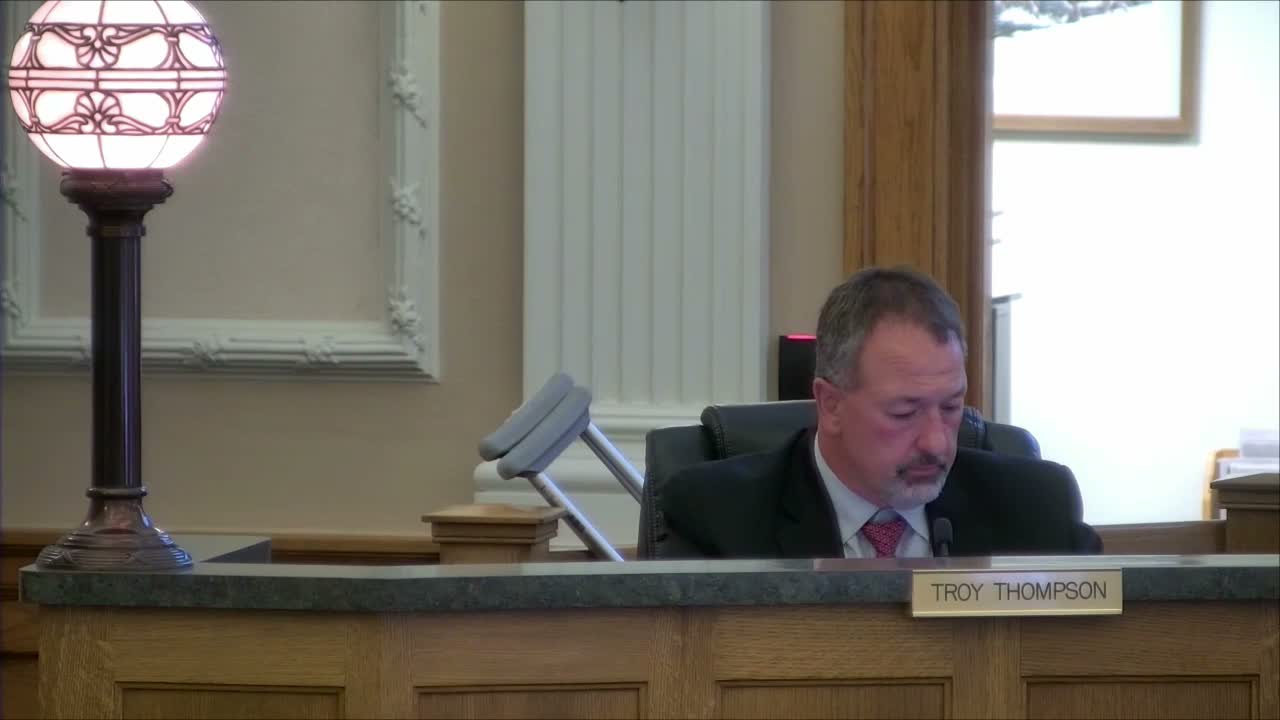
A motion to approve the site plan subject to those conditions was moved and seconded. Commissioners then debated possible additional, county‑level conditions (road‑use agreement with the county, aircraft‑detection lighting and IdentiFlight commitments, funding for the fire authority tanker, and water‑permitting through the State Engineer). An amendment to add a set of such conditions failed on a tied vote. The board then voted on the original motion. The motion failed; Acting Chairman Thompson voted in favor, while the majority of commissioners voted against approval. With that vote, the county did not issue a board‑level site‑plan approval that night.
What happens next: the developer said it intends to pursue the ISD process and other state reviews; developers also asserted that no significant construction would begin until ISD and other permits are in hand. County staff and legal counsel said they would draft formal findings of fact and conclusions of law to memorialize the hearing record and the board’s decision.
Public reaction split along property and policy lines: some local landowners and conservation advocates urged postponement until further study or recommended relocating turbines away from ridgelines and private boundaries; others — including some landowners who signed leases — urged the board to approve the plan, citing long‑term lease income and local economic benefits.
The board’s vote left open what conditions the county might seek later in the ISD process or in future applications. County staff told the board they will incorporate the hearing record and the agency comments into any follow‑up materials and will publish the legal findings once prepared.
Key quote from the hearing: “We have to make sure we’re not rubber‑stamping an industrial project without ensuring the county’s roads, water resources and wildlife are protected,” one commissioner said during deliberations. The applicant emphasized that decommissioning and road‑use financial assurances, and most wildlife mitigation requirements, will be enforced through state industrial‑siting and agency processes.
The project is likely to return to the public record via state ISD reviews and any revised county submittals. For now, the board declined to grant county site‑plan approval at this meeting.