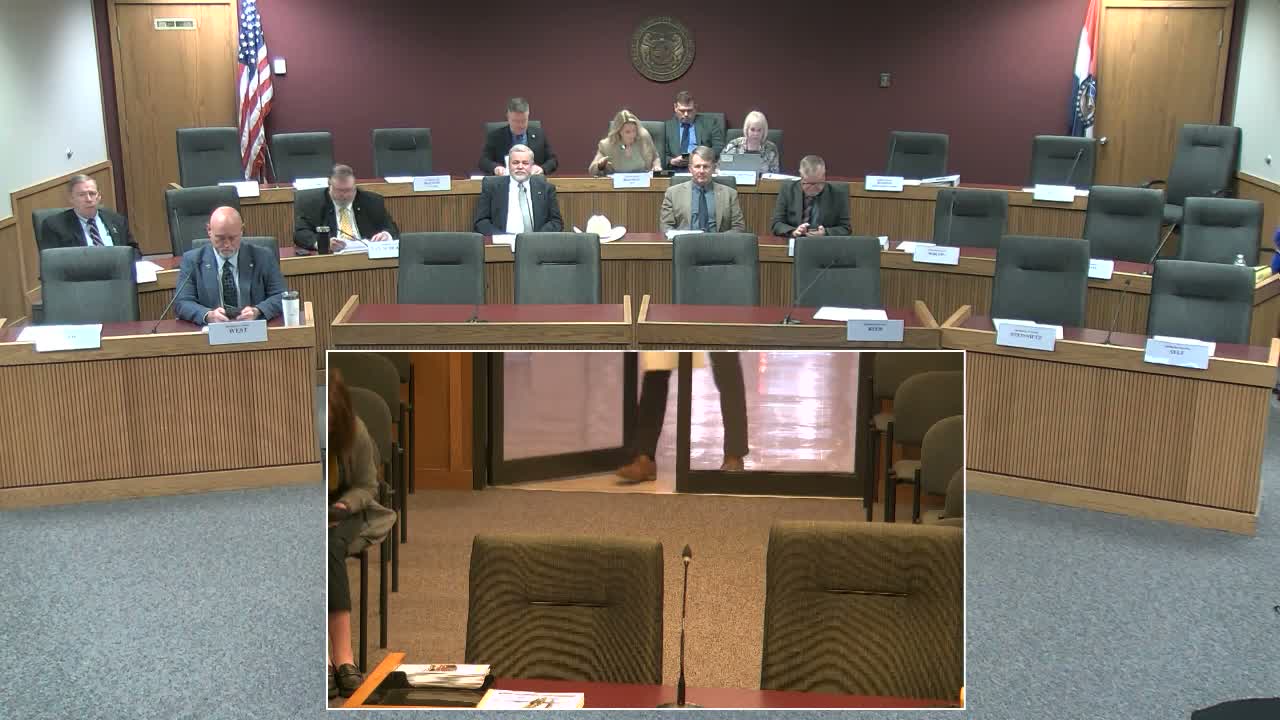
Committee hears bill to exempt long-term RV sites from state and local sales tax
Loading...
Summary
The House Committee on Government Efficiency heard testimony on House Bill 2809, sponsored by Representative Jeff Knight, which would exempt RV sites rented for more than 30 consecutive days from state and local sales tax. Supporters, including campground owners and business groups, said Department of Revenue rulings have created confusion and costly back-tax assessments; no vote was taken.
The House Committee on Government Efficiency held a public hearing on House Bill 2809, which Representative Jeff Knight said would exempt RV sites rented for more than 30 consecutive days from state and local sales tax. "If it's rented for 30 plus consecutive days, this bill would simply exempt them from the state and local tax," Knight told the committee.
The bill, Knight said, is intended to address what he described as a disparity under the state's "four walls" test that treats structures differently from recreational vehicles. "This is long term campground sites," Knight said in his opening remarks, and he yielded his time to witnesses to testify in favor of the measure.
Witnesses described a pattern of Department of Revenue rulings and audits that they said have created uncertainty for campground operators. Larry Helms, who identified himself as executive director of the Missouri Association of RV Park and Campgrounds, told the committee a DOR letter ruling (cited in testimony as letter ruling 8033, March 13, 2019) and a more recent revenue ruling prompted industry calls for a statutory fix. "She recommended a legislative fix to the issue that is in statute right now," Helms said, describing DOR guidance as the reason the bill was filed.
Industry witnesses and advocates said the ruling can produce retroactive tax bills and inconsistent treatment among campgrounds. Ray McCarty of Associated Industries in Missouri urged lawmakers to treat campgrounds for long stays the same way they treat hotels and motels. "The auditors come in and say, 'Well, you should have been collecting tax all along. Here's your tax bill,'" McCarty said, and he warned that such assessments can put small operators at a competitive disadvantage.
Witnesses offered economic context for committee members: Helms said monthly site rates commonly range from about $800 to $1,000 and overnight fees from roughly $40 to $55, and estimated that fixing the tax treatment could reduce a long-term occupant's costs by about $50 to $100 per month depending on region and amenities. Representative Smith asked about fiscal impact; Knight acknowledged there would be a fiscal effect but the transcript does not make the units or timeframe clear for the figures he cited (he referenced "less than $600" and "$5.47").
Committee members repeatedly cited operational confusion at the Department of Revenue about when a campground becomes a "place of recreation" and noted the practical consequences for Missouri businesses and customers. Representative Mayhew said the change was a "no-brainer" and urged the committee to move the bill forward; other members described cases where long-term visitors, including people training at nearby Fort Leonard Wood and traveling nurses, would benefit.
Kaina Eiman of the Missouri Canoe and Floaters Association recounted a case in which a campground was assessed roughly $30,000 in back taxes after auditors classified it as a place of recreation because of nearby water and on-site activities. "That's how crazy some of these settlements have been," Eiman said, and she told members that clarifying statute would prevent similar outcomes.
The committee did not vote on House Bill 2809 at the conclusion of the hearing and took no formal action during the session. Members indicated interest in a legislative fix to clarify how long-term RV sites are taxed and to reduce audit-driven disparities among campgrounds.
Next steps: the committee closed the hearing on House Bill 2809; any further action will depend on committee scheduling and any amendments or fiscal analyses requested by members.