Senate passes judicial nominating reform after debate; vote on special election timing fails
Loading...
Summary
The Oklahoma Senate approved HJR 10-24 to change the Judicial Nominating Commission’s composition and term rules after adopting an amendment to move a proposed vote date; a separate vote to order a special election on the resolution failed.
The Oklahoma Senate on the floor advanced House Joint Resolution 10-24, a proposed constitutional change to the Judicial Nominating Commission, after members adopted an amendment to move the state-question date but later rejected the measure's special-election provision.
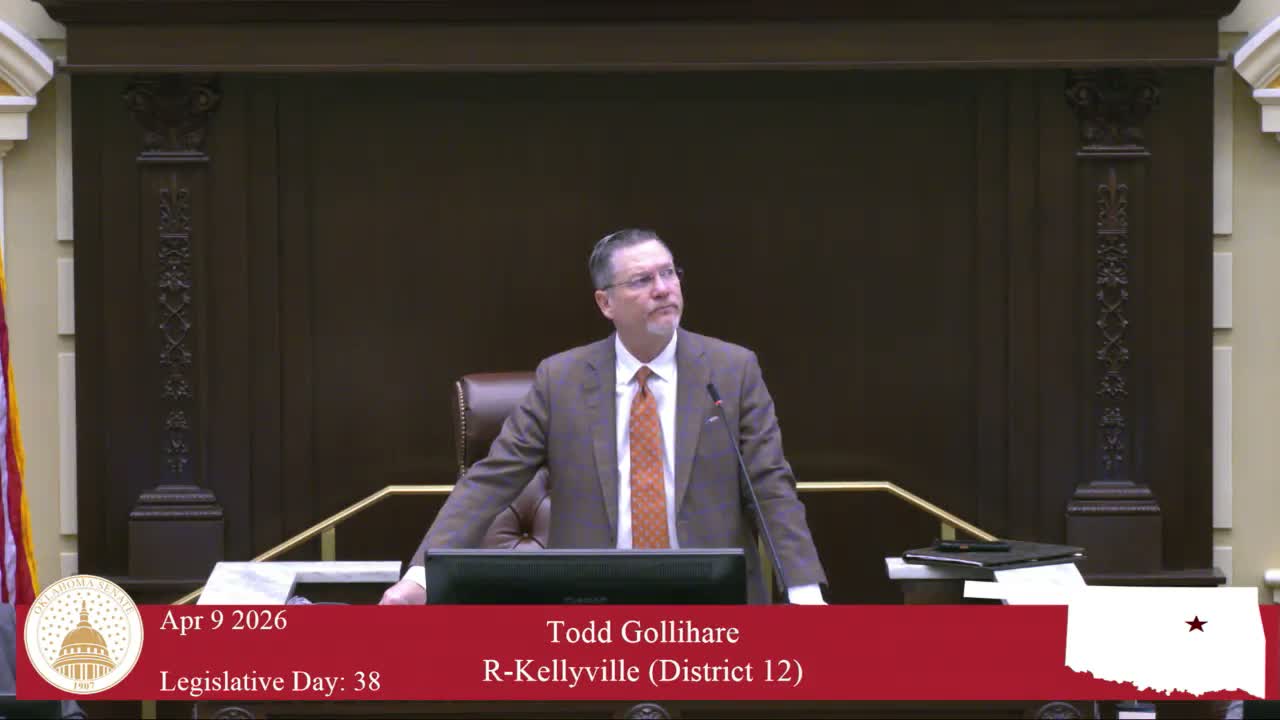
Senator Gollhardt, the resolution's author, said HJR 10-24 removes political-affiliation restrictions for commissioners, allows commissioners to serve consecutive terms (subject to a 12-year limit on consecutive service) and makes other membership adjustments. "This will allow experienced commissioners to serve longer and bring continuity to the selection process," Gollhardt said during explanation of the measure.
Opponents, led in floor debate by Senator Hicks and Minority Leader Kurt, said the changes risk increasing partisan influence and eroding safeguards meant to ensure judicial independence. "This amendment might look like an administrative update, but its consequences are profound," Senator Hicks said, arguing that removing prohibitions on attorney service and political-affiliation limits could "consolidate power" and reduce public confidence.
During consideration an amendment (Amendment 1) was adopted to set the special-election date to Aug. 25, 2026; the amendment passed on a roll-call vote of 39 ayes and 7 nays. After further debate, the full resolution as amended passed third reading by a roll-call vote of 35 ayes and 8 nays.
Under Article 24, Section 1 of the Oklahoma Constitution, the Senate separately voted on whether to order a special election to submit the proposed amendment to voters on the date set in the resolution. That special-election provision failed on the floor (27 ayes, 17 nays), and Senator Gollhardt gave notice he may move to reconsider that vote at a future time.
Supporters said the measure restores balance to a commission they described as skewed by past composition rules; supporters also said some restrictions limited the governor's ability to vet nominees. Detractors countered that allowing more attorneys and loosening affiliation limits could produce perception or reality of conflicts and reduce transparency.
Because the special-election provision failed on the floor, the timetable for submitting HJR 10-24 to voters remained unresolved at the close of the session and may be revisited if the author pursues reconsideration.
The chamber moved to its next agenda items after the vote.