Get Full Government Meeting Transcripts, Videos, & Alerts Forever!
Get email alerts on the Budget Tentative topic
No spam. Unsubscribe anytime.
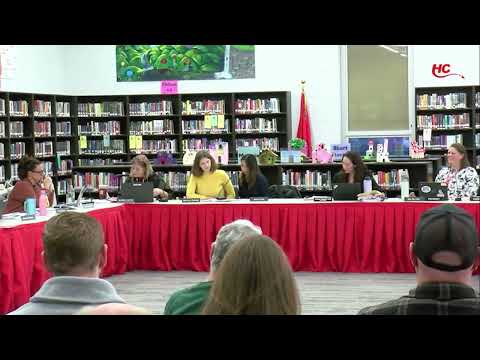
Hunterdon Central board hears tentative budget, public faults $29.1 million capital reserve as members spar over 3% levy request
Summary
Business administrator Heather Spitzer and Superintendent Jessica Candelosi Haid presented a tentative 2026'27 budget that would sustain programs and ask for a 3% tax-levy increase; residents and some board members pressed administration over a $29.1 million capital-reserve balance and recurring surpluses that they say could reduce the tax ask.
Heather Spitzer, the district's business administrator, and Superintendent Jessica Candelosi Haid laid out the Hunterdon Central Regional High School District's tentative 2026'27 budget at the board's March meeting, stressing program preservation amid declining state aid and rising health-benefit costs.
Spitzer said state aid for the district fell by about 0.15 percent (roughly $7,246) but that the tentative budget maintains academic and co-curricular programs while adding two new magnet programs and a 1+1 pathway with Raritan Valley Community College for the Biomedical Sciences Academy. "We can raise the tax levy to 5.73% without going out for vote," Spitzer said, adding that administration recommended a smaller approach: "I am making the recommendation to increase the tax levy by 1 additional percent over the cap or 3% total." (Presentation and fiscal detail were provided to the board as attachments.)
Board members questioned the accounting and the administration's reliance on reserves. Superintendent Candelosi Haid and Spitzer described the district's budgeting strategy as multi-year planning that uses unrestricted and restricted surplus, legal reserves for capital and maintenance, and reimbursements from State ROD grants (up to 40% of eligible costs). Spitzer outlined an $11.6 million list of capital projects included in the tentative budget and said the district expects a partial reimbursement from the state of about $3.5 million tied to earlier ROD grants.
Multiple board members raised procedural and oversight concerns during the question period, including whether the board had adequate time and access to documents required by policy 6220 during budget preparation. Several members asked for additional reconciliation on attorney invoices and other financial details before approving a larger tax increase.
Public comment focused heavily on the district's capital-reserve balance. Esther Mordecai, who identified herself from Flemington, summarized available figures and argued the board should explain recurring surpluses: "Over the past 8 years, the district has increased the tax levy from $51.6 million to $61.2 million, while the capital reserve balance has increased from $14.6 million to $29.2 million," she said, urging transparency on whether budgeting practices are producing recurring surpluses that could be returned to taxpayers.
Other residents echoed concerns that reserves have grown faster than the levy, that enrollment has declined roughly 22 percent since 2019, and that relying on surpluses rather than returning funds to taxpayers is fueling distrust. Several commenters suggested that the board sharpen the budget request, explore administrative efficiencies and consider using more of the reserve balance to reduce the immediate tax impact.
At the meeting's business portion, Board Member Santangelo moved to amend the tentative budget, reducing the general fund tax levy by $1,835,747 (and eliminating the $611,916 health-benefit adjustment). The motion failed by roll call. The board then proceeded to approve multiple consent items (personnel appointments, contracts and other committee recommendations) and scheduled an April public hearing on the final budget.
The board closed the meeting by moving to executive session to address HIB reports, personnel matters and potential litigation; it expected action after executive session and set the final budget public hearing for April 27 in the IMC.
What happens next: the district will post additional financial detail ahead of the formal public hearing on the final budget; the board must adopt a final budget by statute in the coming weeks.