Farm groups and independent cattlemen clash with Farm Bureau and Chamber at long HCR 29 hearing on country-of-origin labeling
Loading...
Summary
Supporters of mandatory country-of-origin labeling (COOL) urged the committee to send a resolution to Congress; opponents including the Missouri Farm Bureau, Chamber of Commerce and Missouri Pork Association argued COOL is costly and voluntary labeling should be used. Testimony included farmers, consumer advocates and industry groups on both sides.
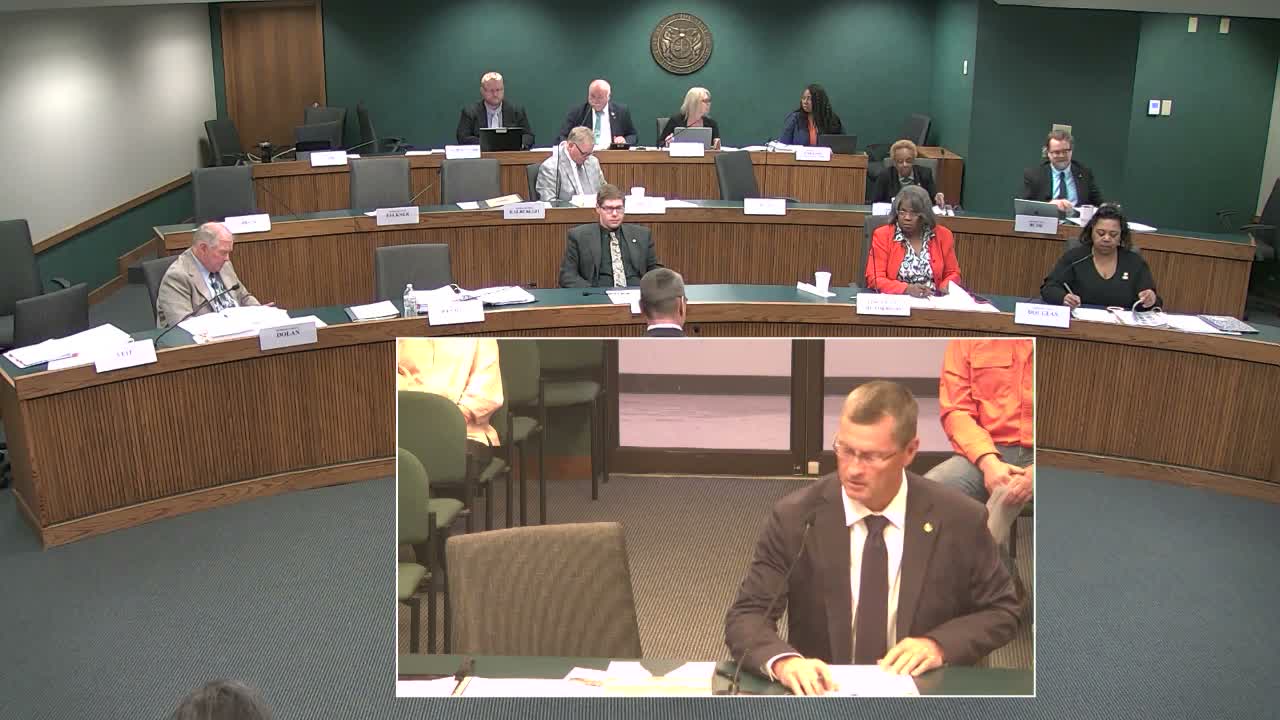
The Committee on Corrections and Public Institutions heard more than three hours of testimony April 8 on House Concurrent Resolution 29, which urges Congress to restore mandatory country-of-origin labeling for beef and pork.
Representative Elliott introduced HCR 29 as a consumer-transparency and farmer-support measure. Proponents—ranging from statewide farm groups to independent cattlemen—testified that mandatory labeling (COOL) previously raised prices paid to producers, gave consumers accurate purchase information and helped family farms compete. Jamie Blair of the Missouri Rural Crisis Center said imports of boxed beef rose in 2025 and that mandatory labeling helped prices paid to U.S. producers when it was in effect; Freddie Keaton and Ben Thomas of independent-cattlemen groups described COOL as a tool to differentiate American product and rebuild market signals for producers.
Opponents argued the policy is divisive and has imposed regulatory costs in the past. Mark Faganbaum of the Missouri Farm Bureau said economic studies showed mandatory COOL increased industry costs and did not produce sufficient consumer demand; he said his organization prefers a voluntary, market-driven approach. Chance Hepla of the Missouri Chamber of Commerce echoed concerns about signaling to Congress and adding regulatory burdens. The Missouri Pork Association registered opposition in testimony.
Committee members questioned witnesses about trade implications, how labeling would be implemented at processing plants, the practicality of tracking and segregation across the supply chain, and the treatment of blended ground beef. Witnesses who support COOL said infrastructure and identification (ear-tags, brands, port-of-entry markings) already exist and that USDA rules (7 CFR Part 65) provide precedent for labeling other commodities. Opponents cited prior WTO disputes and academic analyses indicating economic costs. Several independent producers testified they had organized grassroots support and brought petitions and signatures to the committee.
No committee vote was taken; the hearing record contains detailed exchanges about how mandatory labeling would be enforced at packers and on mixed products such as ground beef. The committee closed the HCR 29 hearing and moved on to other agenda items.