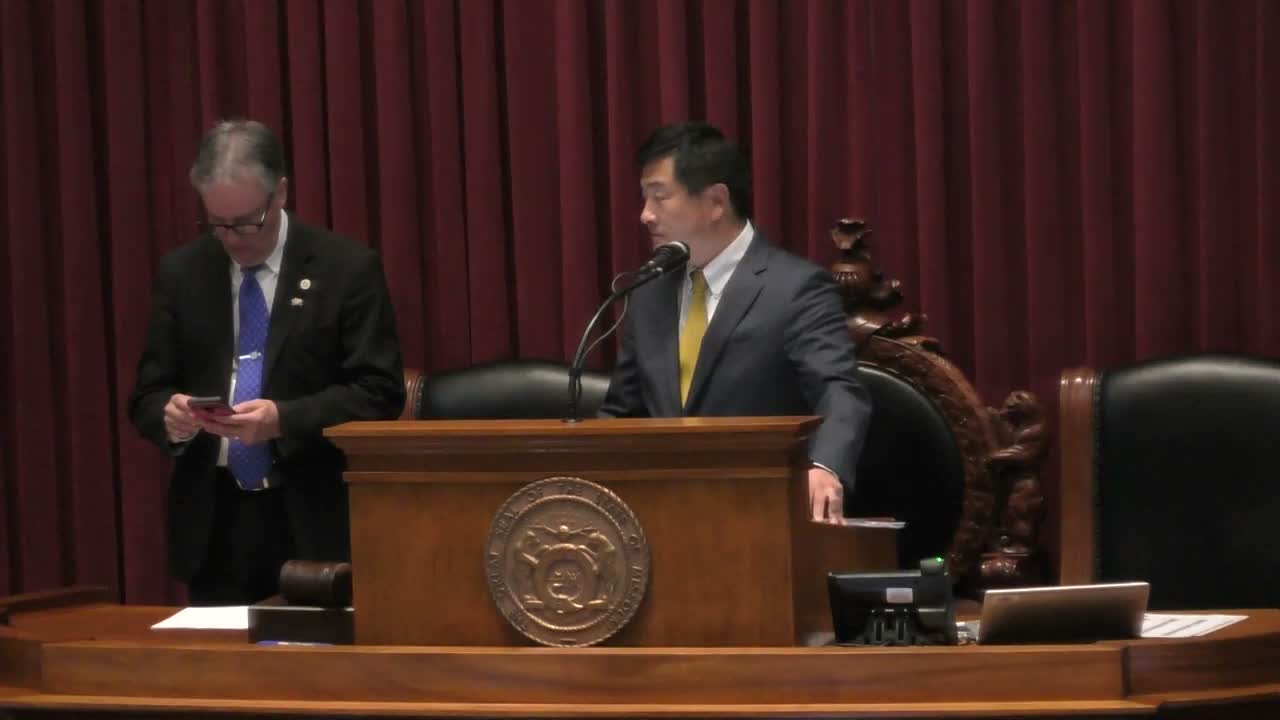
Missouri House passes SNAP verification and nutrition changes after dispute over costs and access
Loading...
Summary
House Committee Substitute for House Bill 2481 passed after floor debate over fraud prevention, verification and program access. Supporters said the bill aligns state rules with federal law and improves nutritional standards; opponents warned it would add burdens and cited a $1,000,000 enforcement cost claim.
The Missouri House approved a committee substitute for House Bill 2481 on April 8 after extended debate about verification, fraud prevention and allowable purchases under SNAP.
The bill sponsor, the representative from Christian County, said HCS HB2481 reinforces consistency with federal law, strengthens verification, and encourages purchases of healthier foods while directing the Department of Social Services to seek a federal waiver. “This is about better outcomes for families, for the better use of public dollars,” he said, and emphasized the measure does not eliminate emergency services.
Opponents, including a representative from Jackson County, said the bill targets low-income Missourians and would add barriers to accessing benefits. On the floor a member asserted the proposal would cost taxpayers $1,000,000 to search for fraud; supporters countered with anecdotes of large local fraud prosecutions and said enforcement targets providers rather than recipients. A former police officer from Cape Girardeau recounted a local case in which a store’s scheme involving SNAP cash-outs resulted in more than $800,000 in losses and prosecution, arguing that fraud exists and the bill helps address it.
Supporters said the measure clarifies permissible purchases (emphasizing staples like flour, eggs and milk) and aims to strengthen program integrity without denying crisis assistance. Critics said the likely result would be more red tape and harder access for vulnerable residents.
The House voted to end debate and later recorded a final tally (yeas 95, nays 44) for third reading and passage of the committee substitute.
Next steps: with House passage the bill proceeds to the Senate (or to conference if changes are required). Implementation will depend on guidance from the Department of Social Services and any federal waivers the department pursues.