Get Full Government Meeting Transcripts, Videos, & Alerts Forever!
Get email alerts on the Transportation Safety topic
No spam. Unsubscribe anytime.
Public commenter urges Denver City Council to require speed tables after East Avenue safety study
Summary
David Minster told the council the East Avenue Safety Study recommended installing speed tables every four blocks on 13th, 14th and 17th Avenues, citing projected reductions in deaths and crashes and urging the council to mandate DOTTI follow the study and dedicate enforcement revenue to high-risk streets.
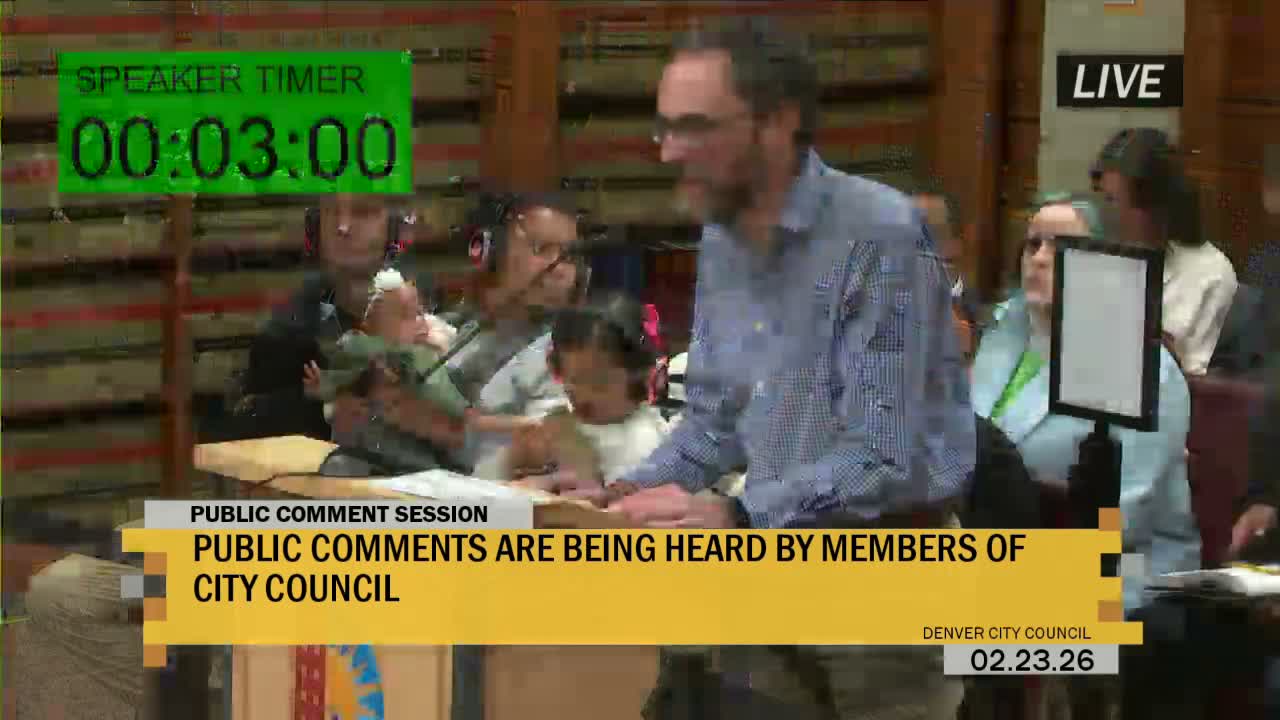
David Minster urged the Denver City Council on Feb. 23 to require the city’s transportation agency to carry out recommendations from the East Avenue Safety Study, including installing speed tables every four blocks on 13th, 14th and 17th Avenues.
Minster, speaking during the council’s half-hour public comment period, said the study found that speed tables “would prevent on average 2.6 deaths, 117 injury crashes, and 335 property damage crashes every 5 years.” He told the council the work would cost about $800,000 and compared that figure to typical traffic-signal installations.
“Rather than finding drivers who speed on a road that encourages speeding, let’s fix the road to prevent speeding to begin with,” Minster said, urging the council to “pass a bill that requires DOTTI to implement all East Avenue safety recommendations” and to mandate that automated-speed-enforcement revenue be directed to the most dangerous streets.
Minster described the city’s current engineering responses—such as posts and signal retiming—as insufficient for reducing high-speed crashes on those arterials. He said the study’s authors recommended more robust vertical treatments and noted that other cities have used speed tables on high-volume arterials successfully.
He also criticized what he called a pattern of safety projects being canceled after opposition from well-resourced interests, saying the council should take legislative steps if necessary. The comment period ended without a response from councilmembers; staff may follow up with speakers after the meeting.
The council did not take action during the Feb. 23 public comment session. Minster’s request would require legislative or administrative steps to become policy and, if pursued, would be considered in future committee or council proceedings.