Get Full Government Meeting Transcripts, Videos, & Alerts Forever!
Get email alerts on the State Legislation topic
No spam. Unsubscribe anytime.
Denver lobby team previews key state bills on housing, transit finance, surveillance and budget
Summary
The mayor’s lobby team and city agencies briefed council on several priority state bills, including the HOME Act (land-use preemption for certain nonprofits), a Transit Investment Area Act with tax-increment-like financing and a pair of surveillance bills (Pepys Act and SAFE Act); staff said Denver generally is in 'amend' or 'monitor' positions while seeking clarifications and technical adjustments.
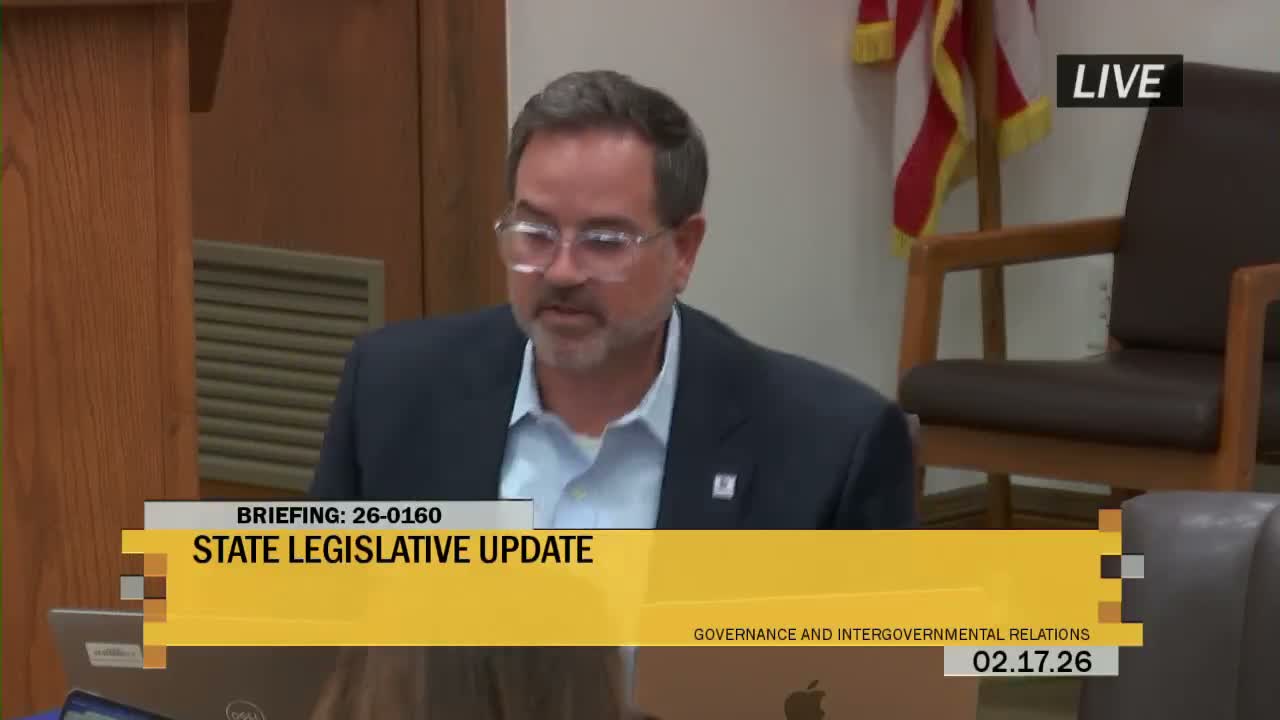
Denver’s mayoral office and lobby team on Feb. 17 presented a high-level preview of major state bills affecting housing, transit finance, surveillance and the state budget, asking council members for early feedback as agencies complete internal reviews.
Adam Paul of the mayor’s office introduced the items and said staff were tracking about 150 bills this session, with five bills in support, one opposed, four in amend and four in monitor positions at the time of the briefing. He and Policy Matters lobbyists outlined several bills that Denver has identified as priorities or concerns.
On housing, staff discussed House Bill 1 (the HOME Act, formerly Yigby), which would require local governments to allow residential development on qualifying properties owned by certain nonprofits, school districts, state colleges, housing authorities or transit authorities. Kyle Dalton of the Department of Community Planning and Development said the city recommended a number of technical and substantive amendments, including clarifications on how to measure a nonprofit’s five-year development history, concerns about preemption of local smart-growth elements and administrative questions about proof of nonprofit qualifications.
On transit finance, staff described HB 1065 (the Transit Investment Area Act), which would let local governments designate transit investment areas and use a portion of increased state sales tax revenue in those zones to finance transit projects for up to 30 years. The bill also authorizes a new $50 million annual affordable-housing tax credit from 2027 through 2033. CPD recommended six specific amendments, such as limiting funding for parking, requiring transit-supportive zoning and ensuring representation of planning and housing experts on any financing authority board.
Surveillance and privacy bills drew intense questions. Staff summarized a bill labeled the Pepys Act that would restrict government access to license-plate reader data with tight retention limits (cutting Denver’s 30-day retention to 4 days) and narrow exceptions for warrants, consent, stolen-vehicle waivers and exigent circumstances. The SAFE Act, by contrast, would more broadly regulate surveillance technologies including facial recognition and drones and generally requires jurisdiction-level policies and warrants for some uses. Agency feedback is ongoing and the city has not finalized positions.
Budget issues: lobbyists briefed council on supplemental and figure-setting developments at the Joint Budget Committee, including proposed provider rate cuts to Medicaid that would affect city providers and a controversial state proposal for county centralization/regionalization of benefit administration; those proposals were noted as tabled or under revision to allow county engagement.
Council leadership said staff would circulate more detailed agency feedback and asked councilmembers to update their tracker positions so the city and mayor’s office can finalize official city stances. Several items, including HB 1065 and the HOME Act, are in an amend position pending the six or more technical changes staff requested.