Get Full Government Meeting Transcripts, Videos, & Alerts Forever!
Get email alerts on the Data Privacy topic
No spam. Unsubscribe anytime.
Denver safety, regulatory staff warn proposed ban on government purchase of third-party personal data would harm investigations
Summary
Denver public-safety and other city agencies told the committee a proposed state bill to prohibit government purchase or exchange of third-party personal data would sharply limit investigative tools such as Leads Online and could disrupt programs that helped cut catalytic-converter thefts; DPD cited use of such tools in as many as 20% of arrests in 2025 and nearly 50% of investigative cases.
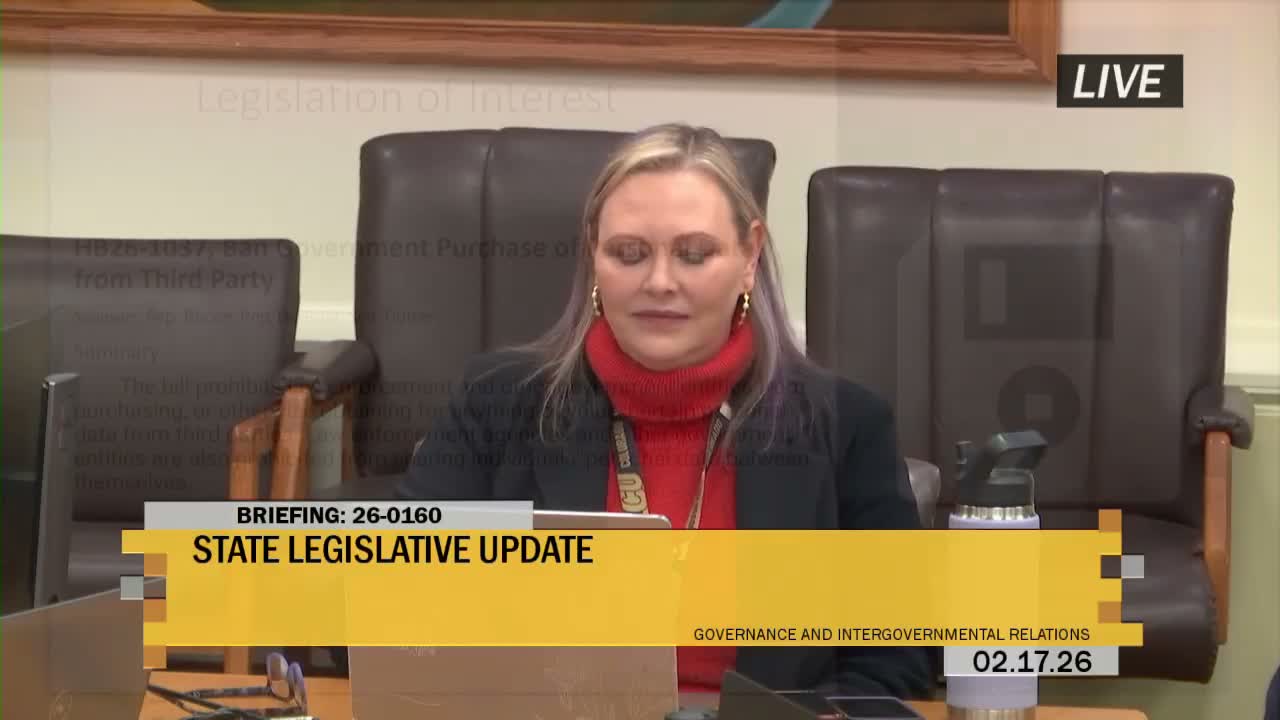
Denver public safety and agency officials told the Governance and Intergovernmental Relations Committee on Feb. 17 that a proposed state bill banning government purchase or exchange of certain third-party personal data could significantly hinder investigations and city programs.
Cliff Barnes, commander of the Denver Police Department’s cyber bureau, said the bill as written was broad and would restrict tools investigators currently use. “We leverage these tools in in nearly 20% of all arrests that we made in in the year of 2025,” Barnes told the committee, and he said the percentage approaches 50% for cases that go to an investigator. He warned that losing contractual access to vendors would shift investigations from immediate operational capability to a slower legal process.
Council members flagged concrete local impacts. Chair Amanda Sawyer noted Denver laws that rely on Leads Online — a pawnshop/secondary-market database — would be affected; she said the city’s catalytic-converter enforcement using that database drove the theft rate “to almost 0% last year.” Council members and agency staff said the bill’s blanket prohibition on exchanging “anything of value” for data could prohibit both paid subscriptions and reciprocal data arrangements (for example, some crash-report services exchange anonymized data rather than direct payment).
Mayor’s office lobbyists and agency heads described a split among councilmembers about whether to seek amendments or oppose the bill outright. Several councilmembers said they were skeptical amendments could adequately protect ongoing public-safety, parking, housing and other agency functions while meeting the bill sponsor’s intent to limit commercial surveillance.
Why it matters: the committee was told multiple Denver programs — criminal investigations, catalytic-converter enforcement, scrap-metal regulation and some human-services data exchanges — depend on third-party data feeds or vendor tools. Agency witnesses urged caution in committing to a blanket oppose-or-support stance and asked council to consider agency feedback as they finalize a city position.
Next steps: staff asked councilmembers to update internal tracking of positions; the committee did not register a final city position but urged members to weigh agency comments in advance of state committee hearings.