Get AI Briefings, Transcripts & Alerts on Local & National Government Meetings — Forever.
Arizona Senate advances package of House bills, adopts committee reports and passes multiple measures
Loading...
Summary
On April 1, 2026, the Arizona State Senate moved a series of House bills through committee and on third reading, adopting committee amendments where noted and recording roll‑call tallies on multiple measures. Bills included changes to property tax exemptions for disability determinations, insurance modeling rules, school reporting and other measures.
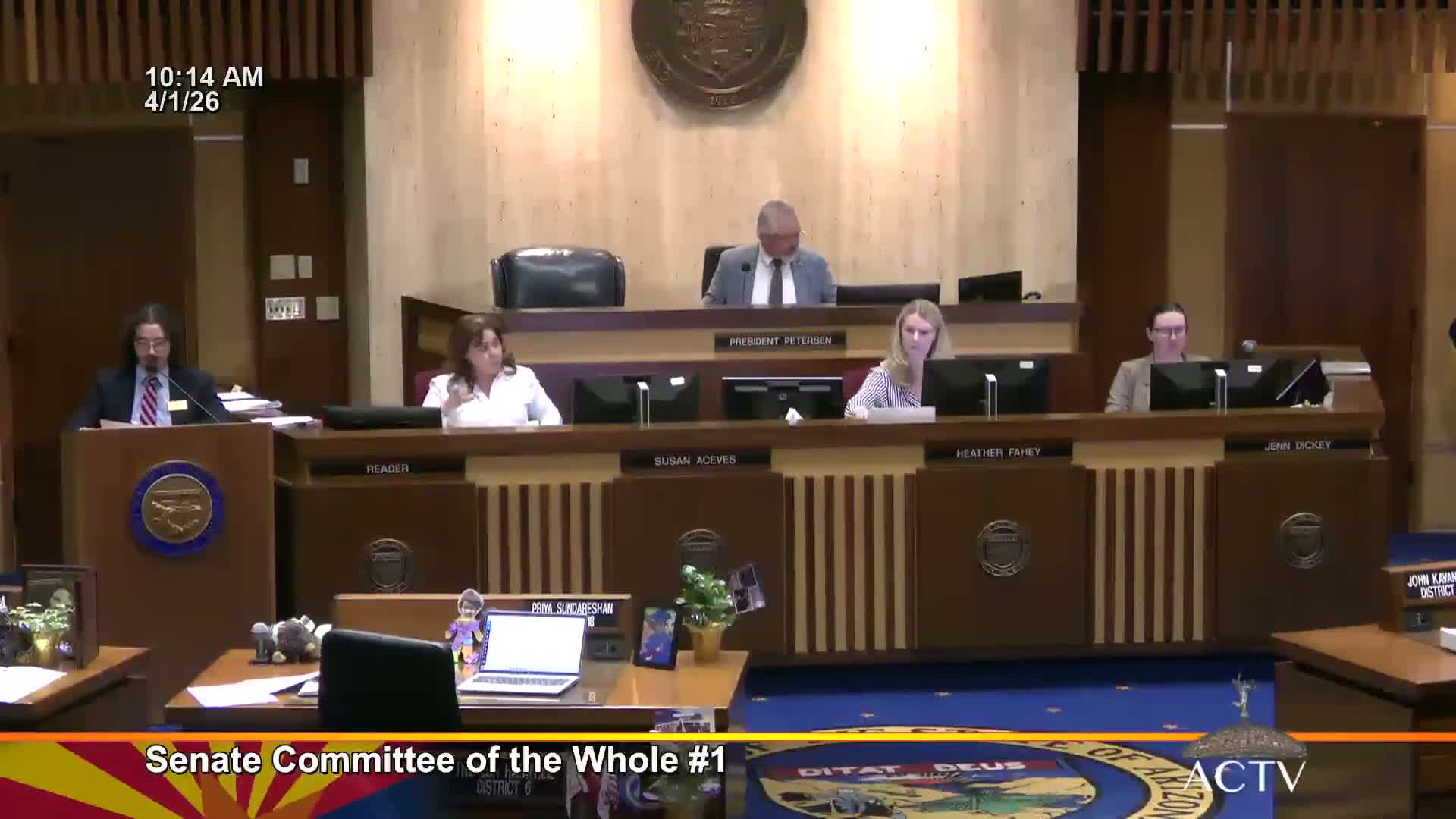
The Arizona State Senate on April 1, 2026, convened and approved a package of House bills after Committee of the Whole consideration, adopting committee amendments where offered and recording floor votes on multiple measures.
Several bills received committee amendments and were reported to the floor. The Finance Committee recommendation to amend House Bill 21‑20, which modifies property tax‑exemption procedures to allow applicants to rely on Social Security Administration disability determinations, was adopted and the committee moved the bill forward as amended. Senator Epstein, explaining a later floor vote, said the bill “does make it easier for folks who are applying for a tax exemption due to a disability” and that the Social Security standard is sufficiently stringent to help applicants (Senator Epstein).
The Senate also advanced HB 21‑74, concerning insurance modeling and data organizations, with the Finance Committee amendment adopted in committee and the committee’s do‑pass recommendation agreed on the floor. Senator Epstein opposed the bill on the floor, arguing the measure “removes protections for not only consumers but protections for markets and for competition in the markets” by limiting the Department of Insurance and Financial Institutions’ authority to examine model providers (Senator Epstein).
Other measures that received do‑pass recommendations and passed in the session included HB 22‑89 (truth‑in‑taxation bond notices), HB 28‑61 (postnuptial agreements), HB 29‑03 (prohibiting undefined “social credit” use by banks and financial institutions), and multiple education bills reported by the Committee on Education (including HB 20‑08, HB 20‑40, HB 20‑75, HB 22‑03, HB 22‑55, HB 23‑83). Several bills required and received additional votes or supermajority tallies where constitutionally required.
A floor amendment to HB 20‑75, offered by Senator Diaz to expand certain employment contract disclosure requirements to charter schools and private schools receiving ESA (Education Savings Account) funds, was debated on the floor and rejected. Senator Diaz argued the amendment would ensure transparency across all education providers and cited “recent reports of over $10,000,000 of misspending in the ESA voucher program” as motivation for the change (Senator Diaz). The underlying bill then received a do‑pass recommendation.
On third reading, the Senate recorded roll‑call tallies for multiple House bills. Examples from the floor record include HB 20‑57 (passed with 17 ayes, 10 nays, 3 not voting), HB 21‑31 (passed 19 ayes, 8 nays, 3 not voting), and HB 22‑23 (passed 27 ayes, 0 nays, 3 not voting). Where senators rose to explain votes, they spoke briefly for the record.
The Committee of the Whole’s report listing recommended actions was delivered by Frank Carroll, chairman of the committee, and the Senate adopted the committee’s report and assigned bills to their proper places for final processing.
The session also included ceremonial business: senators introduced guests from the Arizona Psychiatric Society, and the chamber read a lighthearted proclamation recognizing tradition in ceremonial attire and honoring the sergeant at arms. The Senate adjourned to reconvene on April 2, 2026, at 10 a.m.
Votes at a glance
- HB 20‑57 — Passed (third reading): 17 ayes, 10 nays, 3 not voting. - HB 21‑31 — Passed (third reading): 19 ayes, 8 nays, 3 not voting. - HB 22‑23 — Passed (third reading): 27 ayes, 0 nays, 3 not voting. - HB 22‑64 — Passed (third reading): 20 ayes, 7 nays, 3 not voting. - HB 28‑57 — Passed (third reading): 27 ayes, 1 nay, 2 not voting. - HB 21‑20 — Passed (third reading): 28 ayes, 0 nays, 2 not voting (committee amendment adopted earlier). - HB 21‑74 — Passed (third reading): 18 ayes, 10 nays, 2 not voting (committee amendment adopted earlier). - HB 22‑89 — Passed (third reading): 17 ayes, 11 nays, 2 not voting. - HB 28‑61 — Passed (third reading): 29 ayes, 0 nays, 1 not voting. - HB 29‑03 — Passed (third reading): 17 ayes, 12 nays, 1 not voting. - HB 20‑08, HB 20‑40, HB 20‑75, HB 22‑03, HB 22‑55, HB 23‑83 — Passed as recorded; see journal for roll‑call details.
Why it matters
The package moved on April 1 covers a mix of policy areas including tax‑exemption rules that affect disabled Arizonans, insurance regulation changes that drew consumer‑protection concerns, multiple education bills affecting school operations and reporting, and banking‑sector restrictions on undefined “social credit” practices. Several bills prompted recorded explanations of vote that laid out policy rationales and objections for the legislative record.
What’s next
Passed House bills will be transmitted to the House (and subsequently to the governor as appropriate). Committee follow‑ups and any required implementing actions will be handled as the bills proceed through enrollment and transmittal steps.
Sources: Arizona State Senate floor proceedings, April 1, 2026 (floor record and roll calls).