Oversight committee outlines bills to tighten child-welfare reporting, tribal coordination and investigative practice
Loading...
Summary
Committee leaders described a slate of bills born from stakeholder work after three child fatalities, including a tribal memorandum of understanding, school‑records access for caseworkers, tightened mandatory‑reporting language, expanded hotline review, and a 72‑hour advanced forensic‑interview requirement.
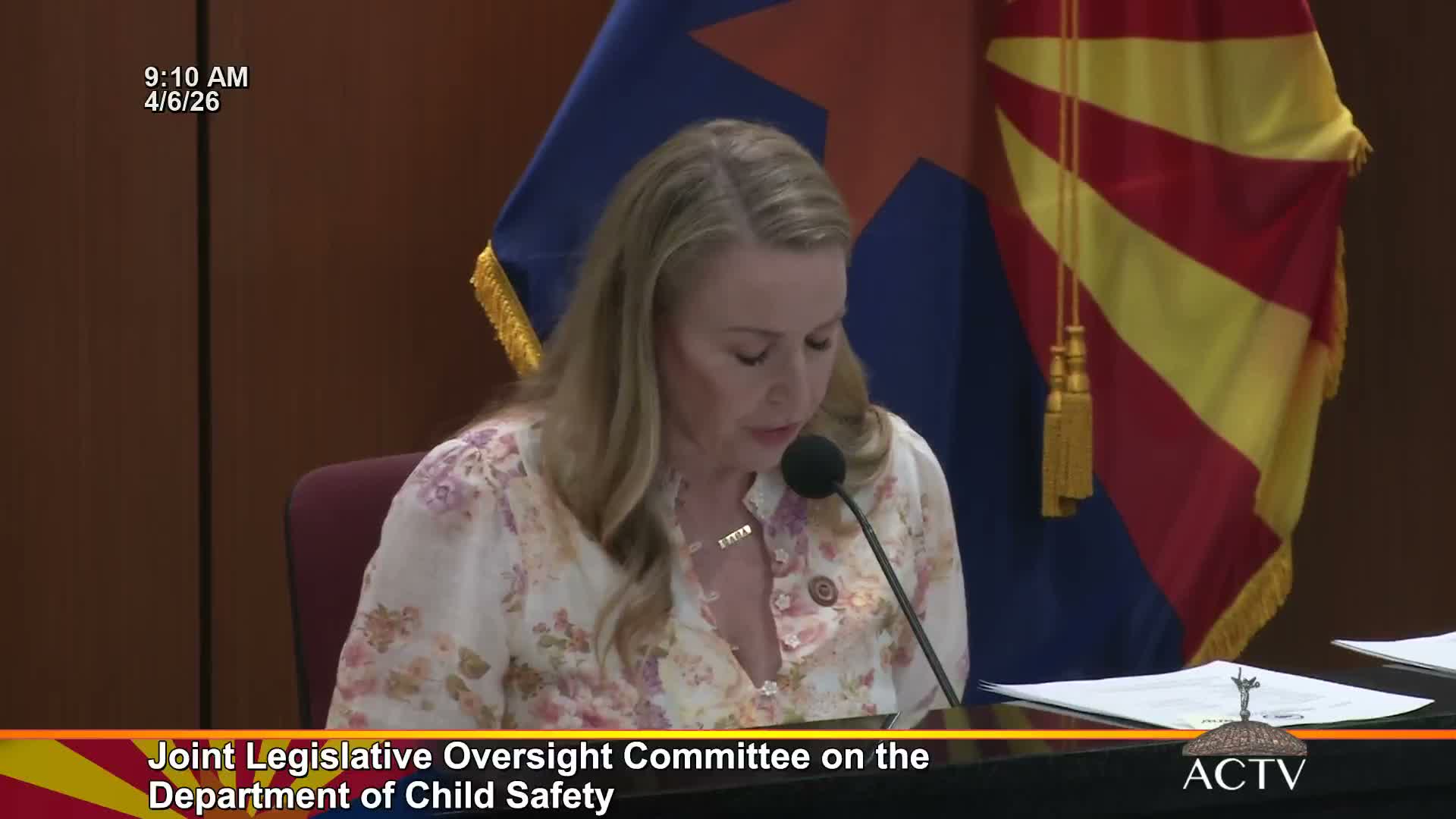
The joint legislative oversight committee on the Department of Child Safety heard an overview of bills aimed at improving information sharing and investigative practice after three high‑profile child fatalities.
Committee leadership said one measure signed by the governor (referenced in testimony as SB 11 25) creates a memorandum of understanding to improve information flow between tribes and DCS when a tribal member enters state care. "What happened to Emily Pike was tragic. Actually, it was horrific," the committee chair said, describing gaps in communication that the MOU is intended to address.
Lawmakers outlined additional legislation introduced this session. A bill referred to as "11/26" would require school districts to provide DCS caseworkers with records related to a student under investigation; sponsors said the change grew from instances when caseworkers were not given timely school information. Another measure, called "1127," would clarify mandatory‑reporting rules so that the person with direct knowledge — the teacher, clinician or hospital worker who actually saw injuries or decline — can provide the hotline with usable answers necessary to start a case.
The committee also discussed intake and investigative‑practice bills. "1174" would route reports involving siblings or multiple referrals to more experienced staff and allow investigators to review 90 days of prior hotline calls when assessing whether a situation meets the threshold for action. "1175" would require DCS caseworkers to take and retain intake photographs to enable longitudinal comparison for signs of decline. Lawmakers described "1496" as a limited change allowing attorneys to share additional safety information with judges without breaching confidentiality, and "1631" would mandate an advanced forensic interview within 72 hours after abuse allegations except when a child is unavailable for legitimate medical or behavioral reasons.
DCS Director Catherine Ptak said the bills respond to findings from fatality reviews and stakeholder meetings that included tribes, county attorneys, law enforcement and school staff. "We also learned that there are really three areas when it comes to the children that are in state care: DCS and their caseworkers, the attorneys that represent children and parents, and the judges — we know the reforms need to happen in all three areas," Ptak said.
Several members questioned implementation details. Representative Bliss asked whether changes could be handled internally or required statutory updates; Ptak said some items will be addressed through internal rulemaking (for example, removing the terms "runaway" and "AWOL" in favor of the neutral term "missing"), while other changes are proceeding as legislation. On timing, Ptak acknowledged ambiguity in statutory language that says reports must be made "immediately" or "within 24 hours," and said discussions with law enforcement continue.
The committee took no formal votes at the hearing. Members said they expect continued work through the interim and next legislative session and requested further updates from DCS as the bills move through the process.