Get Full Government Meeting Transcripts, Videos, & Alerts Forever!
Get email alerts on the Immigration Enforcement In Schools topic
No spam. Unsubscribe anytime.
Prince George's County board details policy to limit immigration-enforcement interactions; principals may shelter in place within 1,000 feet
Summary
Prince George's County Board of Education discussed a proposed policy to limit staff interactions with immigration enforcement and protect students, including an amendment allowing principals to use professional judgment to initiate shelter-in-place if agents are within 1,000 feet of school property. Community group We Are Casa urged immediate implementation.
Denise Douglas, associate superintendent of communications and engagement for Prince George's County Public Schools, opened a public meeting to discuss a proposed board policy on how district staff should interact with immigration enforcement agents. Douglas said the policy is meant to "protect students" and to help students and staff feel supported.
Board chair Brandon Jackson framed the policy as a measure to keep schools safe for every child, acknowledging that uncertainty around immigration enforcement creates fear for many families. "Our school system must be a safe place," Jackson said, and he turned the discussion over to board member Amy Olivo to describe the policy's provisions.
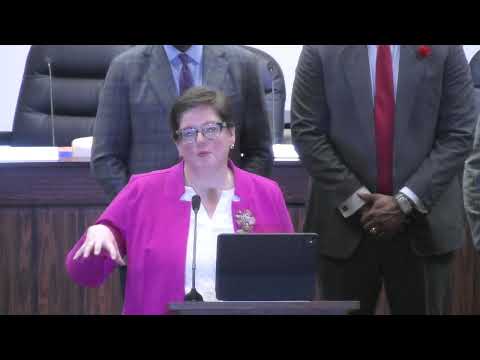
Board member Amy Olivo, vice chair of the policy and governance committee, described the policy as grounded in the Maryland Values Act and said it establishes strict boundaries to keep school property, classrooms, buses and instructional spaces private and secure from "unauthorized interference." Olivo said the policy authorizes schools to enact a shelter-in-place protocol if immigration enforcement is on school property and that the board will consider an amendment to allow principals to use their professional judgment to initiate shelter-in-place if enforcement is within 1,000 feet of school property. "We will allow principals to use their professional judgment to go into shelter in place protocol if immigration enforcement is within 1,000 feet of school property," Olivo said.
Olivo added the policy prohibits school safety and law enforcement partners from acting as immigration agents and said the district will provide resources for family safety planning and legal guidance. She said the policy text and the 1,000-foot figure reflect deliberation over months of committee work and learning from incidents in other jurisdictions where enforcement has positioned itself just outside school property lines.
Interim superintendent Shawn Joseph described the climate around immigration enforcement as creating fear that undermines students' ability to learn. Joseph said shelter-in-place procedures involve accounting for students and securing interior and exterior doors; he said families are typically notified after an incident is resolved and the district issues a statement explaining why the protocol was used. "When a shelter in place happens, we notify the families after because it's an immediate occurrence," Joseph said.
Joseph said the principal or a designated school leader would coordinate with the district legal team and security staff during an incident and that law enforcement is not automatically required but may be contacted if necessary.
Representatives from We Are Casa supported the proposal. Shannon Wilkes, director of education at We Are Casa, thanked Olivo and said the policy was created in consultation with people most directly affected; Wilkes said chronic fear of deportation prevents students from fully participating in school. Austin Asato, a We Are Casa member and county resident, described personal worry about his children's safety at school and urged immediate approval and implementation of the protective policy.
When asked whether the district had experienced enforcement attempts to enter school buildings, Olivo said she was not aware of attempts to enter buildings but said immigration enforcement had been present at drop-off and dismissal locations in some board members' districts, which motivated a proactive approach. On whether the policy could be legally challenged, Olivo said the district's office of general counsel reviewed the proposal and the committee worked through months of consultation; she said any policy could face challenge but the board is confident in its review process.
The transcript does not record a formal vote or final board action on the policy in the excerpt provided. The board presented the amendment and details and opened the floor to media questions and public comment; next procedural steps and any vote were not included in the recorded segment.