Get Full Government Meeting Transcripts, Videos, & Alerts Forever!
Get email alerts on the Climate Policy topic
No spam. Unsubscribe anytime.
City administrator briefs council on Climate Commitment Act; Enumclaw just over threshold and faces rising compliance costs
Summary
City Administrator Chris Searcy told the council that Enumclaw's municipal gas utility is marginally over the Climate Commitment Act threshold (roughly 25,000 metric tons), explained allowance mechanics and customer bill impacts, and sought future policy guidance on options including alternative compliance pathways with Ellensburg and whether to pursue legislative relief or grant funding.
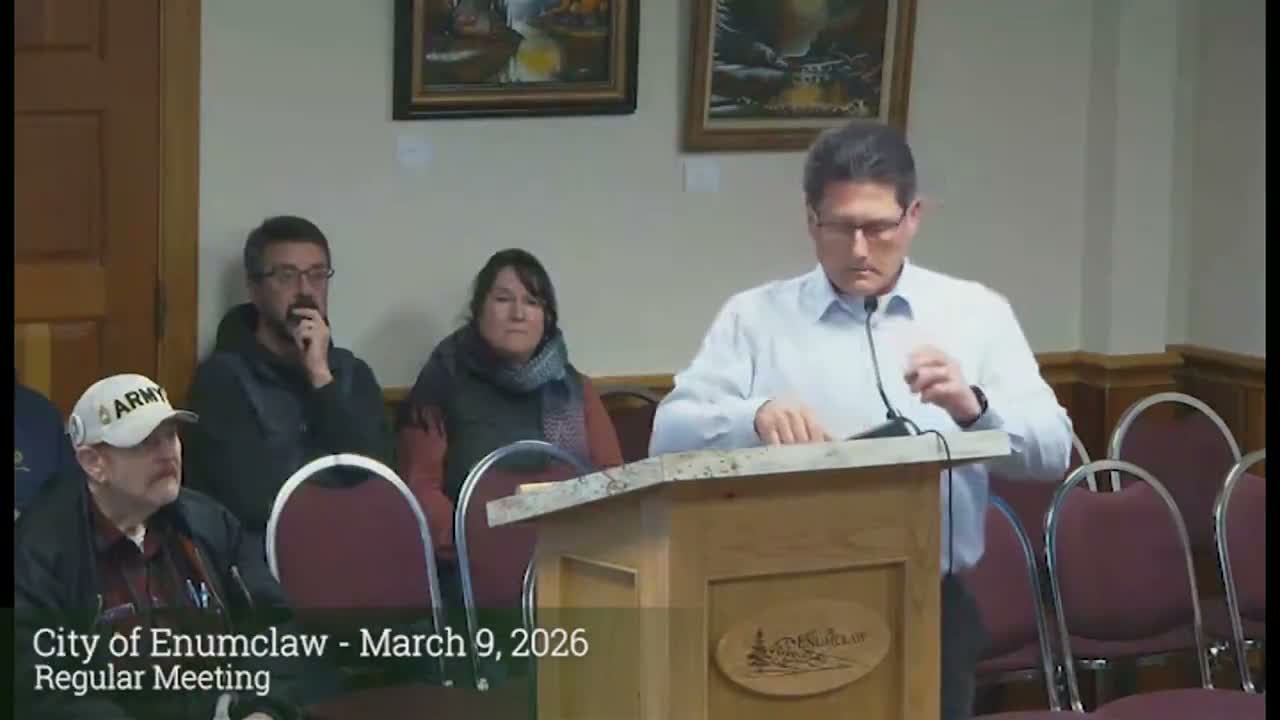
City Administrator Chris Searcy gave a lengthy March 9 briefing on the Climate Commitment Act (CCA) and its implications for Enumclaw's municipal natural gas utility, emphasizing the presentation was informational and required no action that evening.
Searcy explained the CCA is a state cap‑and‑invest program that requires covered entities to obtain annual carbon allowances equal to their greenhouse‑gas emissions; Ecology runs quarterly auctions and provides some no‑cost allowances to certain entities. He said Enumclaw is "just marginally over the threshold" that pulls a utility into the program and that the city's average emissions for 2023–2025 were a little over 25,000 metric tons — the statutory cutoff used in compliance calculations.
Searcy described several operational impacts: Ecology's no‑cost allowances start from a baseline (based on 2015–2019 emissions) and decline each year (staff said no‑cost allowances drop by roughly 7% annually), while the city must buy additional allowances at auction. Some of the auction proceeds from allowances the city consigns to the auction can be used to offset customer bill impacts; Searcy said legacy customers (those connected before July 25, 2021) receive a smaller per‑unit CCA charge (historically about 6–7¢ per 100 cubic feet) while non‑legacy customers face a larger per‑unit impact (previously estimated near 23¢ per 100 cubic feet).
Searcy also raised policy questions: because municipal gas utilities have a duty to serve customers adjacent to gas mains, the city cannot simply refuse new service without statutory change; the council may want to consider full cost recovery for new development or to coordinate with other municipal utilities (including Ellensburg) to pursue alternative compliance or legislative relief. He noted Ellensburg has pursued a restricted‑account approach and received a CCA appropriation grant to support decarbonization planning.
Searcy warned of uncertainty: state greenhouse‑gas reporting is behind schedule and the program's linkage with California (and Quebec) could change auction prices. He also noted Initiative 2066 (a voter action about protecting access to natural gas) is in legal challenge at the state Supreme Court, adding uncertainty about the longer‑term regulatory landscape.
Searcy asked the council to consider policy guidance in the coming months and suggested returning to the council in May with additional information, potential projections, and options for legislative engagement, alternative compliance exploration with Ellensburg, or grant pursuits.
What happens next: staff will prepare more detailed cost projections, pursue information about Ellensburg's alternative compliance concept, and return with options for council policy direction and potential funding or program design choices.