Get AI Briefings, Transcripts & Alerts on Local & National Government Meetings — Forever.
Senate confirms Stephen D. Ecker after extended floor debate over judicial decisions; multiple judicial nominations cleared on consent
Loading...
Summary
The Connecticut Senate on March 26 confirmed Stephen D. Ecker to the state Supreme Court and Superior Court after an extended floor exchange in which Senator Sampson opposed the renomination, citing several court decisions. The chamber also adopted a consent calendar confirming a slate of judicial nominees.
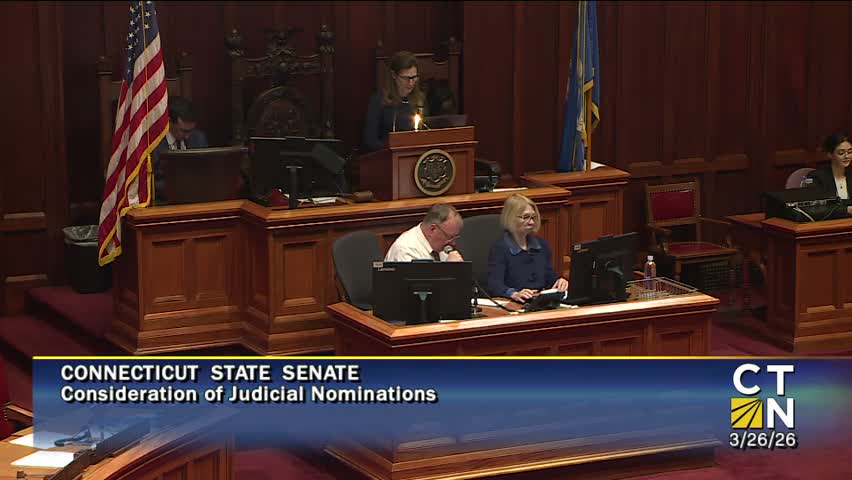
The Connecticut Senate voted March 26 to confirm Stephen D. Ecker of West Hartford as an associate judge of the state Supreme Court and a judge of the Superior Court after a lengthy floor debate that laid out competing assessments of his record.
Senator Eric Winfield moved acceptance of the judiciary committee's favorable report. Senator Sampson rose in opposition and delivered an extended critique of the state supreme court's recent jurisprudence, arguing the court has repeatedly expanded executive authority and stretched statutory and constitutional text in pandemic-era decisions. Sampson cited several cases by name — Casey v. Lamont (2021), Faye v. Merrill (2021), Connecticut Freedom Alliance v. Department of Education (2023) and CHRO v. Edge Fitness (2022) — and said those opinions showed a pattern that, in his view, merited pause before reappointing a justice to the court. "The decision turned a temporary emergency tool into a standing grant of legislative power to the executive branch, and it was wrong," Sampson said on the floor.
Senator Looney and others spoke in support of Judge Ecker's renomination, praising his scholarship and record on the bench. Looney said Ecker has been "an outstanding scholar" whose decisions often reflect mainstream judicial analysis and urged colleagues to confirm him.
An immediate roll call was ordered. The clerk announced the tally: total voting 32; 24 yay, 8 nay; 4 absent. The presiding officer announced the resolution was adopted.
Separately, the Senate moved a consent calendar containing multiple judiciary confirmations (calendar items covering many joint resolutions). Senator Duff closed the day's goal list, the clerk read the consent calendar items and the chamber adopted the consent calendar as announced on the floor. The consent action confirmed numerous judicial nominees to the Superior Court and other judicial posts with brief introductions from senators; those items will be reflected in the Senate journal.
The hearing-style floor exchange underscored a recurring tension in confirmation debates: several senators framed their opposition around judicial philosophy and precedent, while supporters emphasized experience, temperament and past public service. The Senate adjourned after completing the day's agenda and set the next session for April 8.