Get Full Government Meeting Transcripts, Videos, & Alerts Forever!
Get email alerts on the Special Education Transparency topic
No spam. Unsubscribe anytime.
Committee advances bill to create public, anonymized database of special-education complaints
Summary
AB 18 61 would require the California Department of Education to maintain a publicly accessible, redacted database of special-education complaints to reveal patterns across districts; advocates said the change improves accountability while county offices warned about resource tradeoffs.
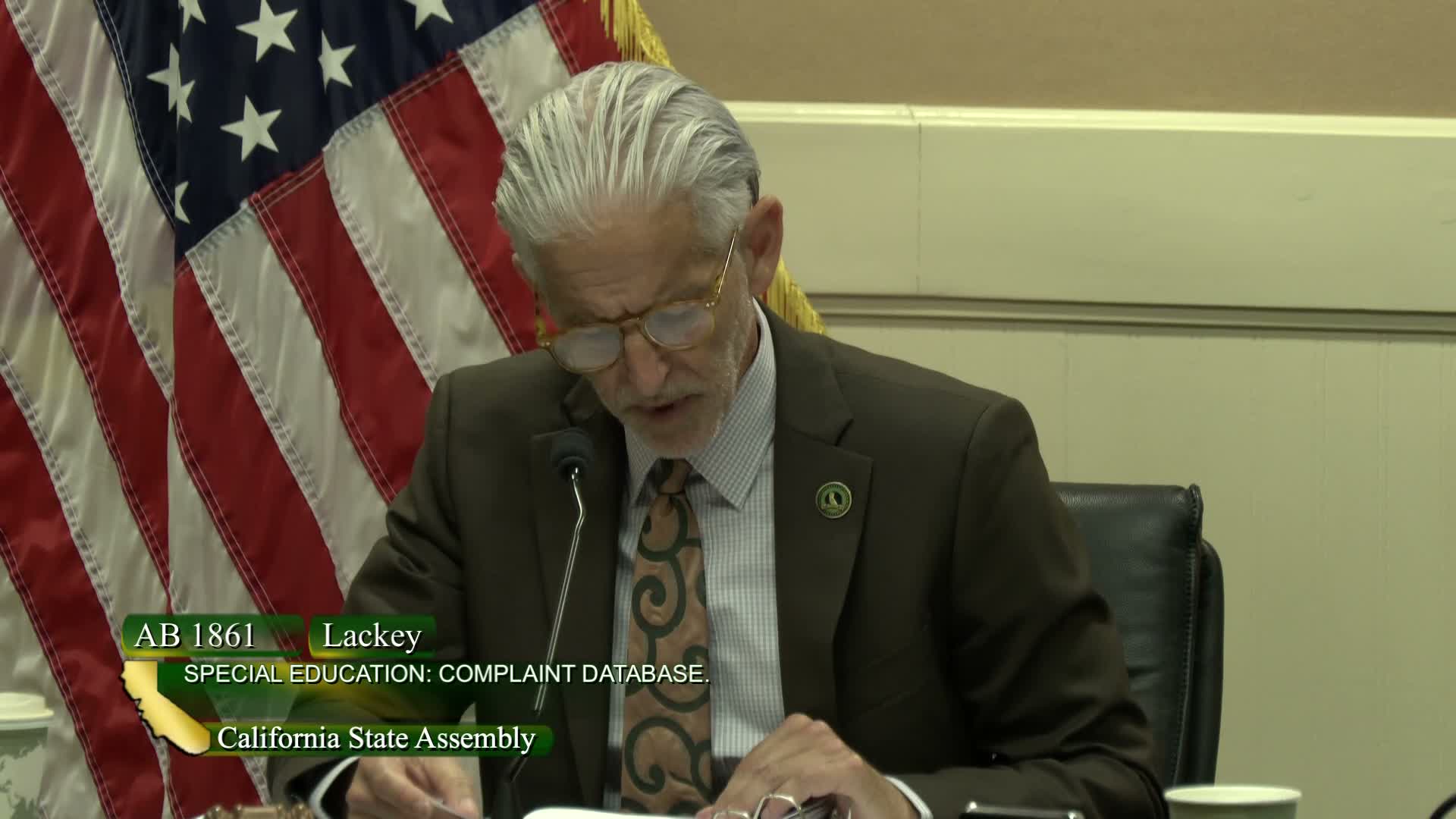
Assemblymember Lackey presented AB 18 61 to the committee as a transparency and accountability measure for special education. He said under current practice the California Department of Education's complaint decisions are technically public but accessible mainly via public-records requests, making it difficult for families and advocates to analyze where problems recur.
Conrad Crump, senior policy advocate with Disability Rights California, testified in support and said the bill's amended form redacts personal student information, focuses on aggregate data and includes an opt-in process to protect privacy. "It creates a centralized database that allows us to see patterns across districts and see where violations are happening," he told the committee.
Lucy Salcedo Carter of the Alameda County Office of Education, speaking on behalf of several county offices, said while she supports transparency goals, she opposed the bill because state resources would be better used to fill special-education staffing vacancies and address service gaps. Several members debated federal funding constraints and the value of aggregate data to hold districts accountable.
The committee, with a quorum present, moved AB 18 61 as "do pass as amended to appropriations committee." The chair and several members said the amendment balances transparency and privacy by reporting high-level information rather than individual student records.