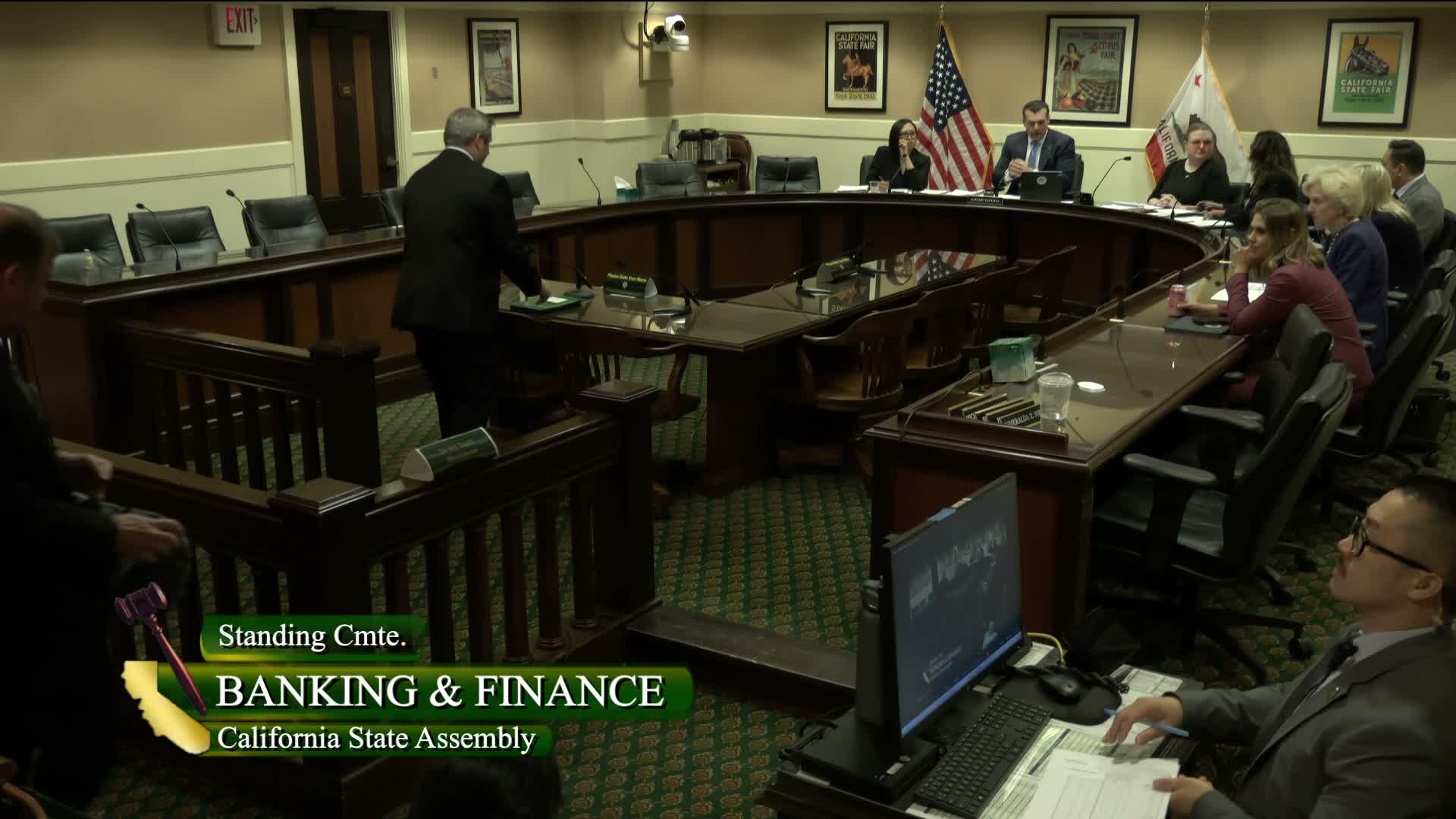
Assembly committee hears AB 1984, a bid to bar corporate treasuries from California elections
Loading...
Summary
Assemblymember Rogers presented AB 1984 to the California State Assembly Banking and Finance Committee, proposing to strip corporations and other "artificial persons" of the power to spend corporate treasuries in California elections; proponents said it would curb anonymous "dark money," while business groups called the measure unconstitutional. The committee took no final vote on AB 1984 and passed one unrelated consent-item to appropriations.
SACRAMENTO — Assemblymember Rogers introduced AB 1984 on behalf of a state-level effort to limit the role of corporate and organizational money in California elections, telling the Assembly Banking and Finance Committee the bill would remove the power of "artificial persons" to spend corporate treasuries on politics.
"This bill really is our attempt to try to neuter the impacts from Citizens United," Assemblymember Rogers said, arguing that unlimited spending has eroded public trust in democratic decisions and that removing certain corporate powers is a lawful state remedy. Rogers said the text uses a broad definition of "artificial persons" to cover business corporations, nonprofits, trusts and some unincorporated associations.
Tom Moore, a senior fellow at the Center for American Progress who described himself as the architect of the bill's legal theory, told the committee the measure focuses on corporate powers rather than individual speech. "What AB 1984 does is simple: it alters the law concerning corporations and no longer grants corporations operating in California the power to spend in its politics," Moore said, adding proponents expect the change to force disclosure of who is funding political communications.
Nancy Price, co-chair of the Alliance for Democracy, told lawmakers the bill responds to decades of corporate political influence and urged the committee to let the Legislature debate the measure. "Corporate money is wrecking popular government," Price said in support of AB 1984.
Committee members pressed proponents on scope and consequences. Assemblymember Dixon asked whether unions and other organizations would be covered; witnesses and staff said the bill's definition includes unions, which may appear as nonprofit corporations or unincorporated associations under federal tax law. Proponents said the bill explicitly excludes political committees and candidate or party committees as well as news-gathering activity by media organizations.
Several members raised concerns about unintended effects on representation. Assemblymember Rubio questioned whether limiting certain institutional spending could empower independent expenditures and billionaire donors who would remain able to spend from personal accounts. "If we keep putting these regulations, we're empowering the IE community," Rubio said, warning that the practical effect could advantage those who can make large individual expenditures.
Proponents countered that the bill would at least require large donors to spend in their own names rather than hiding behind corporate or LLC treasuries. Moore and Rogers cited recent examples of opaque funding and a committee witness quoted an estimate that nearly $1.9 billion in dark money was spent in the last presidential election to illustrate the scale proponents aim to reduce.
The hearing drew organized testimony on both sides. Alexis Rodriguez of the California Chamber of Commerce opposed the bill, saying it "imposes a blanket prohibition on political participation by businesses and nonprofits" and arguing the measure conflicts with Supreme Court precedent such as Buckley v. Valeo and Citizens United. Supporters included Will Brigger of State Strategies on behalf of Climate Action California and multiple Indivisible chapters.
Before the committee recessed the AB 1984 discussion, it paused to pass the consent calendar. The committee approved AB 2607 (Nguyen) on a motion from Assemblymember Rubio, seconded by Assemblymember Fong; the roll call produced unanimous 'aye' votes from members present. No committee vote was taken on AB 1984 at the informational hearing; Chair Valencia closed the session after public testimony.
The bill's next procedural step and any committee amendments were not decided at this hearing. Proponents said they intend to continue refining the text and that other states are advancing similar measures; opponents said courts could strike the law down and emphasized focusing on transparency and accountability rather than broad prohibitions.
The committee adjourned without taking a final vote on AB 1984; supporters and opponents indicated the debate would continue at future hearings.