Committee backs bill letting local governments treat AI'generated agents as nonhuman in public processes
Loading...
Summary
SB 1159 clarifies that local governments are not required to treat AI bots or agents as persons for Brown Act and public-records purposes; supporters argued the bill preserves genuine civic participation, while privacy and public-records advocates urged narrowing to fraud.
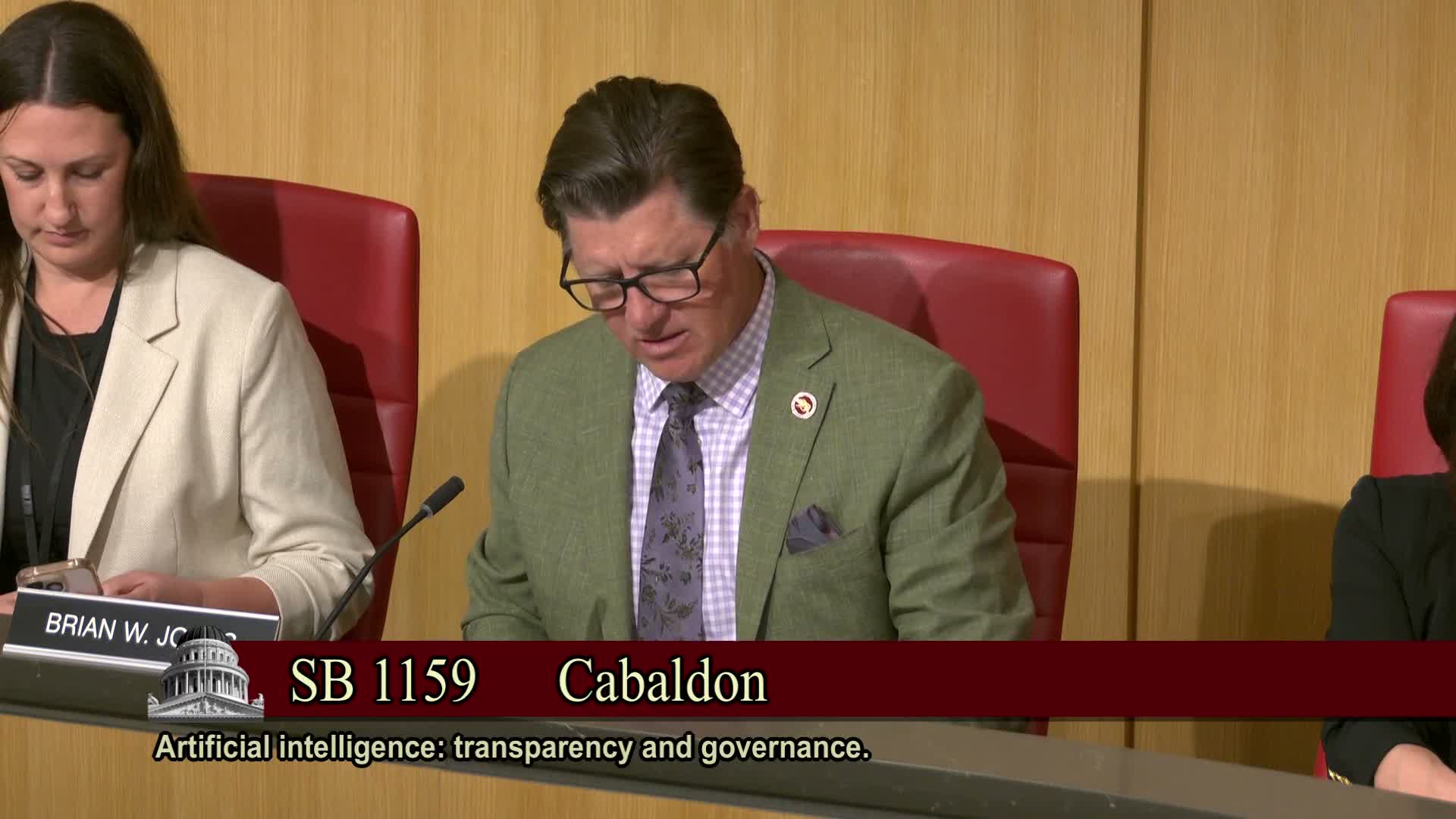
Sen. Scott Wiener (speaking as part of committee leadership) and Sen. Cabaldon presented SB 1159 to make explicit that local governments are not required to treat AI'generated bots and agents as persons for purposes of public comment, the Brown Act, or public-records access. Cabaldon and supporters cited cases where large volumes of machine'generated comments overwhelmed agencies and made it difficult to identify real human participation.
Gabriela Fazio of Sierra Club California (speaker 28) told the committee that environmental-rulemaking efforts were undermined when consulting firms or automated agents submitted tens of thousands of AI'generated comments, burying community voices; she said the bill draws a line to preserve public participation processes.
Yolo County Supervisor Oscar Villegas (speaker 27) and many local government organizations testified in support, arguing local clerks and city attorneys need clarity and tools to preserve public access. Opponents including Oakland Privacy (Tracy Rosenberg, speaker 13) said the problem in some cases was fraud, not AI per se, and cautioned against broadly excluding automated submissions where human direction exists.
The committee recorded a motion to pass SB 1159 to appropriations and the roll call showed strong support; the measure was reported out (9-0). The author said local governments would retain discretion and that technical provenance tools and protocols could assist verification.