Senate panel probes Strong Reader Partnership spending and State Library oversight of Imagination Library program
Loading...
Summary
A Senate budget subcommittee questioned why the Strong Reader Partnership spent roughly $1.1 million with limited documentation, probed vendor invoices that coincided with legislation, and pressed the California State Library for clearer oversight; the Department of Finance will conduct an independent audit.
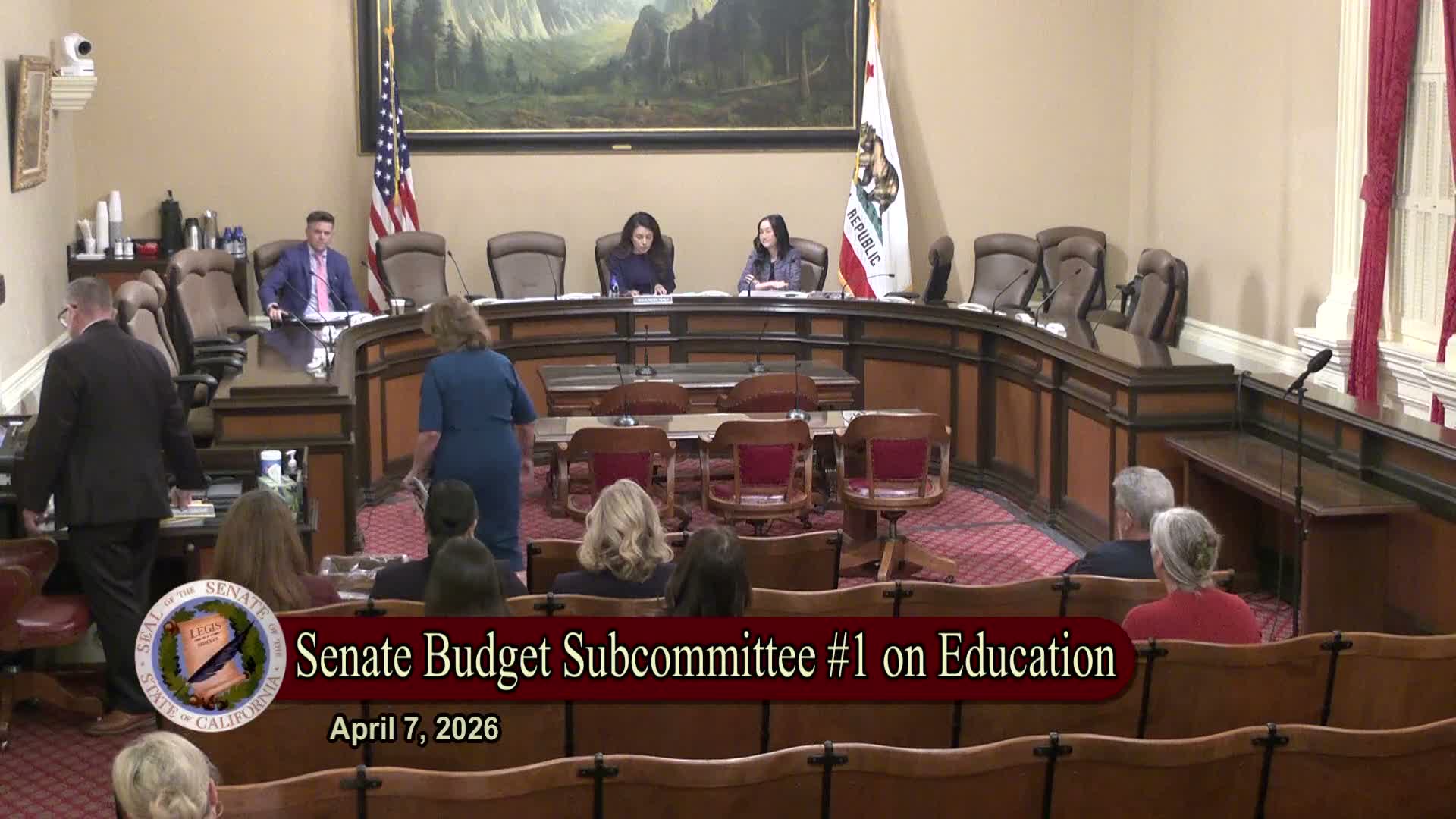
Chair Perez convened a follow-up oversight hearing as members of the California State Senate Budget Subcommittee No. 1 on Education pressed state officials and Strong Reader Partnership (SRP) representatives for clearer accounting of how state funds were spent to expand the Dolly Parton Imagination Library in California.
The hearing focused on state allocations tied to the 2022 investment of $68,200,000 and subsequent redirects under AB 157. State Librarian Greg Lucas told the committee he directed 90% of unspent funds on hand to the Dollywood Foundation when it submitted paperwork and that the library had sought to work collaboratively with SRP before issuing a demand letter in March to obtain invoices and other records. "In retrospect, we should have sent a demand letter earlier," Lucas said, acknowledging delays in providing documents to the subcommittee.
The committee highlighted two distinct funding streams and outcomes. Lucas said the California State Library directly gave a $1,500,000 check to the Dollywood Foundation for bilingual book purchases; the library also advanced $4,800,000 to the Strong Reader Partnership, of which SRP returned most funds and reported $1,100,000 in expenditures. "I don't know how many books were provided by the Strong Reader Partnership," Lucas told the panel, deferring detailed accounting to the nonprofit.
Senator Grove and other members pressed SRP on whether state dollars produced measurable results. Grove contrasted the SRP's $1,100,000 with the Dollywood Foundation's $1,500,000 allocation and asked for concrete enrollment and distribution figures. "For $1,100,000 ... you can't identify 1 book that was delivered to an at-risk kid," Senator Grove said, summarizing the committee's concern that SRP had few visible program outcomes tied to its invoices.
SRP board members — Jackie Wong (chair), Sonia Harris (former executive director and principal at Sage Strategies), and Laura Fink (board member) — described the organization as a volunteer working board that sought to build infrastructure, local partnerships and outreach capacity to reach California's multilingual and hard-to-reach children. "Our job was to lay the groundwork and infrastructure," Fink said, explaining SRP's emphasis on planning, regional outreach and assets that SRP said were ready to deploy before funding was rescinded.
Committee members and staff flagged multiple vendor payments and sparse invoice detail: Shipyard (advertising/marketing) received approximately $581,708.55; Sage Strategies (consulting/executive director services tied to SRP) received about $326,250.99; Lotus Financial Solutions was paid roughly $110,000 for bookkeeping; smaller payments were made to QuickBooks, an auditor and tax preparers. Committee members repeatedly said invoices lacked line-item descriptions tying expenditures to program deliverables and pointed to apparent inconsistencies between SRP's reported pauses in work and months of billed hours.
The panel also raised a specific concern about a $14,500 invoice to ChangeCraft dated Aug. 24'29, 2024, which coincided with the period when AB 157 was being considered. Committee staff provided emails from ChangeCraft to budget staff dated Aug. 25, 2024, that the committee said sought to influence AB 157. SRP witnesses said the ChangeCraft line item covered "stakeholder engagement and communications" and that the invoice did not bill SRP for outreach to the subcommittee. Lucas said the grant agreement with SRP expressly prohibited lobbying as defined by the IRS, and he repeatedly urged the committee to ask SRP about the ChangeCraft contacts.
SRP said much of its work was preparatory and that many creative assets and campaign materials were not deployed because the rescission and closeout timelines cut short planned launches. "We had assets that were on the precipice of being deployed when the rescission came in," SRP board members said, and they offered to provide the committee with website designs, bilingual pages and marketing research.
Committee members disputed whether the assets existed or were deployed, noting that a $5,000 invoice to United Way California Capital Region for "paid media" produced no visible ad placements in online ad libraries and that a referenced SRP website captured in screenshots had minimal content. Committee members also pointed to bank statements and staff reports indicating reconciliation errors, a bounced check and a $110,000 misreporting later corrected in the state's favor.
SRP representatives said they returned unspent funds to the state after SB 105 required remaining funds be returned and said they completed closeout reporting within required windows once the library provided reporting requirements. SRP maintained the board had approved invoices and oversight practices internally, and that the organization coordinated with the Dollywood Foundation while pursuing California-specific outreach and multilingual planning. The Dollywood Foundation, by contrast, told committee staff it had not authorized SRP to spend funds on its behalf and asked SRP not to engage local program partners without Dollywood's involvement.
Chair Perez said the subcommittee would continue oversight and announced the Department of Finance (Office of State Audits and Evaluations) will perform an independent audit of the transactions and reporting; draft and final audit reports will be provided to the State Library and the subcommittee. "Important gaps still remain," she said, and the audit is expected to be completed by Dec. 31, 2026, depending on scope and complexity.
The committee left the record open for additional documents and instructed SRP and the State Library to retain all relevant records. The hearing adjourned with follow-up directed to the Department of Finance for a formal review and the subcommittee preparing a preliminary summary of concerns for release to the public.