Get Full Government Meeting Transcripts, Videos, & Alerts Forever!
Get email alerts on the Autonomous Vehicles topic
No spam. Unsubscribe anytime.
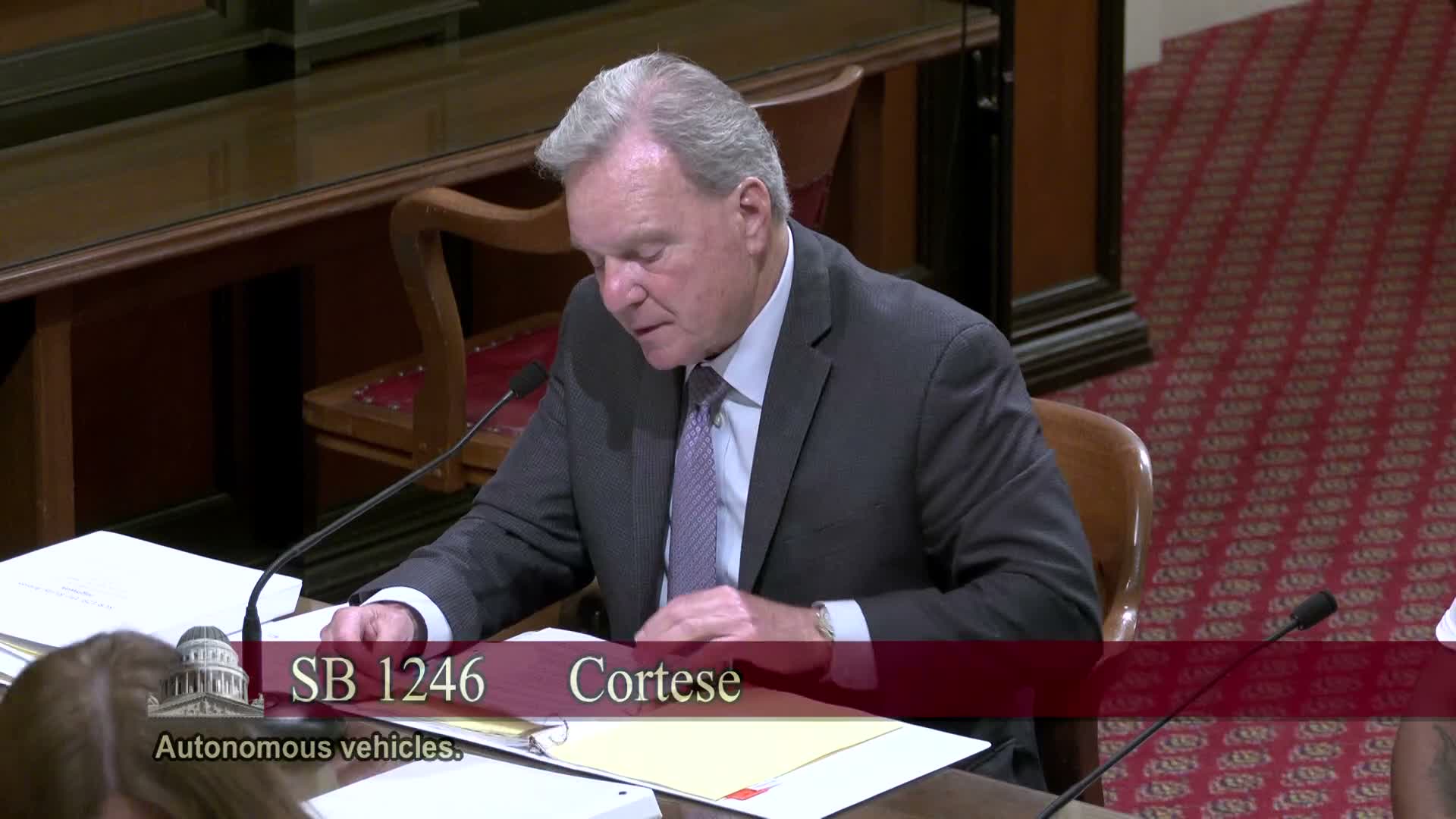
Senate committee advances bill to tighten remote operation and emergency protocols for autonomous vehicles
Summary
The Senate Transportation Committee voted to advance SB 12 46 after hours of testimony, directing stricter remote‑operator rules, a manual override requirement and a rapid on‑scene response standard for autonomous vehicles amid safety concerns raised by firefighters and city workers. The committee vote to send the bill forward was 8–3.
The Senate Transportation Committee voted to advance SB 12 46, a bill that would require that remote operators for autonomous vehicles be based in the United States and hold a valid California driver’s license, impose a 1:3 operator‑to‑vehicle staffing ratio, mandate monthly reporting on immobilizations and response times, and require a manual override system approved by the California Highway Patrol and the state fire marshal.
The bill’s author told the committee the measures are intended to ensure companies can respond quickly in emergencies and “ensure AVs operating on a highway are equipped with manual override systems accessible to first responders.” Meagan Suber, speaking for the California Professional Firefighters, described recent incidents in San Francisco and said the industry’s hotline “was not quick or responsive.”
Parking control officer Sterling Haywood told the committee that AVs are already interfering with street operations, testifying that he had seen AVs “stop in the middle of an intersection and, make a legal u‑turn and nearly hit another vehicle” and that public workers have in some cases had to move or cite vehicles to keep streets clear.
Industry and technology groups urged caution. Sarah Boot of the Autonomous Vehicle Industry Association warned that California recently enacted AB 1777 and that the DMV’s updated AV regulations — set to take effect this summer — already require companies to answer first‑responder calls within 30 seconds and to maintain remote personnel and geofencing tools to direct vehicles away from emergency scenes. She cautioned against layering a second overlapping compliance regime before the new law and regulations are implemented.
Committee members balanced those competing concerns in questioning. Supporters argued the bill addresses documented failures — including long holds on industry hotlines and blocked intersections during a multi‑day outage in San Francisco — while opponents argued some provisions (notably an in‑person 10‑minute on‑scene requirement) may be unrealistic in certain geographies or create conflicts with forthcoming DMV rules.
On the motion to report the measure out of committee, the roll call recorded the bill as advancing with an 8–3 vote.
The committee referred the bill to the Rules Committee for further consideration. Additional amendments are expected as the author and stakeholders continue negotiations on specifics, including the proposed 10‑minute on‑scene response and how manual overrides would be standardized across vehicle types.