Get Full Government Meeting Transcripts, Videos, & Alerts Forever!
Get email alerts on the Energy Nuclear topic
No spam. Unsubscribe anytime.
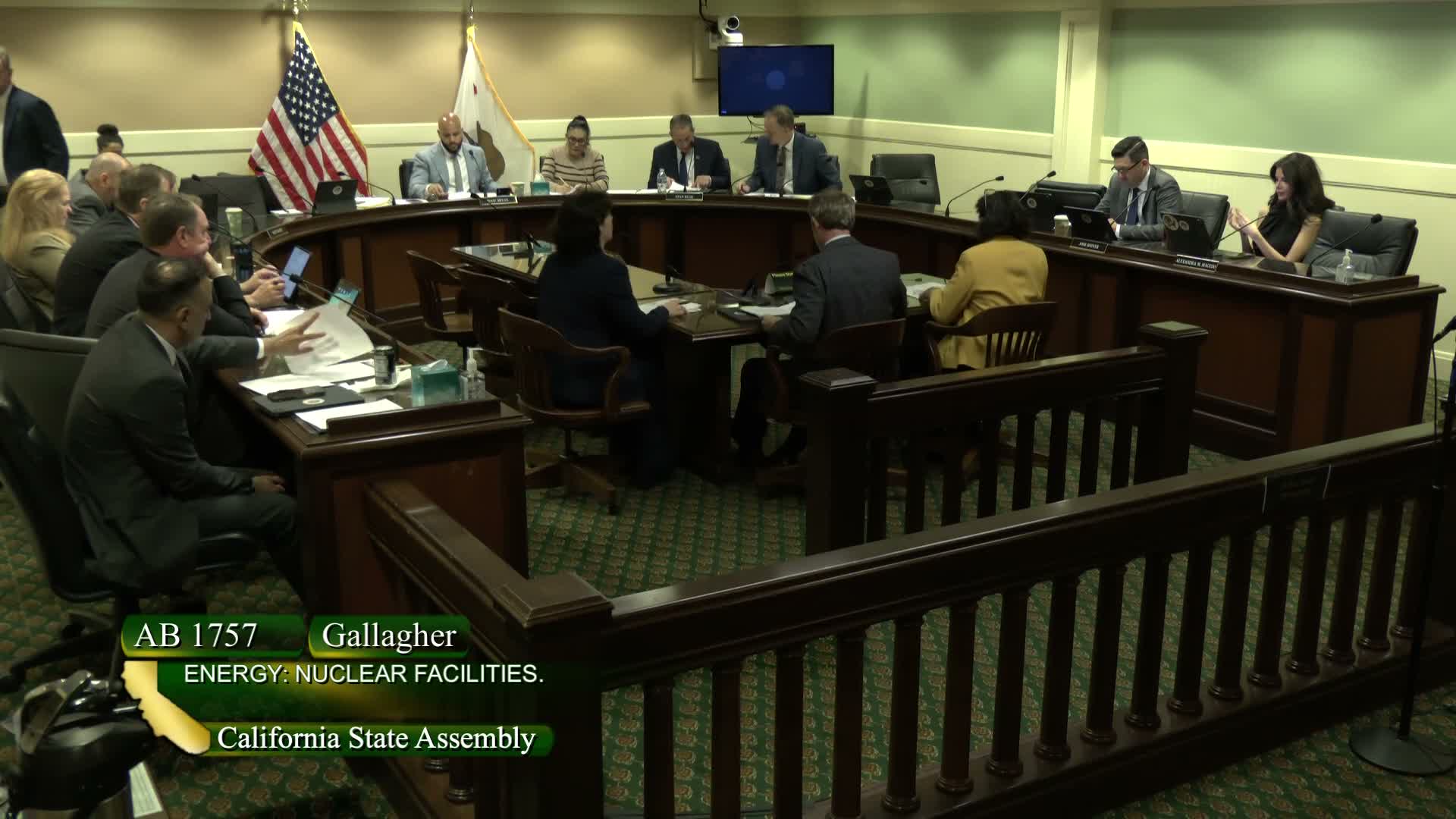
Assembly committee debates and ultimately stalls Gallagher’s microreactor carve-out to the nuclear moratorium
Summary
The Natural Resources Committee heard hours of testimony on AB 17 57, a proposal to allow factory-built microreactors in California. Supporters cited grid resilience and low emissions; opponents warned of high costs, waste-transport gaps and public-safety risks. The measure failed to advance on the day’s vote.
Assemblymember Gallagher introduced AB 17 57 as a limited carve-out from California’s moratorium on new nuclear facilities to permit microreactors for specific uses. Gallagher said the bill does not "exempt from CEQA or from local control" but would allow targeted, factory-built units to be considered under state policy.
Radiant Nuclear’s Rita Barinwald, the company’s chief nuclear officer, described the technology and said Radiant’s Kaleidos microreactor is a 1-megawatt, factory-built unit. She told the committee, “This bill would modernize California's energy policy without compromising safety or environmental standards,” and said the company’s approach returns spent fuel to a central facility rather than storing it on site.
Phoebe Lind of Radiant added that microreactors are transportable, built in factories and designed with passive safety features: “It is designed with passive safety systems, meaning the reactor can safely shut down on its own without operator intervention.” She said Radiant’s business model includes off-site fuel management and that microreactors can provide backup power for data centers and hospitals.
Opponents pressed those claims. Jacob Evans of Sierra Club–California argued that the state’s moratorium protects ratepayers and communities and warned that small modular and microreactor projects have historically exceeded cost estimates. He told the committee that the canceled NuScale project and other small-reactor efforts have shown substantial cost and schedule overruns.
Michelle Canales of the Union of Concerned Scientists warned of public-safety and regulatory gaps, saying that “being smaller does not necessarily reduce [risk],” and expressed concern about federal deregulation shortening environmental review. Committee members pressed witnesses on spent fuel transport and storage. Barinwald said Radiant would return used fuel to its Oak Ridge facility and that no spent fuel would be stored in California under their model.
During member discussion, supporters argued microreactors could add dispatchable, zero-carbon capacity close to load centers and help keep data centers and critical infrastructure online. Critics said California should prioritize renewables, storage and proven firm resources, and asked for more state analysis. Several members asked the California Energy Commission and state regulators to provide additional data before changing the moratorium.
On the roll call that followed, the motion to pass the measure to Appropriations did not receive sufficient support and the measure failed to advance that day. The committee granted reconsideration so members could continue discussions in the coming weeks.
The debate leaves open whether the Legislature will revisit limited pathways for advanced nuclear technology after more analysis of costs, waste logistics and local emergency-preparedness implications.