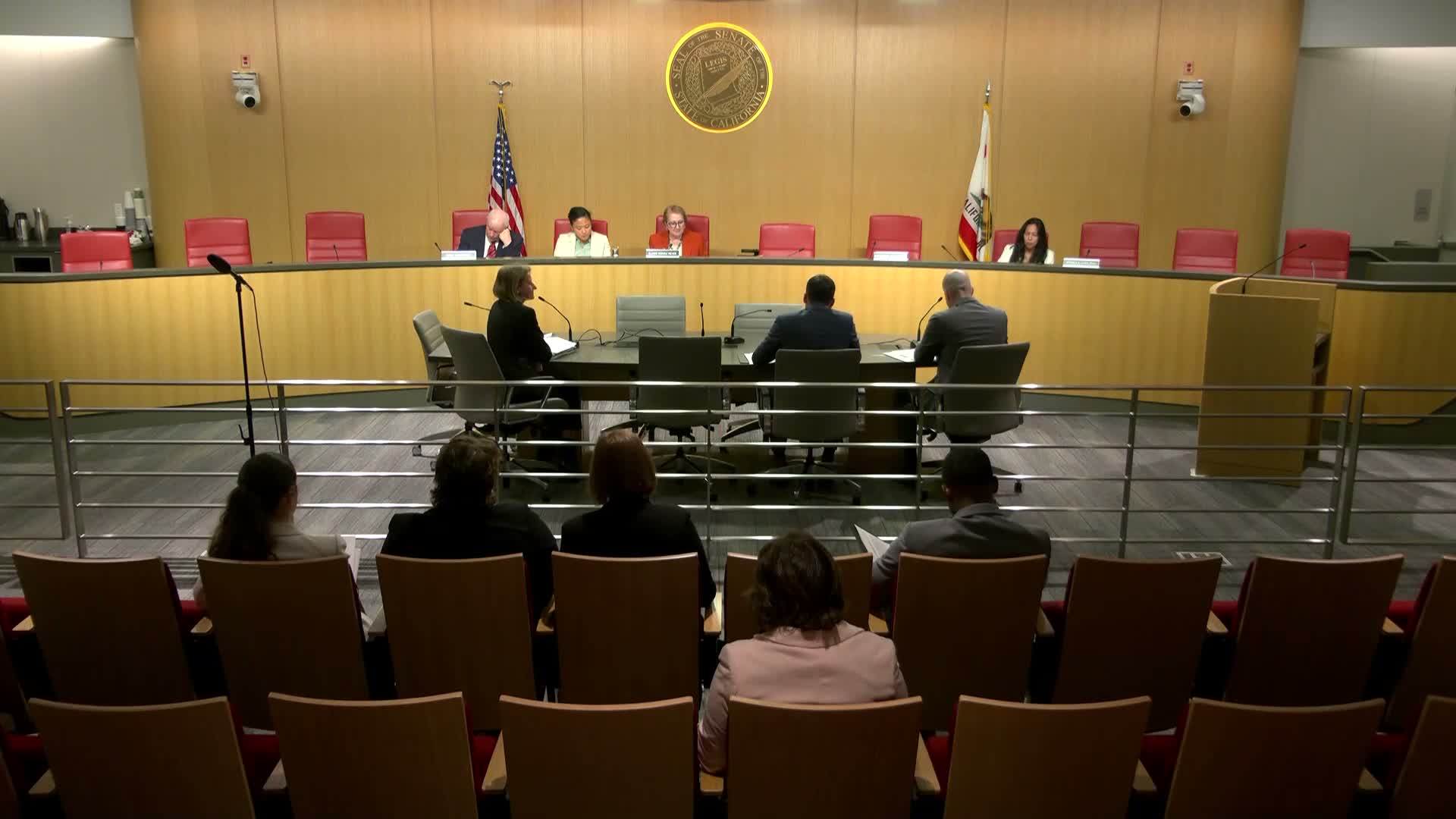
Subcommittee debates GGRF expenditure plan, new ZEV incentive and priorities for transit and community programs
Loading...
Summary
Legislative analysts and Finance sparred over how to prioritize Greenhouse Gas Reduction Fund tiers as the administration proposed backfilling general fund costs and a new $200 million ZEV incentive; LAO urged a high bar for new programs and flagged risks to tier 3 programs such as AB 6 17 implementation.
The budget subcommittee continued with an expansive discussion of the Greenhouse Gas Reduction Fund (GGRF) expenditure plan, trailer bill language to implement SB 840 (referred to in the transcript as SB 8 40) and a one-time $200 million light-duty zero-emission vehicle (ZEV) incentive proposal.
Brandon Merritt of the Department of Finance presented the governor's plan, estimating about $3.7'$3.8 billion in auction revenue for 2026'27 and describing a three-tier funding structure: Tier 1 state operations and priority items (manufacturing tax credits, state operations and a Cal Fire backfill), Tier 2 discretionary items (including a proposed $1 billion for high-speed rail and $1 billion for other discretionary investments), and Tier 3 prior continuous appropriations capped at new dollar amounts. Finance proposed using diesel excise and other GGRF resources to support multiple priorities and asked the committee to approve trailer bill clarifications to implement the reauthorization.
The Legislative Analyst's Office recommended rejecting or substantially revising several new proposals and urged caution in using GGRF to backfill general fund obligations. LAO representatives noted uncertainty in auction proceeds (auctions recently sold near floor prices) and flagged that placing large amounts of recurring or long-term costs into Tier 1 state operations would reduce Tier 3 program funding, including money earmarked for transit and community air monitoring (AB 6 17) implementation.
Committee members pressed Finance and LAO for specifics about what is classified as "state operations" in Tier 1, how pro rata charges are calculated, and what legislative oversight exists to audit the items funded under that label. Finance agreed to provide a more detailed accounting of prior GGRF state operations appropriations and positions funded from the program.
CARB and other agencies also described requests tied to AB 6 17 (community air monitoring implementation), AB 1207/SB 840 implementation work (offset protocol review and rulemaking support), and the sixth California climate assessment. Courtney Smith of CARB explained the proposed $200 million incentive seeks to preserve the ZEV market following the loss of a federal tax credit, target first-time ZEV buyers, and require a 1:1 manufacturer match to leverage state funds.
The LAO recommended rejecting the new ZEV proposal this year, saying the state should prioritize existing equity-focused programs (Clean Cars for All, medium- and heavy-duty HVIP) and be cautious about creating new short-term programs amid out-year general fund pressures. Committee members and dozens of public commenters urged the restoration of Tier 3 funds for transit capital programs, continued investment in medium- and heavy-duty decarbonization, and full funding for AB 6 17 community plans.
The subcommittee did not take votes and left the GGRF plan and related trailer bill language open for further work between the committee, LAO and the administration.