Lifetime Citizen Portal Access — AI Briefings, Alerts & Unlimited Follows
Senate subcommittee hears stark split over governor's sustainable aviation fuel tax credit
Loading...
Summary
Experts and analysts warned the proposed $1'$2-per-gallon SAF tax credit would be costly, risk shifting renewable diesel to aviation and reduce transportation revenue; the administration and industry said it would help decarbonize aviation and preserve refinery jobs. Public comment split sharply between environmental groups opposing the credit and unions and refinery advocates supporting it.
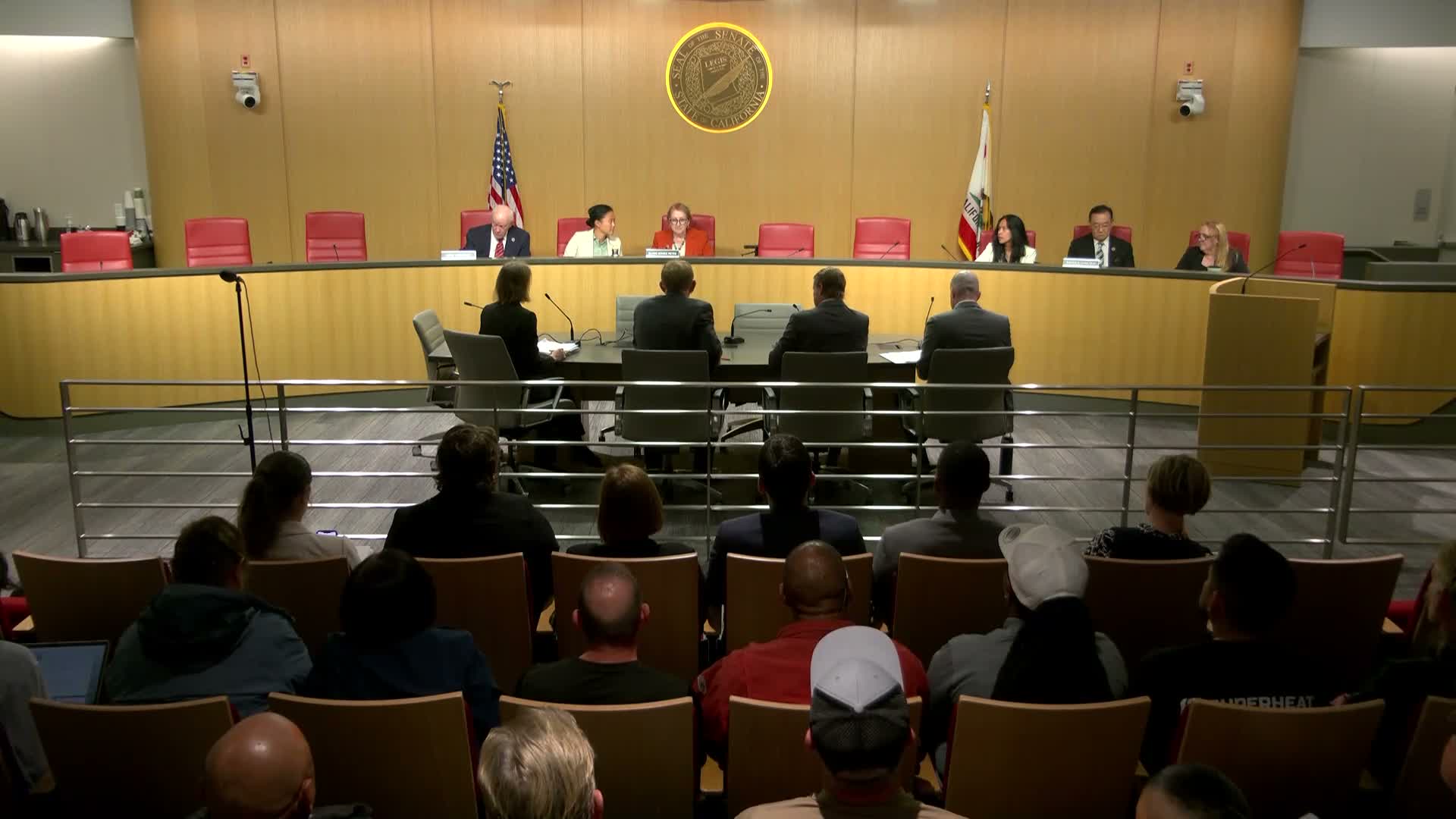
A California Senate budget subcommittee on Thursday heard sharply contrasting views on the governor's proposal to create a $1 to $2 per gallon tax credit for sustainable aviation fuel sold for use in California from 2026 through 2036.
Aaron Smith, a professor at the University of California, Berkeley, told the panel that while the credit would likely spur much more SAF production than the administration projects, it would be expensive for the state and for motorists. "SAF is expensive to produce and would generate few benefits for the climate if incentivized through this particular tax credit," Smith said, arguing most additional SAF would displace renewable diesel rather than add new low-carbon fuel.
The Legislative Analyst's Office also recommended rejecting the plan, citing a high cost per ton of greenhouse gas reduced, uncertainty about environmental benefits, and substantial potential losses to the diesel excise tax that currently funds highway and local streets programs. Helen Kersting of the LAO warned the revenue losses could be large and would reduce funding available for Caltrans maintenance programs, local streets and roads, and the Trade Corridor Enhancement grant program.
Andrew March of the Department of Finance summarized the governor's proposal as a $1'$2 credit tied to SAF carbon intensity and defended the administration's assumptions, saying recent EPA changes and available feedstock led Finance to conclude a wholesale substitution would be unlikely. Finance also noted that existing federal and state programs already subsidize renewable fuels and that the proposed credit is intended to narrow the gap in SAF's higher production costs.
A representative of the California Air Resources Board said policy design can target waste-based feedstocks (used cooking oil, tallow) to avoid pressure on food commodity markets and to reduce carbon intensity. CARB staff described waste feedstock collection and industry adaptations that have substantially increased waste feedstock availability in recent years.
Committee members probed multiple angles: whether the credit could be limited to in-state production without violating the Commerce Clause; how much diesel excise revenue could be lost and what backfill options exist; whether the program would primarily preserve specific refineries and jobs; and whether SAF's climate benefits would be worth the cost. Department of Finance cited a Supreme Court precedent involving an Ohio ethanol credit as a legal caution against preferential incentives that disadvantage out-of-state producers.
Public comment reflected the split. Environmental and public-health groups urged rejection, contending the credit would produce limited net climate benefit, risk worsening local air quality impacts, and divert transportation dollars. Christina Scribe of the Center for Biological Diversity said the state should instead "max out funding for cost-effective GHG reductions and equitable clean transportation." Several labor unions, refinery workers and local residents urged support; speakers from United Steelworkers Local 3'26 and employees at the Rodeo Renewable Energy Complex and Phillips 66 said the incentive helps keep jobs and investments in California.
No vote was taken; Chair Yellen said all items remain held open and would be considered at a future hearing. The committee moved on to the GGRF expenditure plan and related budget items.