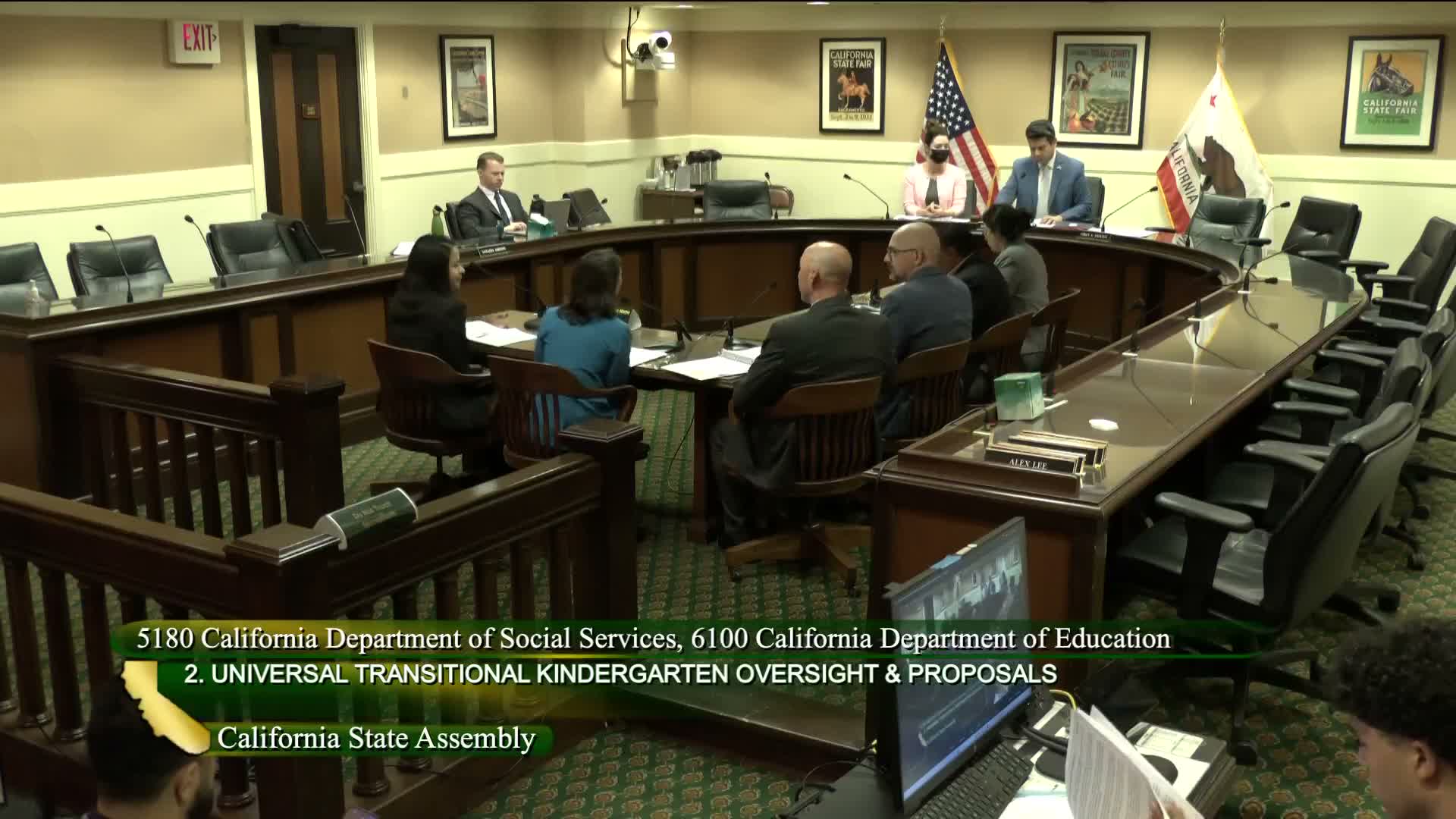
Lawmakers probe TK rollout as governor proposes billions for expansion and lower ratios
Loading...
Summary
Panelists told the Assembly that TK enrollment rose rapidly but uptake among eligible 4‑year‑olds is about 50–55%; the governor’s January budget proposes roughly $3 billion (2025‑26) for full TK implementation including lower student‑to‑adult ratios, while agencies warned one‑time implementation grants will sunset and districts need continued supports.
The committee’s second panel focused on universal transitional kindergarten (TK) implementation, enrollment trends and the governor’s budget proposal.
A Department of Finance fiscal representative described the administration’s TK funding request: “the governor’s budget provides a total of 3,000,000,000 Proposition 98 general fund to support full implementation of universal transitional kindergarten, which includes 1,900,000,000 for TK expansion and 1,100,000,000 for lowering the average student to adult classroom ratio to 10 to 1.” The department said those estimates are based on TK ADA projections used in the budget.
Hannah Melnick (Learning Policy Institute) said TK enrollment expanded by about 100,000 children in three years and that uptake of TK among eligible children was roughly 55% in 2024‑25; she advised continued outreach so families know about universal TK and recommended investments in administrator training to ensure developmentally appropriate practice.
Stephen Proffeter (California Department of Education) reported CDE expects TK uptake to be “just over 50%” of eligible 4‑year‑olds this year, noted district staffing and facility work remains, and warned that several one‑time grants supporting planning and teacher development are scheduled to sunset in 2028. He and other witnesses urged keeping UPK coordinators and continued professional development funding to preserve coordinated implementation across districts and community partners.
Committee members asked for a clearer breakdown comparing eligible population, expected enrollment uptake and ADA projections so the committees can decide whether the budget’s ADA assumptions match likely uptake. Agencies agreed to provide more detailed enrollment and slot‑type data ahead of the May revise.