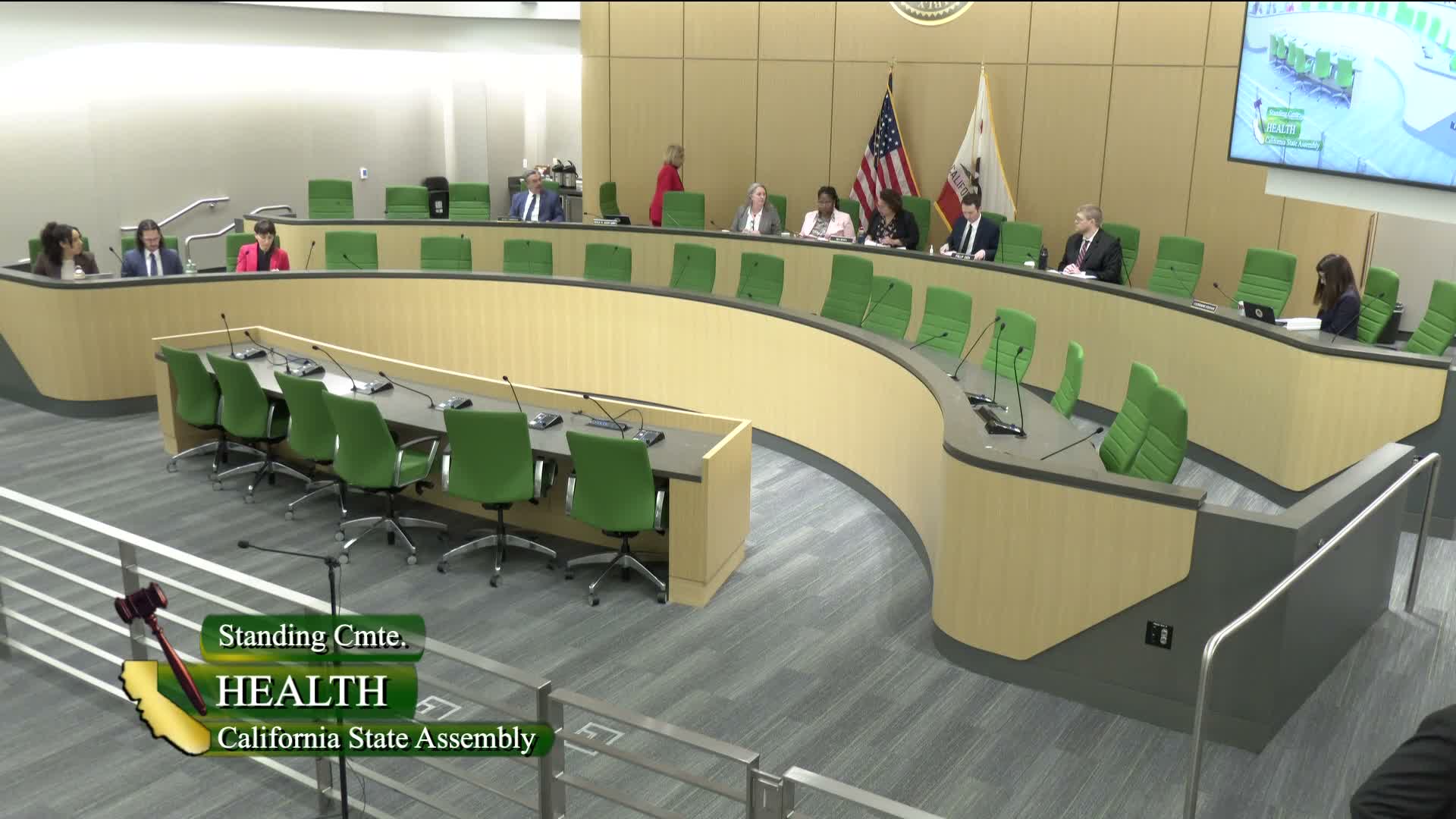
Assembly committee advances Bonta bill to notify parents when school vaccination rates drop below herd immunity
Loading...
Summary
The Assembly Health Committee heard hours of testimony for and against AB 2651, which would require schools to notify parents when a school's vaccination rate falls below a California Department of Public Health herd-immunity threshold; supporters called it transparency, opponents warned it could misrepresent snapshot data and risk stigma for medically exempt students.
Assemblymember Bonta's AB 2651 would require schools to notify parents when their child's school vaccination rate falls below the herd-immunity threshold set by the California Department of Public Health, the bill's author told the Assembly Health Committee on April 7.
"This bill requires schools to notify parents when their child's school vaccination rate falls below the herd immunity threshold established by the California Department of Public Health," Assemblymember Bonta said, adding the notice would use already public, de-identified data and would not publish information that identifies individual students.
Supporters framed the bill as a narrow transparency measure to help families assess health risk. "AB 2651 is a simple, practical solution to ensure parents are notified when their child's school falls below critical herd immunity levels," said Dr. Ian Kim, a family physician and representative of the California Academy of Family Physicians, a cosponsor. He noted recent local measles cases and urged the committee to move the bill forward.
Shereen Walter, a past president and health advocate with the California State PTA and a cosponsor, said parents "deserve to know when the risk changes in their child's school" and emphasized the bill would not change vaccine requirements or remove parental choice.
Opponents urged changes or defeat. Karen Amagon of Voice for Choice Advocacy said the Department of Public Health's school vaccine compliance data is a limited, point-in-time snapshot (collected for kindergarten and seventh grade at the start of the school year) and can count conditional entrants as "not up to date," producing misleading percentages. "Transparency requires context," she told the committee, asking the author to exclude exempt and conditional students, use end-of-year data, and clearly label grade-level results.
Joshua Coleman, cofounder of V Is For Vaccine, warned that because California allows only narrow medical exemptions, school-level notices could effectively identify medically exempt or special-needs students. "Publicly signaling that a school is unsafe because of its IEP and medically exempt students risks stigmatizing disabled children," he said, urging a "no" vote.
Members pressed for clarity and local data. One committee member cited San Jose figures, saying nine elementary schools reported MMR coverage below 95 percent in 2025 (roughly 460 students) and argued that 95 percent is the community-immunity threshold for measles. Supporters pointed to those numbers to argue that accessible school-level reporting helps families make decisions.
In closing, Bonta reiterated that the bill uses existing CDPH data and provides de-identified notices. The committee recorded a motion to move AB 2651 "due pass as amended to education" (moved by Assemblymember Addis and seconded by Assemblymember Rogers); the roll call was recorded and the bill was referred to the Education Committee.
What happens next: AB 2651 will go to the Assembly Education Committee for further consideration. If that committee approves it, the measure would continue through the regular legislative process and may be amended further.
Reporting notes: The committee hearing included extended public testimony both supporting and opposing the bill; proponents emphasized communicable-disease prevention and parental access to information while opponents raised concerns about data context, potential identification of medically exempt students, and the timing and granularity of CDPH data.